요약
The president simultaneously allowed the company to sell advanced computer chips to China while also claiming the need ‘to beat’ China in AI race.
본문
LOADINGERROR LOADING
WASHINGTON ― President Donald Trump let the CEO of a major computer chip maker participate in talks with China despite knowing U.S. intelligence believed he had grown close to a Chinese spy, even allowing the company to sell advanced chips to the autocratic country ― all while claiming the need “to beat” China in the race for artificial intelligence dominance.
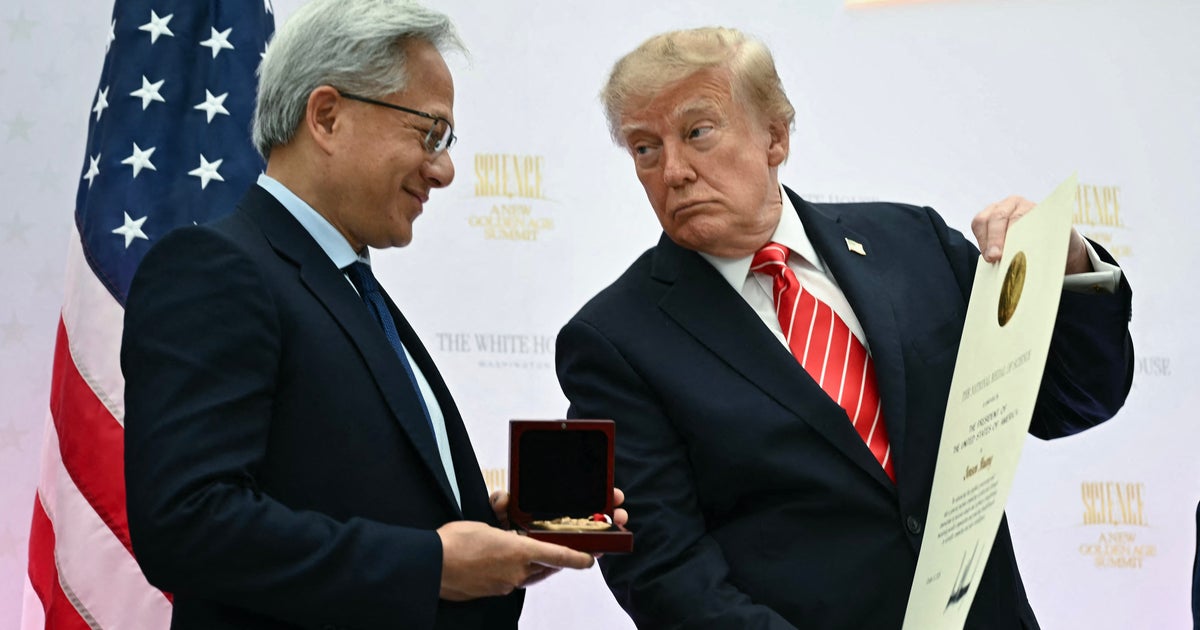
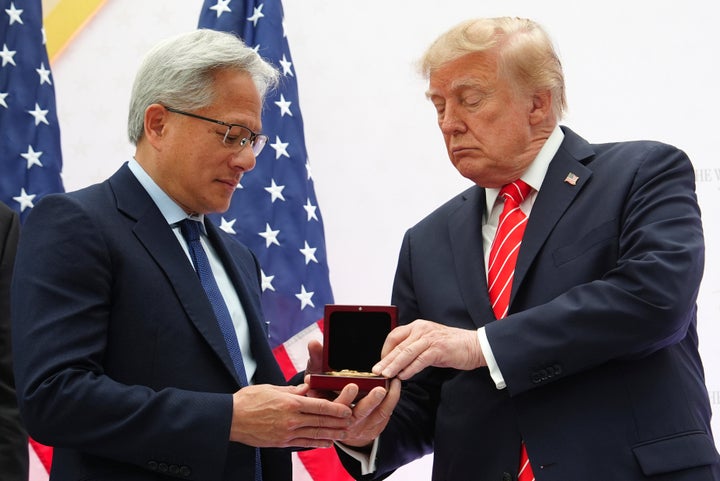
And in what may be the biggest pay-to-play episode yet of Trump’s second term in office, Trump continues to stand by Nvidia CEO Jensen Huang, whose company donated $25 million to Trump’s ballroom project, even as Nvidia launched an internal investigation following Huang admitting he had an affair with an executive at a Malaysian data center company.
Advertisement“I think he’s an honorable guy,” Trump told reporters as he left South Florida Sunday night following another golf weekend, off-handedly suggesting that “everybody” has affairs with spies that implicate national security.
“I haven’t heard he’s done anything wrong. He dealt with somebody but, you know, so does everybody else,” he said, adding that he saw no reason for Huang not to accompany him to yet another meeting with Chinese dictator Xi Jinping next week. “I’d certainly take him.”
Trump also admitted he had been informed of Huang’s entanglement with a woman whom U.S. intelligence officials believe is an operative of the Chinese government.
Advertisement“I think he probably has an excuse for it,” Trump said.
At an impromptu news conference Monday, Trump expressed his continued support for Huang.
“I believe he’s suffering greatly. I read his statement, and I believe he’s suffering greatly,” he said. “He said he had absolutely no idea that the person in question was a spy. I asked him that question. ‘Did you have any idea that she was a spy?’ He said, ‘I had no idea that she was a spy.’ And I really believe him.”
Trump also claimed he only learned of the matter recently ― despite reports that a memo detailing the situation had been circulating this spring. Trump said that he may have seen it, but did not think much of it. “Certainly, it didn’t make much of an impact on me,” he said.
The scandal has wide-reaching implications, touching on a company whose stock performance has helped lift the broader U.S. economy during Trump’s presidency, the donor-driven policies at the center of the administration and, possibly foremost, the country’s national security.
AdvertisementBut Trump’s handling of the Huang affair also profoundly undercuts the “beat China” argument he’s made central to his decisions to ignore any and all calls to regulate artificial intelligence or slow down data center development.
“We’re in a race with China,” Trump said yet again in an interview with CBS’ “60 Minutes” that aired on Sunday. “If we don’t have it, China’s gonna have it. That would put us at an unbelievable disadvantage. It’s all between us and China. There’s nobody else.”
How such a situation could have possibly evolved, with massive national security implications, has experts dumbfounded.
Advertisement“The questions are arising a lot faster than any answers,” said John Bolton, one of Trump’s first-term national security advisers.
Robert Kagan, a top State Department official in the Ronald Reagan administration, wondered if the answer is as simple as Huang’s donation to Trump’s nine-figure ballroom, which is using both taxpayer money and corporate donations for an enormous new complex, larger than the existing White House mansion, where the East Wing had stood until Trump bulldozed it one weekend.
Advertisement“There is no foreign policy. There are only opportunities for enrichment,” Kagan said. “That is our Russia policy, our Middle East policy, our Asian policy. It’s all about money for Trump and his family.”
Former Chicago Mayor Rahm Emanuel, who may run for the presidency in 2028, noted on social media that Trump has personally purchased more than $6 million worth of Nvidia stock this year.
“The questions are simple,” Emanuel wrote. “Who in the Trump Administration knew? When did they know it? And knowing it, why did they keep letting Huang make his case?”
AdvertisementNeither the White House nor the National Security Council responded to HuffPost queries.
Trump’s willingness to send some of the nation’s most advanced computer chips to China while at the same time extolling the importance of remaining ahead of that country in the development of artificial intelligence has always seemed a contradiction.
He told reporters on April 25 as he was boarding Air Force 1: “We want to beat China at the industry…. We want to lead in AI, we want, and we’re leading China by a lot in AI.”
“We have AI. We’re dominating AI. We’re leading everybody, including China,” he told embassy staff in Dublin, Ireland, on Sept. 12, just days before he took Huang with him on a trip to meet Xi in Beijing.
AdvertisementAnd following an AI summit at the White House on Sept. 29, Trump told reporters: “As President Xi would say, you know, they’re quite a way’s back. And we have to keep it that way… We’re leading by a lot, and we’re going to keep it that way.”
Despite this, Trump acceded to Huang’s requests to allow his company to send its second-fastest chip, the H200, to Chinese firms.
On Monday, Sens. Elizabeth Warren (D-Mass.) and Jim Banks (R-Ind.), who had previously called on the Commerce Department to suspend Nvidia’s chip export licenses to China pending a national security review, said the spy revelation demands congressional scrutiny.
Advertisement“Nvidia CEO Jensen Huang’s confirmation of a relationship with a suspected spy for China’s intelligence service makes these national security concerns even more urgent and raises important questions NVIDIA must answer about the extent to which these activities were related,” they wrote.
Go to Homepage|Submit a tip