요약
Explore nine WWII Private Snafu cartoons created with Dr. Seuss and Warner Bros. animators to teach soldiers military skills through humor.
본문
Follow Followed Add us on
 By
Ryan Thomas LaBee
Published Oct 21, 2026, 3:00 AM EDT
Sign in to your Military.com account

During World War II, the Army had a problem. Millions of Americans were entering military service, and they needed to learn everything from maintaining their weapons to protecting themselves against disease. Unfortunately, sitting through another training film wasn't necessarily the best way to keep a young soldier's attention.
The Army's solution was to bring in some of Hollywood's funniest people.
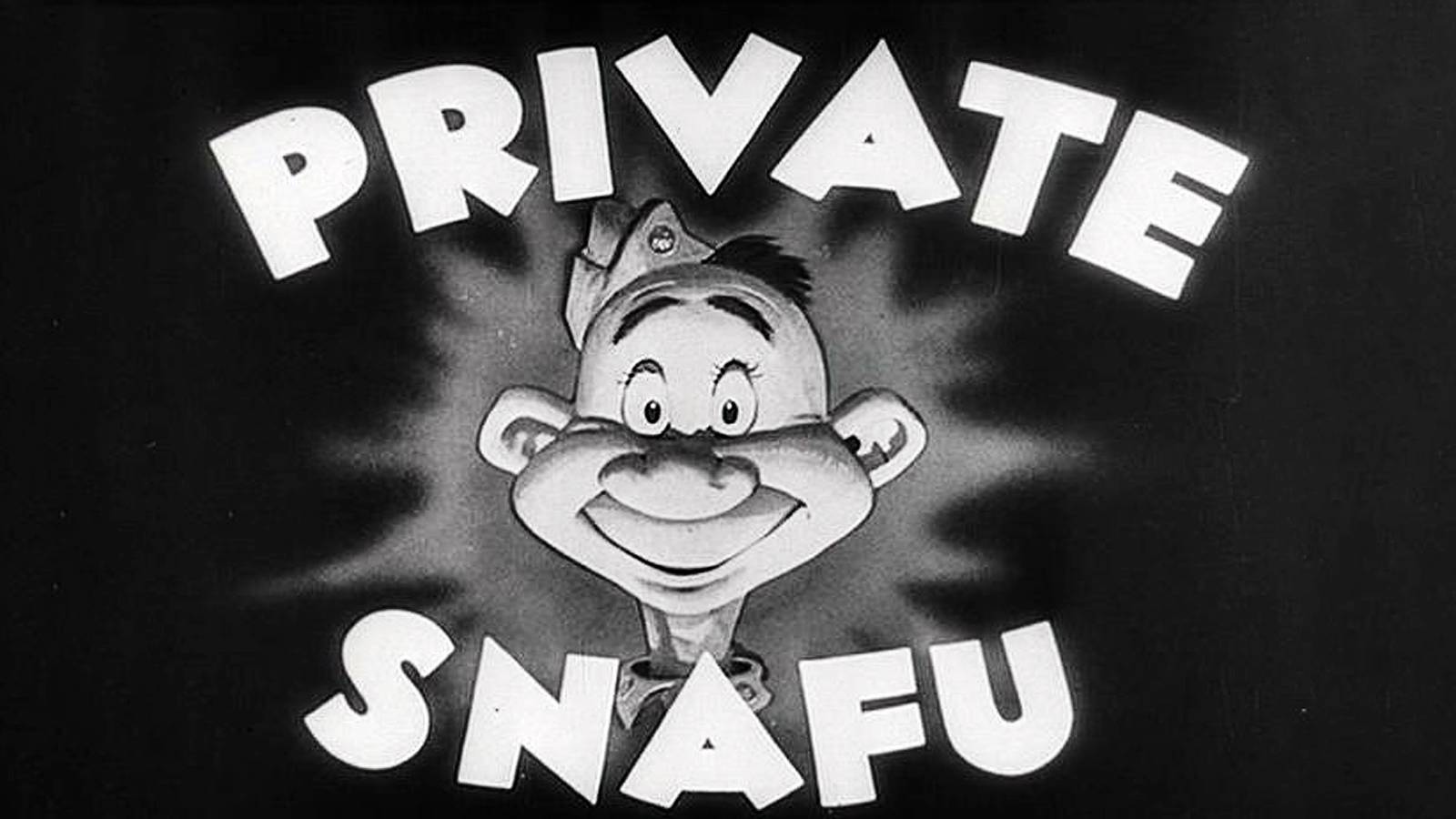
Theodor Geisel, better known as Dr. Seuss, joined forces with Warner Bros. animators Chuck Jones, Friz Freleng, Bob Clampett and Frank Tashlin to create a series of animated training films starring Private Snafu, a soldier who seemed incapable of following even the simplest instructions.
Mel Blanc, the legendary voice behind Bugs Bunny, Daffy Duck and Porky Pig, voiced Snafu.
The character's name came from the military acronym SNAFU, commonly rendered in its cleaned-up form as "Situation Normal, All Fouled Up." It was a fitting name for a private whose carelessness regularly resulted in injury, embarrassment or death.
Under the broader supervision of filmmaker Frank Capra, the Army produced the cartoons for military audiences beginning in 1943. Their creators could get away with sexual jokes, suggestive imagery and language that would have been difficult to include in ordinary theatrical cartoons.
The humor served a practical purpose. Soldiers might ignore another lecture about regulations, but they were considerably more likely to remember what happened to Snafu when he ignored those same rules.
According to the National Archives, the cartoons became part of the Army's effort to make military instruction entertaining and memorable.
Here are nine Private Snafu shorts that reveal what the Army wanted its soldiers to learn, and the ridiculous lengths Warner Bros. went to teach them.
1. 'Gripes' (1943)
Every service member has complained about an assignment, a regulation or a supervisor who seems determined to make life unnecessarily difficult. Private Snafu is no exception.
In Gripes, directed by Friz Freleng, Snafu is tired of kitchen duty and military discipline. He's convinced that the Army would run considerably better if everyone could simply do whatever they wanted.
Enter Technical Fairy, First Class, a cigar-smoking, winged, miniature soldier who appears throughout the series to grant Snafu's wishes. The fairy gives Snafu the freedom he wants, and the results are disastrous. Without discipline, the Army can't function when the enemy attacks.
A familiar military complaint becomes a cartoon nightmare. The Army understood that soldiers didn't necessarily enjoy rules, but it wanted them to understand why those rules existed.
The military lesson: Discipline and routine duties matter, even when they seem pointless.
2. 'The Infantry Blues' (1943)
Long before social media gave service members a place to complain about their jobs, the Army had Private Snafu.
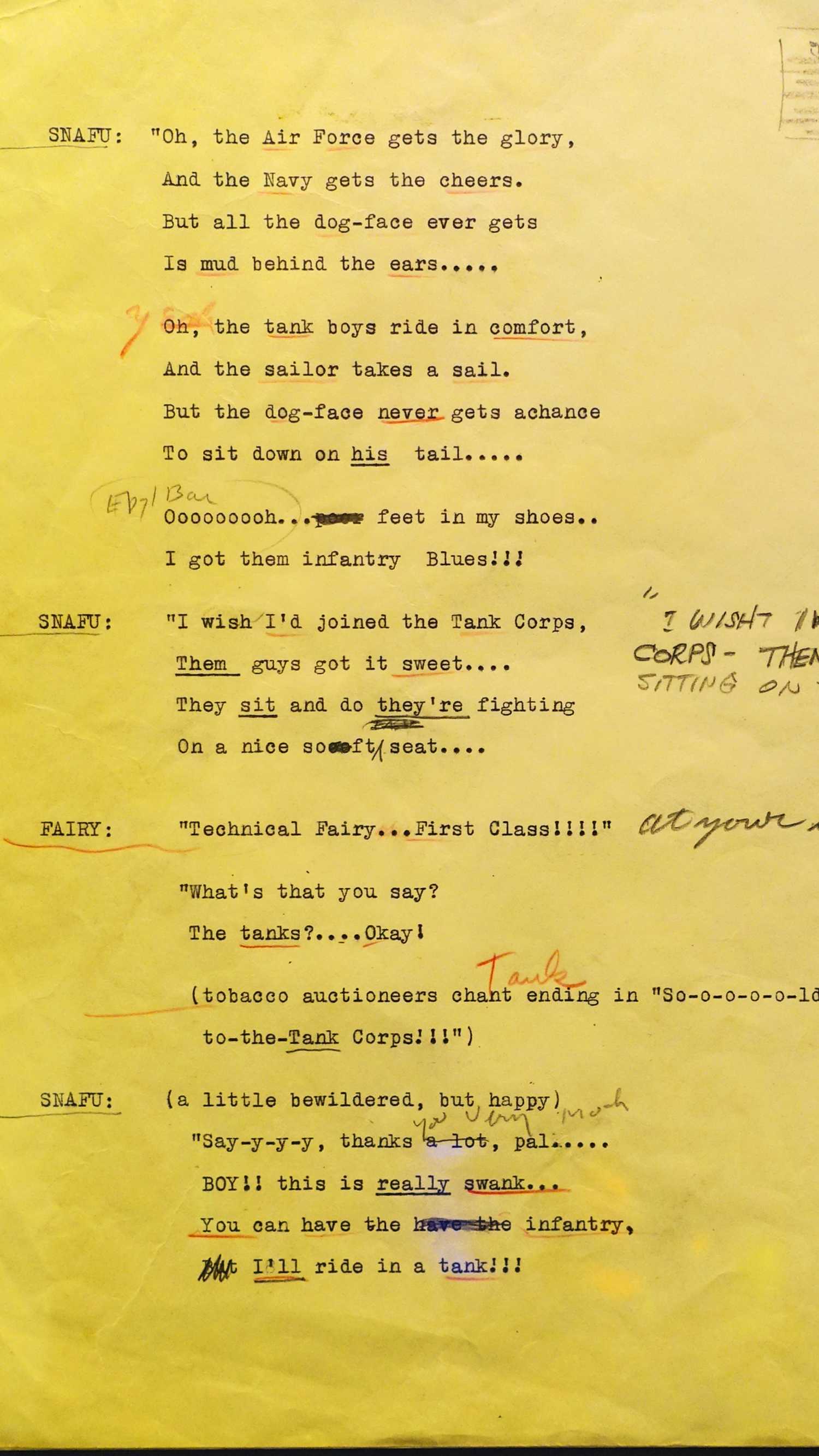
In Chuck Jones' The Infantry Blues, Snafu is miserable in the infantry. He believes everyone else has a better assignment, especially the soldiers riding around in tanks or serving aboard ships.
Naturally, Technical Fairy, First Class, arrives to help. Snafu is transferred into a tank, where he discovers that armored warfare isn't particularly comfortable. He tries the Navy next, only to find life aboard a vessel equally unpleasant.
Even the Army Air Forces don't offer the easy assignment he imagined. By the end, Snafu learns that every military specialty comes with its own problems.
The cartoon is especially entertaining because its underlying joke hasn't aged much. Ask almost anyone who has served, and they'll probably have an opinion about which branch or career field has it easiest.
The military lesson: Every assignment has hardships, and the grass isn't always greener in another branch.
3. 'Fighting Tools' (1943)
A soldier can have the finest equipment in the world, but it becomes far less useful when nobody bothers to maintain it.
That's the central idea behind Bob Clampett's Fighting Tools.
Snafu proudly boasts about American military technology while neglecting the weapons and vehicles he's supposed to depend on.
When an enemy soldier appears, Snafu discovers that his equipment is in terrible condition. One particularly memorable sequence features a neglected cannon barrel occupied by a family of ducks, including a brief appearance by Daffy Duck. The joke is classic Warner Bros., but the point is serious. Weapons jam. Vehicles break down. Batteries fail. On a battlefield, preventable equipment problems can become deadly.
For soldiers responsible for maintaining everything from rifles to aircraft, the lesson probably sounded familiar.
The military lesson: Clean, inspect and maintain your equipment before you need it.
4. 'Rumors' (1943)
The Army was warning soldiers about misinformation decades before anyone could spread a rumor with a smartphone.
In Rumors, another Friz Freleng cartoon, Snafu participates in ordinary barracks gossip about enemy activity. As the story moves from soldier to soldier, the information becomes increasingly exaggerated.
Eventually, the rumors take on lives of their own, with bizarre animated creatures spreading panic through the camp. It's an entertaining example of the surreal humor that made Warner Bros. cartoons so memorable.
The military implications were considerably more serious. Unverified information could cause confusion, undermine morale and interfere with operations, particularly when soldiers had limited access to reliable news about the war. The National Archives preserves Rumors as part of its wartime military film collection.
Eighty-three years later, the Army's warning about believing and repeating every alarming story someone tells you remains surprisingly relevant.
The military lesson: Verify information before spreading it, especially when lives and military operations are involved.
5. 'Snafuperman' (1944)
What happens when you give the Army's least competent soldier Superman's powers?
Nothing good. In Snafuperman, directed by Freleng, Snafu decides that studying maps, military equipment and aircraft identification charts is a waste of time.
After all, he reasons, the enemy won't be defeated with books. Technical Fairy, First Class, responds by giving him superpowers.
Unfortunately, being able to fly doesn't make Snafu any better at understanding military operations. He attempts to bomb Berlin but fails to read his map correctly, nearly dropping the explosives on Washington, D.C. He also mistakes an American tank for an enemy vehicle, creating another potentially disastrous situation.
The cartoon parodies the Superman adventures already popular in the 1940s, making it an especially interesting crossover between military training and comic-book entertainment.
Underneath the superhero jokes is a straightforward message: physical ability and confidence cannot replace basic military knowledge.
The military lesson: Study your maps, recognize friendly equipment and learn your job before going into combat.
6. 'Private Snafu vs. Malaria Mike' (1944)
Not every enemy American soldiers faced during World War II carried a rifle.
In the Pacific, mosquitoes spreading malaria posed an enormous threat to military operations. The Army decided that a cartoon mosquito might help get the message across. Directed by Chuck Jones, Private Snafu vs. Malaria Mike introduces a determined mosquito searching for an opportunity to bite the careless private.
Snafu has access to protective clothing, mosquito netting, repellent and antimalarial medication, but he doesn't consistently use the precautions provided. Mike eventually finds an opening, and the consequences are fatal.
The short includes the kind of suggestive humor that made the series popular with soldiers, including a mosquito targeting Snafu's exposed backside.
According to the National Library of Medicine, the cartoon was specifically intended to teach soldiers how to prevent malaria.
It was a serious issue. Disease could remove troops from combat just as effectively as enemy weapons.
The military lesson: Use insect repellent, protective equipment and prescribed malaria-prevention measures.
7. 'A Lecture on Camouflage' (1944)
Camouflage is supposed to keep soldiers and equipment from being spotted by the enemy. Unfortunately, Snafu isn't particularly good at it.
In Chuck Jones' A Lecture on Camouflage, Technical Fairy, First Class, attempts to explain the importance of concealment.
Snafu disguises a jeep but fails to account for other clues that might reveal his position. Later, he encounters enemy soldiers who are considerably better at disguising themselves. Trees, rocks and other ordinary objects become potential threats as Snafu repeatedly fails to recognize enemy deception.
The film turns concealment techniques into a series of visual jokes, something Jones would become famous for in his later theatrical cartoons. Its lesson extends beyond simply wearing camouflage. Soldiers must think about tracks, movement, surroundings and the possibility that enemy forces are using concealment themselves.
The complete cartoon is available through Wikimedia Commons, with a documented public-domain designation.
The military lesson: Effective camouflage requires awareness of the surrounding environment and an understanding of enemy deception.
8. 'Gas' (1944)
One of the most recognizable cartoon characters in history makes a brief appearance in this Army training film.
In Gas, directed by Chuck Jones, Snafu struggles to locate his gas mask during a military drill. When he finally opens his equipment bag, he pulls out several unexpected items, including Bugs Bunny. It's a quick gag, but especially memorable since Mel Blanc voiced both characters.
Unfortunately, the cartoon becomes considerably less amusing for Snafu. After additional training, he decides that carrying a gas mask is too much trouble and throws it away. Naturally, an enemy aircraft soon releases a poisonous gas cloud. Snafu is forced to scramble for the protective equipment he should have kept with him.
The Army was preparing soldiers for the possibility of chemical warfare, even though chemical weapons were not widely used against American troops on World War II battlefields.
The danger was real enough that protective equipment and training remained important parts of military readiness. And if an appearance by Bugs Bunny made someone remember to carry a gas mask, the cartoon had accomplished its mission.
The military lesson: Keep protective equipment accessible and know how to use it before an emergency.
9. 'Outpost' (1944)
After spending much of the series showing how to do almost everything wrong, Private Snafu finally helps the war effort.
He just doesn't realize it.
In Chuck Jones' Outpost, Snafu is stationed on a tiny Pacific island with little company beyond a bird. He's bored, frustrated and convinced that his assignment serves no useful military purpose. Then the bird finds an unusual food can marked as a Japanese naval ration. Snafu doesn't consider the discovery important, but he includes the information in his routine report.
That seemingly insignificant detail helps American forces locate an enemy fleet. It's one of the series' cleverer lessons because Snafu actually does something useful by following a routine reporting requirement.
The cartoon also recognizes something soldiers have complained about for generations: spending hours on an isolated assignment without understanding how their work contributes to the larger mission.
In this case, the Army wanted them to know that even the smallest observation might prove important.
The military lesson: Routine reporting and seemingly insignificant intelligence can have consequences far beyond a soldier's immediate assignment.
The Army Found a Way to Make Training Entertaining
Private Snafu never became as famous as Bugs Bunny or Daffy Duck, but the character offers an unusual look at how the Army approached training during World War II.
The cartoons understood their audience. Soldiers complained about their assignments, disliked repetitive instruction and occasionally ignored rules they considered unnecessary.
Rather than pretend those frustrations didn't exist, the filmmakers built their stories around them. Snafu was lazy, careless, overconfident and frequently convinced that he knew better than the people giving him orders. His mistakes made soldiers laugh, but the consequences reinforced lessons the Army hoped they would remember.
The shorts also reflect the attitudes of their era. Some contain racist wartime caricatures, sexualized depictions of women and other material that would be unacceptable in modern military training. Those elements are part of their historical context and shouldn't be overlooked.
Today, the original films are generally considered public domain in the United States because they were created for the federal government. Many survive in archival collections and are available to watch online.
For viewers familiar with the work of Dr. Seuss, Chuck Jones and Mel Blanc, the cartoons provide a fascinating glimpse at what happened when Hollywood's most inventive entertainers were given a military assignment.
And for anyone who has ever sat through mandatory training, there's something satisfying about discovering that the Army once used Bugs Bunny, Daffy Duck and a superhero parody to get its point across.