요약
Meet Marc Andersen, the Army's financial management chief, and learn how he's working to modernize budgeting, manufacturing and investment.
본문
Follow Followed Add us on
 By
Douglas Lindsay
Published Oct 21, 2026, 3:00 AM EDT
Sign in to your Military.com account

Long before Marc Andersen was helping oversee one of the nation's largest military budgets, he was growing up in rural Idaho, where a childhood marked by hearing difficulties and a speech impediment helped shape his understanding of perseverance, opportunity and leadership.
Today, Andersen serves as the 18th Assistant Secretary of the Army for Financial Management and Comptroller, bringing decades of private-sector experience to an institution confronting rapid technological change and growing demands on its resources.
His responsibilities extend beyond managing money. As the Army explores new ways to attract private investment, modernize military manufacturing and give commanders better financial information, Andersen is among the senior officials working to connect financial management more closely to the service's mission.
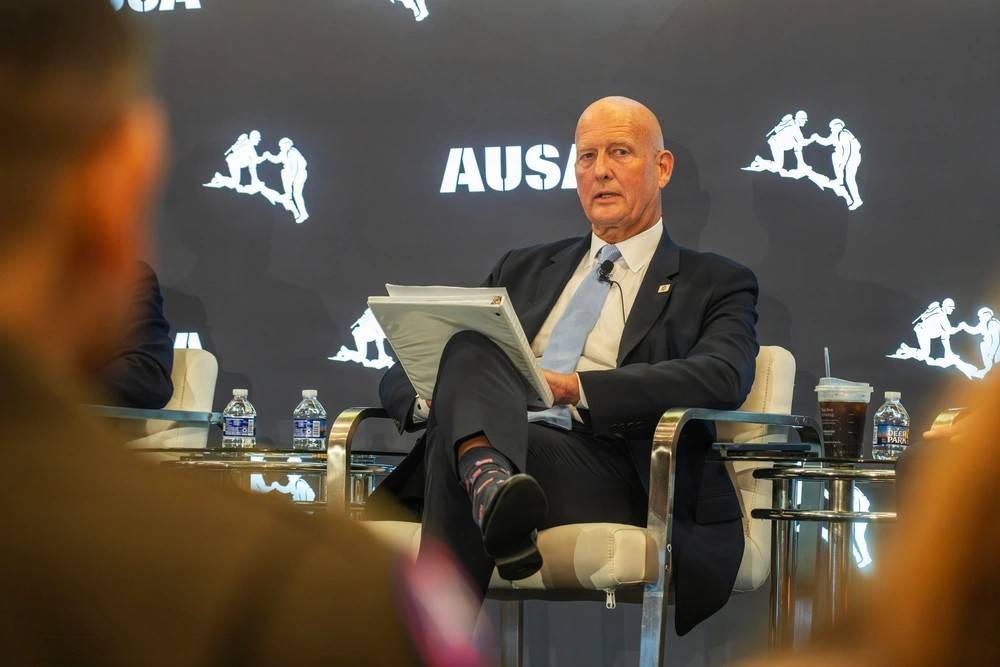
Military.com first met Andersen at the Association of the United States Army's annual meeting in Washington, D.C., in October. That introduction led to a subsequent conversation about leadership, public service and organizational transformation.
His journey from rural Idaho to the Pentagon offers a personal dimension to an increasingly consequential role in the Army's future.
From Rural Idaho to the Pentagon
Andersen's path to senior Army leadership was anything but conventional.
In an August appearance on the Not Special podcast, Andersen described growing up in small Idaho communities, including time spent living in a log cabin.
He also discussed experiencing hearing loss and a speech impediment during childhood, challenges that affected his confidence and willingness to speak publicly.
A teacher who recognized his potential became an important influence, challenging him to move beyond those limitations rather than allow them to define his opportunities.
Those experiences helped shape the leadership philosophy Andersen would later carry into business and public service.
Before joining the Pentagon, Andersen was a private sector leader and technology entrepreneur. He spent more than two decades at EY, formerly Ernst & Young LLP, where he founded and grew the firm's U.S. federal consulting practice from the ground up and held other senior executive positions.
He subsequently worked in venture capital and advisory organizations focused on defense and dual-use technology, strategic investment and business transformation.
Andersen was sworn into his Army position on Oct. 15, 2025, following his nomination by President Donald Trump and confirmation by the Senate.
His transition from private enterprise to public service placed him in a position to apply experience in organizational change, technology and financial strategy to the challenges of military readiness.

Using Financial Management to Power the Mission
For most soldiers, financial management is something that happens far from the battlefield.
Yet decisions about budgets, resource allocation and financial systems influence nearly every aspect of military operations, from equipment maintenance to training and modernization. Andersen has publicly emphasized that connection.
In a May 2026 Army announcement outlining a financial transformation effort, he described financial leadership as a direct contributor to readiness and military decision-making.
Financial leadership is not a back-office function, but the front-line enabler of readiness, speed, and decision advantage, Andersen said.
The initiative seeks to modernize Army financial systems, reduce administrative delays and provide commanders with more useful information about available resources. One example is Fiscal Frontline, a financial analytics dashboard launched in April.
The platform brings together information from multiple Army systems, providing leaders with a centralized view of how resources are allocated and spent.
According to an August Army announcement, the dashboard allows commanders and financial analysts to identify funding surpluses or shortfalls and make more timely decisions about training, maintenance and operational requirements.
The Army has also consolidated budget lines for unmanned aircraft systems, counter-drone capabilities and electronic warfare, creating greater flexibility to respond as technologies evolve.
These changes are intended to make financial processes more responsive to operational requirements.
For soldiers facing increasingly sophisticated threats, the ability to move resources efficiently can affect how quickly new capabilities reach their units.
Bringing C-Suite Innovation Into the Army
Andersen's private-sector experience is particularly relevant to another initiative underway within the Army.
The Army’s Strategic Capital Initiative, where Andersen serves as Chief Investment Officer, seeks to attract commercial investment and expertise to projects supporting military modernization.
Rather than relying exclusively on traditional government funding and contracting approaches, the Army is exploring partnerships that combine military requirements with private-sector technology, manufacturing capabilities and capital.
Andersen participated in an AUSA forum in October alongside senior Army leaders and commercial executives discussing the initiative's potential.
The Army has identified opportunities involving energy resilience, critical minerals, advanced manufacturing, supply chains and military infrastructure. Several projects are already moving forward.
At Red River Army Depot in Texas, the Army is working with manufacturing company Hadrian to establish flexible production capabilities for batteries and tactical vehicle repair parts.
At Anniston Army Depot in Alabama, a partnership with Siemens is intended to expand domestic manufacturing capabilities supporting unmanned aircraft systems and armored vehicles.
The projects illustrate how commercial expertise could help modernize facilities that have long been essential to maintaining military equipment.
They also reflect a broader Army effort to strengthen domestic manufacturing and reduce vulnerabilities in defense supply chains.
The initiative remains in development, with long-term results dependent on successful implementation and partnerships that meet military requirements while protecting taxpayer interests.
For Andersen, whose professional background includes strategic capital investment and government-industry collaboration, the work brings together areas of experience developed throughout his business career.
A Leadership Philosophy Centered on People
Despite his financial responsibilities, Andersen's public discussions of leadership frequently return to relationships, trust and the importance of people.
During his August podcast appearance, he spoke about building relationships through trust rather than treating them as transactions.
He also discussed the importance of family, describing his marriage of more than three decades to his wife, Shaza, and the values they sought to instill in their children.
That people-centered perspective carries into his work with the Army's financial management community.
At a September financial management symposium in Indianapolis, Andersen discussed how artificial intelligence could automate repetitive administrative tasks, allowing financial professionals to devote more attention to analysis, planning and decision-making.
People make the difference, Andersen said. We want to invest in our people.
He also emphasized that technological advances do not eliminate the need for professional judgment. "We still need people, we still need judgment, and we still need to validate what's correct," he said.
The message reflects an approach to leadership that sees technology as a way to strengthen the workforce rather than simply replace existing processes.
Andersen's public service experience also extends beyond the Pentagon.
He previously served on the White House Commission on Presidential Scholars, as a trustee of the Virginia Veterans Services Foundation and as an honorary commander of the Air Force's 89th Airlift Wing.
A Family Commitment to Service
Andersen and his wife have also maintained a longstanding involvement in charitable work.
Shaza, a banking executive and entrepreneur, leads the Trustar Youth Foundation, a nonprofit supporting children and families throughout the Washington, D.C., metropolitan region.
Its work includes supporting children's health care, educational opportunities, food security and other community needs.
The couple has also supported organizations connected to veterans and military families, including The Honor Foundation and the Global Special Operations Forces Foundation.
Their philanthropic activities provide another perspective on Andersen's career, connecting his professional responsibilities with a personal commitment to supporting people and communities.
That connection is particularly relevant in an organization where decisions made at senior levels ultimately affect soldiers and their families.
Turning Resources Into Readiness
The Army's modernization efforts are unfolding as unmanned systems, artificial intelligence, electronic warfare and increasingly complex supply chains reshape military requirements.
Meeting those demands requires more than purchasing new equipment. It also requires changes in how the service manages information, develops its workforce, maintains infrastructure and collaborates with industry. Andersen's initiatives sit at the intersection of those efforts.
Fiscal Frontline is designed to give commanders better financial information. The Strategic Capital Initiative is exploring new ways to strengthen military manufacturing and infrastructure. Workforce modernization is intended to prepare financial professionals for an increasingly complex operational environment.
Each initiative addresses a different part of the same challenge: helping the Army turn available resources into capabilities that soldiers can use.
The ultimate measure will be how effectively these efforts improve readiness, accelerate decisions and support soldiers.
Andersen's path from rural Idaho to the Pentagon has taken him through the C-Suite, technology and public service, experiences that now inform his approach to Army financial management.
For the official helping oversee the Army's financial future, the mission is about more than managing dollars. It is about ensuring those resources help build a stronger, more capable force that’s prepared to meet the challenges of the modern era, both today and for generations to come.