요약
Wrist estimates of VO2 max miss fit athletes by six to eight points. A 1968 running test and a 1992 cycling test still read you better, and they measure the thing that actually matters.
본문
ISSUE 95 | The twelve-minute test answers your fitnessWrist estimates of VO2 max miss fit athletes by six to eight points. A 1968 running test and a 1992 cycling test still read you better, and they measure the thing that actually matters.
 Endurance CapitalOct 05, 2026
Your watch is roughly right about a crowd and often wrong about you. The best tool for tracking your own fitness is still a stopwatch, a track and twelve honest minutes.
Last week Terra, the wearable data company, published a small experiment by its Head of Research, Alistair Brownlee, double olympic gold medallist who I am happy to call a friend. He asked volunteers to send in a recent lab VO2 max test alongside their watch data, then compared the two. Nearly 200 signed up. Thirty-three sent a lab result. After filtering, seven had enough running data to score.
For those seven, the running-based estimate missed the lab by 6.6 ml/kg/min on average. The estimate built from resting heart rate missed by 10.8. When resting heart rate was missing and filled in as a default of 60 beats per minute, it ran 12.5 points low.
Brownlee is candid that this is not a validation study. It does not need to be. The published research says the same thing, more firmly, and it has been saying it for a long time.
The error is not new
The best independent work on consumer wearables is a 2022 meta-analysis from the INTERLIVE network: 14 validation studies, 403 people. Watches that estimate VO2 max from exercise land almost exactly on the lab average, with a bias of minus 0.09 ml/kg/min. But the 95 percent limits of agreement run from about minus 10 to plus 10. The crowd is right. The individual can be off by ten points either way.
Newer devices have not closed the gap. A 2026 peer-reviewed study of the Apple Watch Series 10, run by researchers at University College Dublin, tested 35 healthy adults against a full cardiopulmonary exercise test. The watch read 6.25 points low on average, with a mean absolute percentage error of 13.2 percent. It placed only 14 percent of people in the correct fitness percentile band.
The authors made a quieter observation that deserves more attention. That level of error, they wrote, is close to the error of the traditional submaximal prediction methods used in clinics for decades, which carry limits of agreement of roughly 11 ml/kg/min either way. The sensor moved to the wrist. The physics of predicting a maximum from a submaximal heart rate did not change.
An expert I spoke with, a physician and research physiologist who has spent decades studying how the human body performs under exercise and where its limits sit, put it more bluntly. “The sorts of workload, speed or heart rate errors from any source are about like this. This has been known since about 1960, when early prediction nomograms were made on the cycle ergometer.”
A wrist estimate inherits the error of every heart-rate prediction method before it. The packaging is new. The uncertainty is not.
The fitter you are, the worse it reads
Error is not spread evenly. It concentrates exactly where readers of this newsletter live.
A 2025 study in the European Journal of Applied Physiology tested the Garmin Forerunner 245 on 35 endurance athletes. For moderately trained athletes, after two runs, the watch was within 2.8 percent of the lab. For athletes above 60 ml/kg/min, it under-read by about 6.3 points, an error near 10 percent.
The Apple Watch study found the same pattern. Participants with lower fitness were under-read by 2.4 points. Those in the top fitness bands were under-read by 7.8.
Exhibit one: fit athletes are under-read most
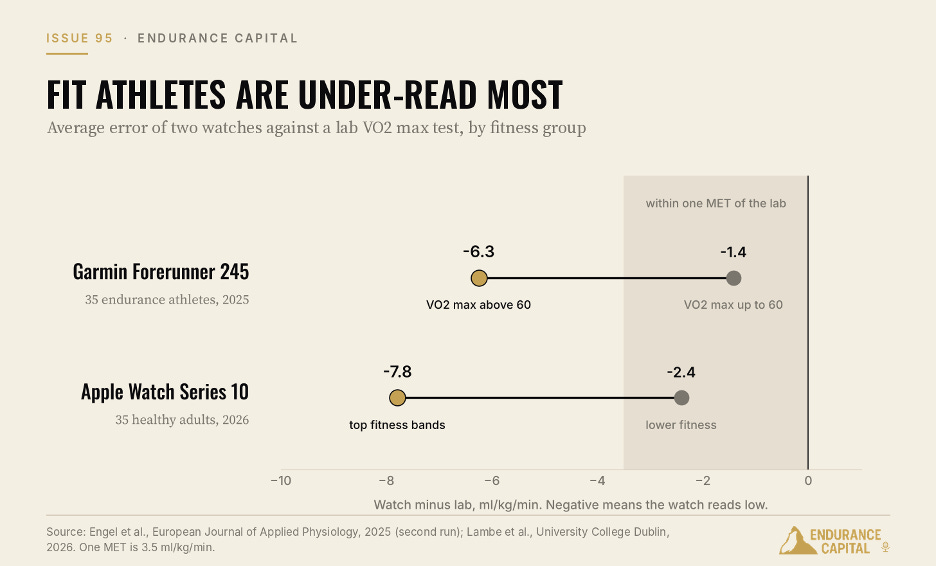
Average watch error against a lab test, by fitness group, for two independently tested devices. Source: Engel et al., European Journal of Applied Physiology, 2025; Lambe et al., University College Dublin, 2026.
One metabolic equivalent, or MET, is 3.5 ml/kg/min. A six-to-eight point miss is roughly two METs. In large cohort data, each MET of fitness is associated with about 11 percent lower all-cause mortality. Two METs is not a rounding error. It is the difference between two fitness bands on a clinical chart.
Estimates compress the range. Low-fitness users read high, high-fitness users read low, and the average hides both.
Accurate for a crowd is not accurate for you
This is the distinction that matters, and most wearable marketing blurs it.
A near-zero average bias across a population is a genuine achievement. It means a watch is useful for epidemiology, for large trials, for ranking cohorts. It says nothing about whether a three-point rise in your own number over a training block is real, or noise from heat, terrain, a new route or a missing resting heart rate.
The same expert drew the line precisely. “A MET or two more is great, but that is population data, not about a longitudinal change in a given individual.”
That second question, whether the estimate tracks change within one person, is the one athletes actually care about. It is also the one with the thinnest evidence. The Apple Watch Series 10 authors noted that no independent study has yet tested the reliability of Apple’s estimate over time. Brownlee, asked the same question on LinkedIn, said the scores should be directionally good with enough varied training data, and was clear he had not tested it.
A good population statistic is not a personal measurement. The question you want answered, am I getting fitter, is the one the evidence covers least.
Two tests older than the watch
The irony is that we solved the personal version of this problem decades ago, with nothing more than a clock.
In 1968 Kenneth Cooper published a field test in JAMA. He asked 115 US Air Force officers and airmen to run as far as they could in 12 minutes, then compared the distance with a treadmill VO2 max. The correlation was 0.897. The Air Force needed a way to test hundreds of thousands of personnel without a lab. Twelve minutes on a track did the job.
In 1992 John Hawley and Tim Noakes did the same for cycling. In 100 trained cyclists, 54 men and 46 women, peak power output in an incremental test correlated with lab VO2 max at 0.97. Peak power alone explained 94 percent of the variance.
Exhibit two: field tests rank athletes more closely than the wrist
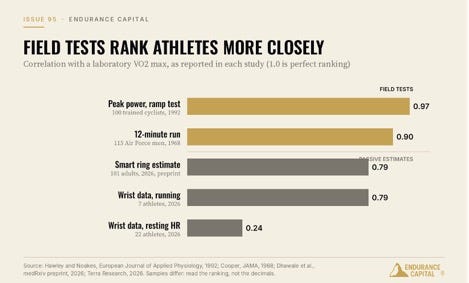
How closely each method tracks a laboratory VO2 max, measured by the correlation reported in each study. Samples differ, so read the ranking, not the decimals. Source: Hawley and Noakes, 1992; Cooper, 1968; Dhawale et al., medRxiv preprint, 2026; Terra Research, 2026.
A caveat belongs here. These correlations come from different people, in different decades, on different protocols. A high correlation shows a method ranks people in the right order. It does not by itself prove the absolute number matches. Cooper’s sample was military men, and his equation is not recommended for untrained people. But the direction matches what the same physiologist told me without hesitation. “The equations and values based on these sorts of field tests are much better than any wearable. Heart rate has a lot of individual variability as well. All of this is known but willfully ignored.”
A stopwatch and a power meter measure what you did. A watch infers what you might be able to do. When the two disagree, trust the one that measured.
Performance is the point
“Performance is more important than max per se,” the same expert added. It is the deeper reason the field tests hold up. They do not really measure VO2 max. They measure performance, and VO2 max is only one input to performance, alongside threshold and economy.
Hawley and Noakes made this explicit. The same peak power that predicted VO2 max also predicted 20 km time trial performance, with a correlation of minus 0.91. Peak power explained 82 percent of the variation in race time. The test is not a proxy for the thing you care about. It is close to the thing itself.
That changes what to track. A VO2 max number on your wrist is an estimate of a capacity. Your 12-minute distance, your ramp-test peak watts per kilo, your time over a fixed hill at a fixed heart rate, are records of what you can do. Only the second kind is fully yours.
A simple protocol, for healthy athletes already training hard:
● Run. Twelve minutes, as far as you can, on the same track. Cooper’s equation converts distance to an estimate: VO2 max equals metres minus 504.9, divided by 44.73. 3,200 metres reads as about 60. Repeat every eight to twelve weeks.
● Ride. An incremental ramp to failure on the same trainer, same position, same warm-up. Track peak watts per kilo, not the number the app converts it into.
● Wrist. Enter your measured maximum and resting heart rate. Read the trend over months, never a single reading. Ignore changes smaller than three or four points.
Maximal efforts are not for everyone. If you have a heart condition or are returning from illness, speak to your doctor before testing to exhaustion.
Track what you can do, measured the same way, often enough to see change. The estimate is a summary of that, never a substitute for it.
If you want the pieces where elite performance, science and capital allocation actually meet, this is the place. Free to subscribe.
What this means for builders and investors
An estimate shown as a measurement is a product risk. Wearables display VO2 max to one decimal place, in the same font as heart rate. Users treat it as measured. The evidence says it carries roughly the error of the old clinical prediction methods. That gap is where trust breaks.
The moat is protocol and data quality, not more sensors. Brownlee’s own conclusion was that the quality of the inputs mattered more than the sophistication of the equation. A missing resting heart rate did more damage than any algorithm choice. The companies that win health data will be the ones that capture the right signal under the right conditions, not the ones with the most streams.
Population-grade is a real business. Personal-grade is a different one. A device accurate across cohorts is valuable to insurers, trials and public health. A device that can detect a real two-point change in one athlete would be worth far more. Nobody has independently shown that yet. Whoever does, with a published reliability study, owns the category.
The twelve-minute answer
Every few years a new sensor promises to measure fitness without the effort of measuring it. The numbers improve on the average and stay stubborn on the individual, especially the fit individual.
The honest answer has been on the shelf since 1968. Run as far as you can for twelve minutes. Ride until you cannot. Write the number down. Do it again in two months under the same conditions.
It is not elegant and it is not passive. That is why it works.
If this is the kind of thinking you want in your inbox, subscribe. One or two pieces a week, at the intersection of endurance, longevity, technology and capital.
Expert comments were given to the author by email and are quoted anonymously at the source’s request.
Endurance Capital. Where elite performance meets capital allocation. More on YouTube, Instagram and X, with the podcast wherever you listen.
Editorial note
This article was developed from my original notes, source material, and independent research, and refined with the assistance of artificial intelligence as an editorial and research tool. The ideas, analysis, conclusions, and final editorial decisions are my own. Any errors, omissions, interpretations, or judgments remain solely my responsibility.
Disclaimer
This article is provided for informational and educational purposes only. It reflects my analysis, interpretations, and opinions based on publicly available information and the sources cited herein.
Nothing in this publication should be construed as investment advice, legal advice, tax advice, regulatory advice, medical advice, or a recommendation to buy, sell, or hold any security, company, fund, token, or other financial instrument.
Any investment decision should be based on independent research, due diligence, and consultation with qualified professional advisers where appropriate.
Scientific findings discussed in this article may evolve as additional research becomes available. References to longevity science, biological age, biomarkers, nutrition, exercise, artificial intelligence, or emerging healthcare technologies are intended solely for educational discussion and should not be interpreted as personal medical recommendations.
Past performance, whether financial, biological, or athletic, is not indicative of future results.
Sources
Cooper, K. H. (1968). A means of assessing maximal oxygen intake: correlation between field and treadmill testing. JAMA, 203(3), 201 to 204. JAMA
Hawley, J. A. and Noakes, T. D. (1992). Peak power output predicts maximal oxygen uptake and performance time in trained cyclists. European Journal of Applied Physiology, 65, 79 to 83. Springer
Molina-Garcia, P. et al. (2022). Validity of estimating the maximal oxygen consumption by consumer wearables: a systematic review with meta-analysis and expert statement of the INTERLIVE network. Sports Medicine, 52(7), 1577 to 1597. Springer
Engel, F. A. et al. (2025). Validity of VO2max estimates from the Forerunner 245 smartwatch in highly vs. moderately trained endurance athletes. European Journal of Applied Physiology, 126(1), 591 to 603. PMC
Lambe, R. et al. (2026). Accuracy of VO2 max estimates from Apple Watch Series 10. University College Dublin, peer-reviewed, 4(2), 100357. ScienceDirect
Dhawale, N. et al. (2026). Accuracy of a smart-ring VO2max estimate and five published prediction equations against cardiopulmonary exercise testing. medRxiv preprint, not peer reviewed, authors employed by the device maker. medRxiv
Brownlee, A. (2026). How accurate is your wearable VO2max? Terra Research, 2 October 2026. Terra
The Cooper Institute. 50 years of the Cooper 12-minute run. cooperinstitute.org