🔗 원문 전체 보기 → The Daily Galaxy --Great Discoveries Channel

요약
A Spanish museum guarded a 3,000-year-old secret. Two corroded objects in Europe's richest Bronze Age gold hoard were made from metal that fell from the sky.
본문

For sixty years, two corroded lumps sat among a glittering collection of Bronze Age gold, quietly defying explanation. The bracelet and the hollow gold-capped hemisphere clearly contained iron. But by every archaeological clock, iron smelting had not yet reached the region when the rest of the treasure went into the ground.
Now researchers have an answer, and it reaches beyond Earth.
The metal fell from the sky. A team led by Salvador Rovira-Llorens, former head of conservation at Spain’s National Archaeological Museum, confirmed the cosmic origin through chemical analysis. The findings, published in the journal Trabajos de Prehistoria, identify these two artifacts as the first known objects made from meteoritic iron on the Iberian Peninsula.
/https://tf-cmsv2-smithsonianmag-media.s3.amazonaws.com/filer_public/31/a2/31a2e8ea-70d9-417f-843f-e2babeac54db/46-47_broche_y_pasador_1.jpeg)
“The available data suggest that the cap and bracelet from the Treasure of Villena would currently be the first two pieces attributable to meteoritic iron in the Iberian Peninsula,” the researchers wrote, “which is compatible with a Late Bronze chronology, prior to the beginning of the widespread production of terrestrial iron.”
A Treasure That Kept a Secret
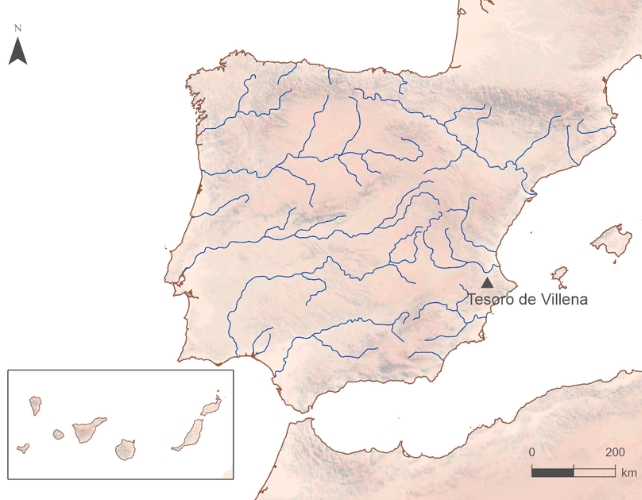
The Treasure of Villena surfaced on December 1, 1963, when a civil engineer named José María Soler dug foundations near the town of Villena in Alicante, Spain. What emerged became one of the richest prehistoric gold hoards in Europe: 66 objects in total, weighing nearly 10 kilos of gold, including bowls, bracelets, bottles, and various ornamental pieces.
The collection now lives at the Archaeological Museum “José María Soler” in Villena. The museum displays the hoard as a centerpiece of western Mediterranean prehistory, the gold surfaces still catching light much as they did 3,000 years ago. The pieces come predominantly from Bronze Age sites around the region, especially the settlement of Cabezo Redondo.
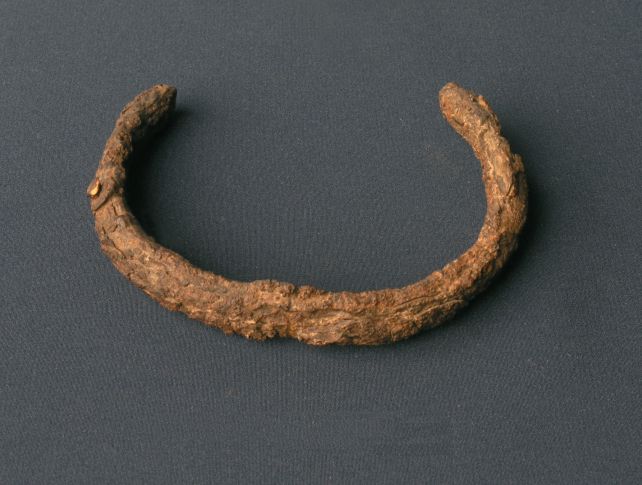
The iron pieces never fit the timeline. The goldwork dated the deposit firmly to between 1500 and 1200 BCE, a period when bronze dominated tools and weapons across the peninsula. Yet terrestrial iron production did not begin in Iberia until roughly 850 BCE, when the Iron Age finally took hold and smelted iron began replacing bronze.
For decades, curators catalogued the two objects as unexplained early ironwork and left the question hanging.
The Nickel Signature
Meteoritic iron carries a chemical calling card: nickel levels far higher than anything pulled from Earth’s crust, plus trace elements matching the makeup of iron meteorites. These are fragments of the cores of small planetary bodies that never grew into full planets.
Rovira-Llorens and his colleagues, based at the Instituto de Historia of the Consejo Superior de Investigaciones Científicas in Madrid, secured permission to sample both artifacts. Using mass spectrometry, they measured the nickel content and overall chemical profile. The analysis leaned firmly toward an extraterrestrial source, even with heavy corrosion scrambling the elemental picture across millennia.
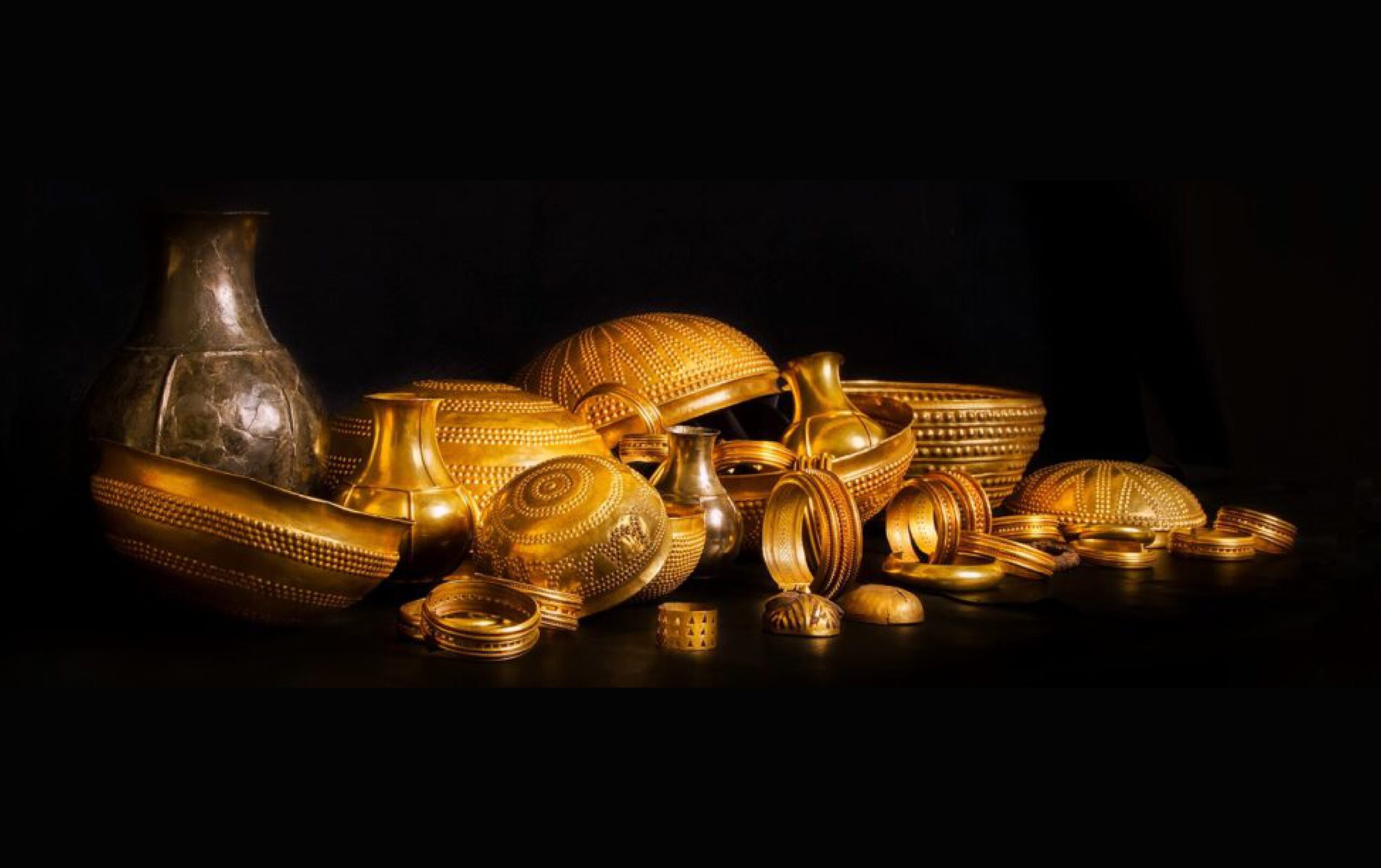
The bracelet shows the marks of patient hammering and shaping. The hollow hemisphere, probably part of a scepter or sword hilt, still holds a smooth, nearly mirror-like surface. Both pieces are small, technically demanding, and unusually resistant to the decay that normally eats through ancient iron. That corrosion resistance is itself a clue: meteoritic iron weathers time differently than smelted terrestrial iron.
Space Rock in the Ancient World
The Villena find joins a short, rarefied list of Bronze Age artifacts forged from meteorites. The best known is Pharaoh Tutankhamun’s dagger, laid in his tomb around 1323 BCE. Other Bronze Age weapons made from the material have surfaced across Eurasia and North Africa, always treated as high-status objects.
Nothing suggests ancient Iberian metalworkers knew where the metal came from. But they would have noticed its odd hardness and the way it took a finish. The research team proposed that a meteorite fragment may have been gathered locally or arrived through Mediterranean trade networks, then worked into ceremonial or prestige objects for a Late Bronze Age society elite.
The study stops short of calling the results definitive. Severe corrosion weakens any chemical reading, and the authors explicitly recommend newer, non-invasive techniques to build a more detailed dataset without further sampling.
Still, the conclusion redraws part of what archaeologists understand about prehistoric metalworkers on the peninsula. They shaped iron from the sky centuries before pulling it from the earth, producing two small objects that now anchor a display case in Villena, forged from material that crossed the solar system long before any human hand touched it.
Spread the word with a share!
Share on X Send through Whatsapp Copy the link
Who is the author, Arezki Amiri?
Arezki is an Editor-in-Chief and Project Manager based in Japan, specializing in science and technological innovation. Originally from Algeria, he holds a Foreign Languages Diploma from Lycée Zamoum Mohamed, a BA in English from Université Mouloud Mammeri de Tizi Ouzou, and a Nursing Diploma from the Bel Air Institute in Boghni. Bridging science, communication, and humanity, he explores how space research and emerging technologies shape the future of health and society, leading global editorial projects at The Daily Galaxy that translate complex ideas into engaging, cross-cultural stories.
Social medias:The Daily Galaxy --Great Discoveries Channel is an independent media. Support us by adding us to your Google News favorites:
Follow us on Google News