요약
“It isn’t going to look like your God-given penis, only larger. It’s going to look like you’ve had work done.”
본문
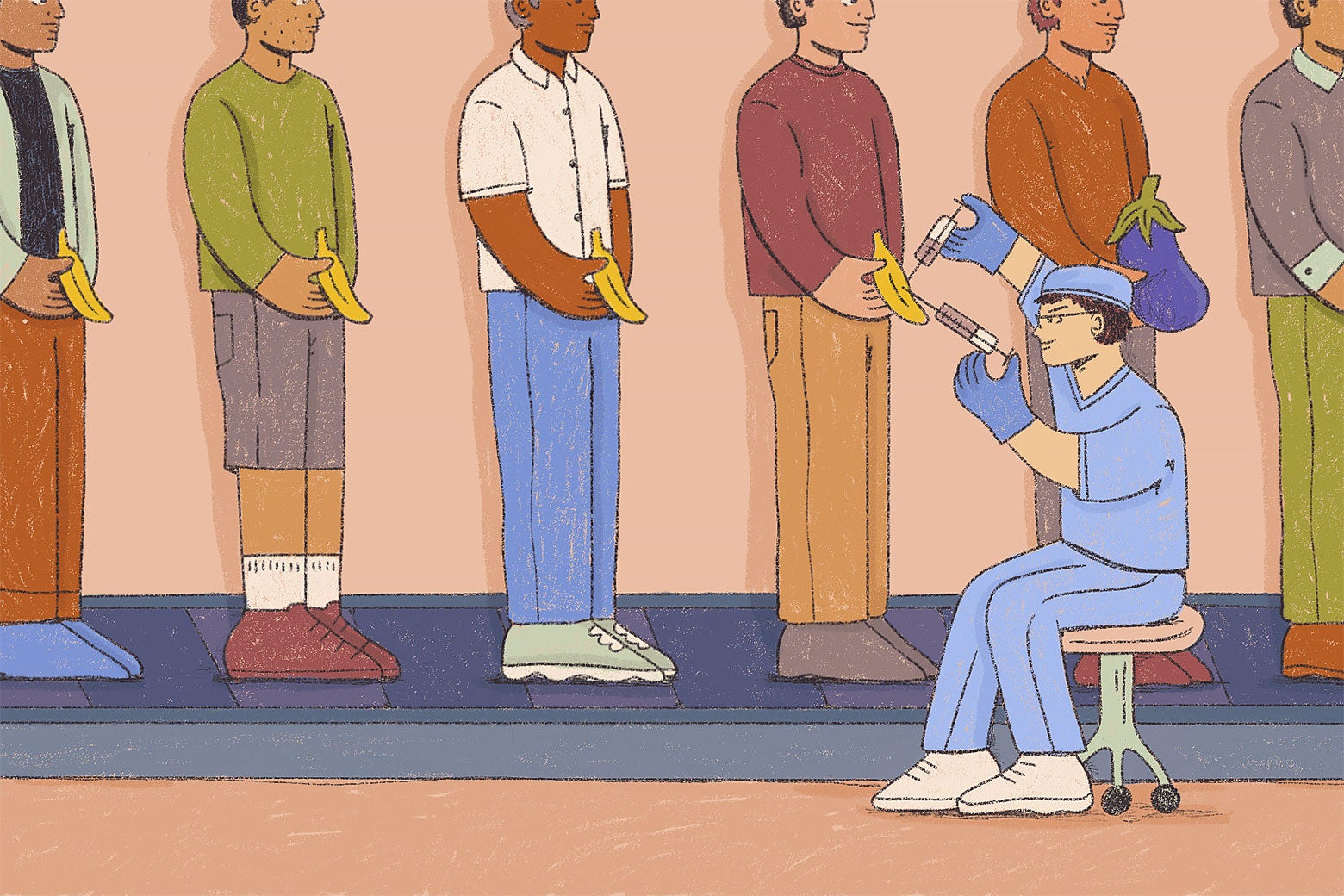
 Illustration by Kelly Malka
Copy Link
Share
Share
Comment
Illustration by Kelly Malka
Copy Link
Share
Share
Comment
Sign up for the Slatest to get the most insightful analysis, criticism, and advice out there, delivered to your inbox daily.
“We’ll be right with you, my man.”
I’d never been greeted this way at a doctor’s office before, but then again, I’d never been to a place like the Tennessee Men’s Clinic. I’d only ever experienced the unpleasant waiting rooms of doctors who take insurance, but this place was posh, softly lit, and full of tasteful furniture. I hardly had time to sit down before a kind nurse ushered me into an examination room and took vials of blood. On the wall behind the patient chair was an ad in the style of a doctor’s office informational poster that explained how the clinic’s compounded blend of medications would deliver two-hour erections.
Before I’d finished reading the poster, a doctor came in and shook my hand like he meant it. He was a short man in an immaculate white coat and studded red cowboy boots that nearly reached his knees. He looked me in the eye and asked me why I was there.
I had come as a journalist. The clinic and its founder, Evan Bass—a former Bachelor in Paradise star who is not a doctor—had been fined by the state attorney general’s office in 2019 for deceptive advertisements marketing erectile dysfunction treatments. Lately, I had read Reddit accounts and Google reviews of the clinic by men who had left feeling exploited, pushed to sign contracts they felt prioritized profits over patient health. Looking to judge the sales tactics for myself, I’d filled out the questionnaires vaguely but honestly: Sure, sometimes I wanted a faster, stronger erection. A bigger penis too? Twist my arm.
“I want to be more virile,” I said.
“Virility is what we’re all about,” the doctor said. “Or, as I usually put it, optimization. I want to help guys optimize. That’s why I work hard to create a safe space where guys can talk about hard subjects honestly and openly—erectile dysfunction, premature ejaculation, penis size.”
AdvertisementHe walked the talk. He discussed the injection he had given himself when he’d had a bout of ED. He told me about a patient he’d seen that morning who’d recently managed to have sex with his wife for the first time in three years. He modeled the frank kind of conversation men ought to have about sex but, in my experience, never do. I felt guilty for doubting him.
Advertisement Advertisement AdvertisementBut not for long. The good doctor moved seamlessly from intimate anecdotes to a three-pronged optimization plan for my body.
Phase 1: boosting testosterone via Clomid. “Are you sometimes lethargic?” he asked. “Do you struggle to enjoy things you used to enjoy? Signs of low T.”
Phase 2: more boners through an oral compound of Viagra, Cialis, and Levitra.
He saved Phase 3, the real showstopper, for the end: “penile girth enhancement.”
“I think of your penis as a canvas,” he began, before spelling out his artistic vision for my member, which he hadn’t seen yet. (Bass declined to make himself available for an interview, and the clinic didn’t respond to a request for comment about what I experienced on my visit.) He planned to start by injecting Botox at the base of my penis. This would relax the muscles and prevent the dermal filler, which he would inject at regular intervals along the shaft, from “accordioning.” The filler would last 12 months, maybe 18, before dissolving and leaving me with a choice: submit once more to his expensive needle or shrivel back up to my old self.
AdvertisementWhile the filler lasted, however, there would be the problem of ongoing maintenance. “A molding process is required,” the doctor explained. “If you sleep on your right, the filler will migrate to the right. Some guys come in every few months for a touch-up, but you probably won’t have to. Instead”—here he paused to rub his open palms together as if heating himself over a campfire—“you can rub your penis between your hands like the Play-Doh snakes you made when you were a kid.”
You might think that such optimization would be a hard sell at just over $7,000 for filler and Botox, but by all accounts men across the country are lining up to submit to the needle. These once niche cosmetic procedures have gone mainstream, boosted by the endorsement of porn stars and looksmaxxing influencers like Clavicular, who released a video that purports to show him receiving an injection. A lot of men, it turns out, so dislike their bodies that they are ready to spend a fortune to change them. Justin Dubin, a urologist and director of Men’s Sexual Health at Baptist Health Miami Cancer Institute, put it this way: “If urologists had the ability to make every man big the way he wants, we’d be the richest people on Earth.”
Advertisement Advertisement Advertisement AdvertisementIt’s only anecdata, but every single woman I’ve told about this procedure—women ranging in age from their 20s to their 70s—has recoiled in revulsion. As well they might: According to an often-cited study, 85 percent of partnered women are satisfied with their man’s penis. Straight men, however, do not seem to be listening to their sexual partners, since only 55 percent of all guys report satisfaction with their own size.
To help men alleviate this discontent, clinics all across the country are competing with one another to offer injections under different proprietary names: Magic Shot, Juvéderm Voluma, Restylane, UroFill, PhalloFILL, and others. Whatever the brand, the basic offering is the same: Hyaluronic acid is injected into the soft tissue of the penis to serve as dermal filler. The doctors’ promise is also the same: A man can temporarily gain about half an inch to a full inch of girth, but no extra length. Recovery from the injections requires careful hygiene and two weeks’ abstinence to minimize the risk of complications, which can include infection, nodules (soft lumps), granulomas (hard lumps), and disfigurement.
AdvertisementThose side effects may sound bad, but the injections do represent a real breakthrough in men’s enduring quest to enlarge themselves. “It’s been so hard to come up with safe treatments since the penis is so much more complicated and dynamic than other places we look to enhance, like lips or breasts,” Dubin explained.
Not that men and their doctors haven’t been trying anyway. In the ’90s, the Serbian surgeon Sava Perovic developed a technique in which he removed cartilage from the rib and inserted it into the penis shaft, an operation that can, among other serious side effects, lead to scarring and kinking. Silicone injections can cause severe necrosis. And “fat grafting”—on second thought, I don’t actually want to say what can happen with fat grafting, and I strongly suggest you not look it up yourself.
Advertisement Advertisement AdvertisementAnd so it is good news that the safety profile of these injections is relatively auspicious. Complications are both rare and rarely serious, especially if recipients follow instructions. The treatment is also reversible: If a patient is dissatisfied, his doctor can administer hyaluronidase, an enzyme that breaks down hyaluronic acid.
AdvertisementThe bad news is that these injections are an off-label use of a Food and Drug Administration–approved dermal filler. That in itself is not disqualifying; many cosmetic injections of hyaluronic acid are off-label. Still, however eager some urologists may be to sell the penile injections, that should not be confused with medical consensus about its safety. In its 2024 statement on the practice, the Sexual Medicine Society of North America cited a “lack of high-quality studies, making it hard to understand the true risks and benefits. This lack of data means informed consent is limited.”
When I reached out to the SMSNA for elaboration, a spokesperson referred me to Landon Trost, a Utah-based urologist. He explained that because hyaluronic acid has been used for many years with Peyronie’s disease—a condition in which the accrual of scar tissue in the penis can result in sexual dysfunction, pain, and curved erections—we can have a “degree of assurance that the therapy has a reasonable safety profile. However, there is very limited data on its use for augmentation purposes in the penis alone. We don’t know how the risk profile changes when people undergo higher volumes of injections, repeated injections, or other similar types of treatments.”
AdvertisementThere are few high-quality studies on the long-term consequences of the procedure—or even how many people have had the treatment. Many of the companies providing these injections don’t publicize their sales. Because insurers typically do not cover the procedure, there is no insurance billing code, which is what epidemiologists ordinarily use to determine any given treatment’s prevalence. As a result, it’s not possible to know how many people are getting injections.
Advertisement Advertisement AdvertisementEven so, Trost and the other urologists I spoke with all believe that the treatment is on the rise. He cited a few possible reasons for the trend: rising awareness of the procedure, different fillers on the market, relative lack of serious safety concerns, increased prevalence of providers looking to cash in. Still, he said, “I personally don’t think this will ever be a major industry.”
Others seem to be making a different bet. At the time of our interview, Dubin was training to start offering penile injections to his own patients. And when I asked Jim Capalbo, the PR person for PhalloFILL, how business was going, he said growth was exploding: “The challenge is training urologists fast enough to keep up with demand.” Between 2020 and 2025, PhalloFILL expanded from just one provider to 30, while boosting revenue by more than 1,000 percent. The company was now serving a mix of “blue- and white-collar workers, all different backgrounds and ethnicities.”
AdvertisementIt seems that, wherever these doctors open up shop, a lot of men are ready to spend a small fortune to be briefly bigger.
Would-be patients still bear much of the responsibility for assessing the research, or so I learned from Amy Pearlman, a urologist in the PhalloFILL network who offers injections in Coral Gables, outside Miami. (Dubin observed that there was particular demand for these injections in South Florida.) She urged men considering the injections to come to their urologist with a plan. “Do your research,” she advised. “Go down the rabbit holes. Go to Google, and go on Reddit. If you haven’t done your research before going to the doctor, you’re setting yourself up for failure.”
She referred me to a patient of hers, whom I’ll call Chuck. Early 50s, white, straight, and actively dating, Chuck was unusually qualified to sort out the risks for himself: Not only was he an anesthesiologist, but he worked in cosmetic surgery, “doing boob and butt implants all day long. And if girls are getting their boobs done,” he told me, “I don’t feel ashamed about getting my penis done.”
Advertisement Advertisement Advertisement AdvertisementHe was unequivocally positive about the injections: “I would recommend them to any man lacking confidence in the bedroom. They have increased my confidence and my partners’ satisfaction.” Well, not all his partners’ satisfaction, he clarified: Some now thought he was “too big.”
Still, one benefit of the filler that he kept returning to, more than his partners’ or his own satisfaction, was his pleasure at revealing how big he had become. “I almost do the injections because I can’t wait to see the girl’s reaction. The reaction when they see the size is so, so great. When a girl sees it for the first time …” He trailed off, then added, “I have no problem walking around a locker room now.”
I asked him the question that had been hanging over our conversation, and in fact my entire reporting process: How big was the ideal dick? Or, I clarified, how big would his dick have to become before he himself considered it too big? “I think that however much you have,” he replied with a sigh, “you always have the feeling that you want a little more.” In fact, he went on, he had had his fourth round of injections from Pearlman just a few days before I called. He was still black-and-blue.
AdvertisementI put the same question to the urologists: What is the ideal size for a man? Pearlman acknowledged that penis size is not a big factor for most women’s sexual satisfaction—a finding consistent with the conclusion of the famous 1960s sex researchers William Masters and Virginia Johnson—but then immediately related anecdotes in which size mattered a lot. In a more memorable one, a woman “literally didn’t feel her partner” when having sex with him before he increased his width with injections. Indeed, a more recent study found that some women rate girth as more important than length in penis size, suggesting that this purported preference influenced their partnering behavior.
Advertisement Advertisement AdvertisementEven if such inclinations are the norm, this treatment can’t always be about addressing a size mismatch between partners’ genitals: Many, if not most, of the men seeking these injections from Pearlman, she said, are already average-sized or larger. Chuck told me that he had started with about 5 inches of girth. For his part, Dubin declined to say how big a man would have to be before he would refuse to give him the treatment. So long as a man wanted the injections and had “realistic expectations” about them, he was ready to help boost any man’s confidence and self-satisfaction.
This idea of “realistic expectations” took on a new meaning when I talked to Marty, an advertising man who, like Chuck, was in his early 50s. I was connected to him by Akis Ntonos, a doctor of nursing practice at Aion Aesthetics in New York City. Marty had not opted for filler. Instead, he had received Botox and a p-shot (an injection of platelet-rich plasma). The Botox was intended to minimize shrinkage, while the p-shot was meant to increase size, a claim that is not backed by scientific evidence. Marty’s main goal for the procedures, he said, was to gain the confidence required to walk naked on a nude beach.
Like Chuck, Marty was pleased with his treatments. “I noticed a change of weight,” he said. “Literally, I was hanging differently: I felt like I was swinging.”
When I asked him how big would be too big, he paused and, in a very gentle voice, asked me if I was gay or straight.
“Straight.”
“I thought so,” he said. “With gay guys, there’s no such thing as too big. The size limit does not exist.”
What’s more, he went on, size really matters when you’re gay. “Gay guys will complain after a date with someone, ‘We hooked up, but his dick was too small.’ I think most gay men will admit that size is important, and not just during sex. Traditionally, with gay sex, the guys with the big dicks are the tops—so if you don’t have a big dick, it’s expected that you will be the bottom. After my treatment, I was feeling less stuck in the role of the bottom.” (Though sexual role and penis size aren’t always correlated, some research backs up the idea that size matters more to gay men than to straight women when choosing sexual partners.)
Advertisement Advertisement AdvertisementAccording to Marty, what counted as a big dick had grown in his lifetime. “Body expectations have changed,” he said. “With the easy access that we all have to pornography, we’re only ever seeing big dicks, so anyone who doesn’t have a big dick is convinced he’s in a minority and he’s inferior. We just see gargantuan dicks all the time now.” He laughed and changed course: “I’m not complaining about that, but it does skew your perception of what’s normal.”
Indeed, more and more men seem to be dissatisfied with their bodies. Body dysmorphia—a preoccupation with a physical defect that is slight or unobservable to others, according to the DSM-V—is increasing in the population at large, with as many as 40 percent of BDD cases estimated to be among men. And though gay men have over the years consistently reported higher levels of body-image distress, everything about how these emerging men’s clinics market themselves makes clear they have targeted heterosexual men as their potential clientele. In fact, their messaging seems designed to convince straight men that women think about penis size the way Marty says gay men do.
On UroFill’s site, for example, there are five pictures of happy-looking heterosexual couples in pre- or postcoital poses. The PhalloFILL site features a video that starts with two men staring at a large-breasted woman walking along a pool in a red bikini; a brawny Adonis emerges with a splash and leaves her stammering. “I thought the water was cold,” says one of the betas. The narrator, in a voice so deep it makes the Marlboro Man seem effete, concludes: “Be the man you were meant to be.”
The question of how big the optimized dick is—and the price one should pay to have it—is essential to thinking through whether the procedure is worth the substantial downsides. Though Chuck was all in favor of the injections, he conceded: “The filler does migrate and get misshapen. If you want your penis to be symmetrical, the treatment’s not going to work. Still, it’s so thick.” Or, as the doctor at the Tennessee Men’s Clinic put it, “It isn’t going to look like your God-given penis, only larger. It’s going to look like you’ve had work done.”
Advertisement Advertisement AdvertisementNot all men are happy with this trade-off, as I learned when I spoke to Ntonos, of New York’s Aion Aesthetics, who administers cosmetic enhancements regularly. “I see more issues with the fillers than benefits,” he said. “I find that people who have it end up with more erectile dysfunction. With the filler, you put a buffer between the muscle and the skin—that can create a deterioration of nerve endings and decline sensation. And the gel ends up being lumpy and bulgy. A lot of guys come into my clinic after getting the filler done elsewhere, and I have to dissolve it.”
Just what portion of men gain lasting confidence from this kind of augmentation will be revealed in further studies. Trost, for his part, is doubtful. “Anytime someone tries to address a problem that is predominantly psychosocial in nature with a physical treatment,” the Utah urologist said, “I suspect the long-term efficacy and success is very poor.” Indeed, Marty admitted he still isn’t confident enough to walk naked on a nude beach.
And even if the treatment were a guaranteed success for every man who gets it, the question remains: Why? Straight men are not going to find their sexual roles transformed the way Marty did, so why would an artificially fattened penis boost self-confidence when most women are already happy with their partner’s size? Nobody is suggesting that this treatment is some magic bullet to fix a shaky marriage. It isn’t going to make your partner want to have sex with you all the time; it isn’t going to teach you how to talk to women.
For straight men, girth enhancement isn’t a signal to women, because most simply don’t care enough about size for it to be a determining factor. It isn’t much of a signal to other men, because outside of the nude beach or locker room, there just aren’t that many situations in which straight guys get naked with one another. And so it must be primarily a signal a man gives himself. It confirms his membership in the supposed community of big-dicked men, with all the benefits that distinction allegedly confers, even in situations when his penis remains unseen. It’s a Dumbo’s-feather kind of confidence, a way for guys who feel like bottoms in the world of men to feel like tops, but at greater cost than leasing a new Mercedes. Cosmetic dermatologist Jason Emer put it most succinctly: “I have a patient who thinks he can do his business deals better because now his penis is really big.”
Advertisement Advertisement AdvertisementIn the treatment room at the Tennessee Men’s Clinic, the doctor, to his credit, made the procedure’s intended audience explicit: “This treatment is about changing how you feel when you look in the mirror.” Indeed, when I followed Pearlman’s advice and went on Reddit, I did find some men delighting in how happy and sexually fulfilled they and their partners had become—but not nearly as many as the guys exalting in going from growers to showers. The treatment’s main function seems to be helping men stand up to the male gaze.
Which can be hard to do, as my experience at the clinic showed. After spelling out his vision for my “canvas,” the doctor asked me to pull down my pants. He tugged on my flaccid penis, examined it for three seconds, and told me that most white guys are growers, not showers—“which is a good thing,” he added, still squatting. He then announced that he was going to leave and that others would handle the rest. “I don’t like to talk about money,” he explained.
And with that, after talking to me for 35 minutes, for the low, low consultation fee of just $99 (plus blood work!), he abruptly walked out, leaving me feeling a bit raw. I saw my surroundings in a new light: The walls featured a series of photos of an off-brand Marilyn Monroe, first staring out with shy love-me eyes, then lying dazed in a tangle of sheets. The promotional literature nearby showcased men with muscles as shiny and braided as fresh challah.
A moment later, there was a knock, and in came two new men, both dressed all in black. One, a thin man with squeaky shoes and pasty skin, leaned against the door, his arms crossed, looking at me without smiling. The other was one of the most muscular men I’ve ever seen in my life. He sat on a stool, pulled it near, and leaned in a little too close.
Advertisement Advertisement Advertisement“With low-T guys like you,” he said in his deep voice, “we recommend a two-year plan.” Money wouldn’t have to be a problem; the office had partnered with a loan company that would offer me financing on really nice terms. “Ordinarily, we’d be happy to get you injected right here today, but you’ll have to wait until the morning. Can we sign you up?”
The larger man held out the pen and stared, his eyes unwavering. I felt how hard it can be to say no to a big man, how nice it would be to be a man who could throw his weight around. I crossed my legs.
Copy Link Share Share Comment