요약
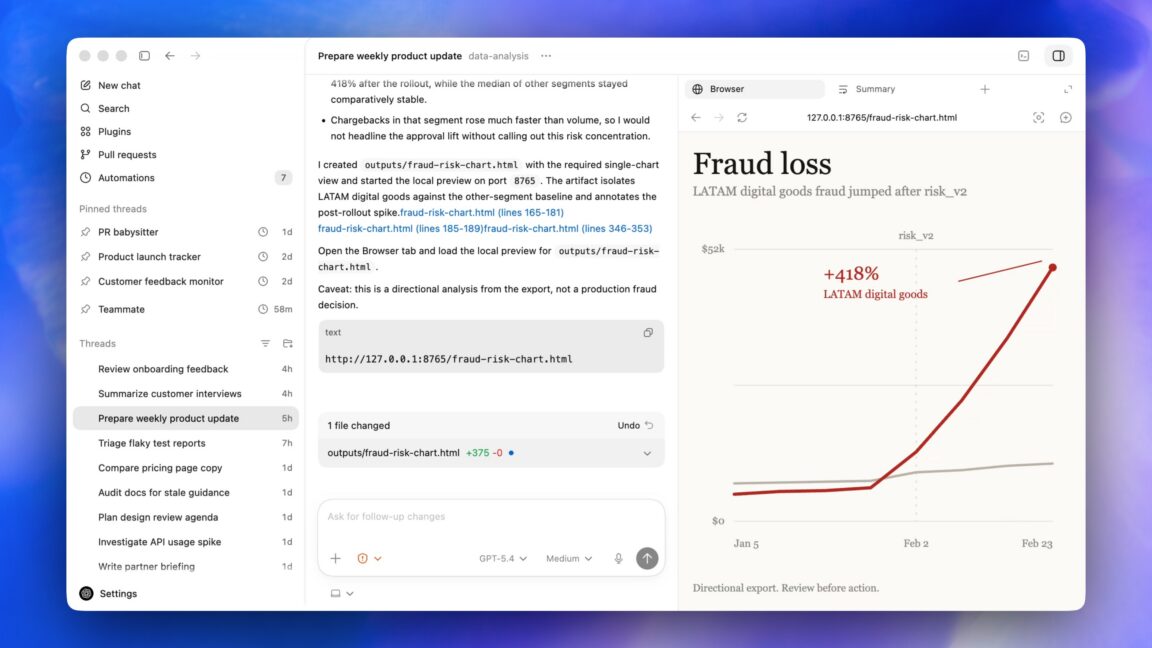
An in-app browser allows visual feedback while building websites and more.
본문
Story text Size Small Standard Large Width * Standard Wide Links Standard Orange * Subscribers onlyLearn more
A new version of OpenAI’s Codex desktop app reaches users today. It brings a smorgasbord of new features and changes, ranging from new developer capabilities to expansion into non-developer knowledge work to laying the groundwork for the company’s “super app.”
The most interesting for the moment is the ability to perform tasks on your PC in the background; OpenAI claims it can do this without interfering with what you are doing on your desktop.
OpenAI explained the update in a blog post:
With background computer use, Codex can now use all of the apps on your computer by seeing, clicking, and typing with its own cursor. Multiple agents can work on your Mac in parallel, without interfering with your own work in other apps. For developers, this is helpful for iterating on frontend changes, testing apps, or working in apps that don’t expose an API.
Additionally, Codex can now schedule work that it plans to do at a later time hours, days, or even weeks in advance, and wake itself up to perform those tasks at the proper time.
It also now has an in-app web browser. This allows you to assess the work Codex is doing with web experiences, and you can leave comments on specific parts of the page with instructions, similar to popular tools that organizations already use to give feedback to web designers and developers. There’s a newly added ability to leverage gpt-image-1.5 to generate images, which can be included in mockups and the like.
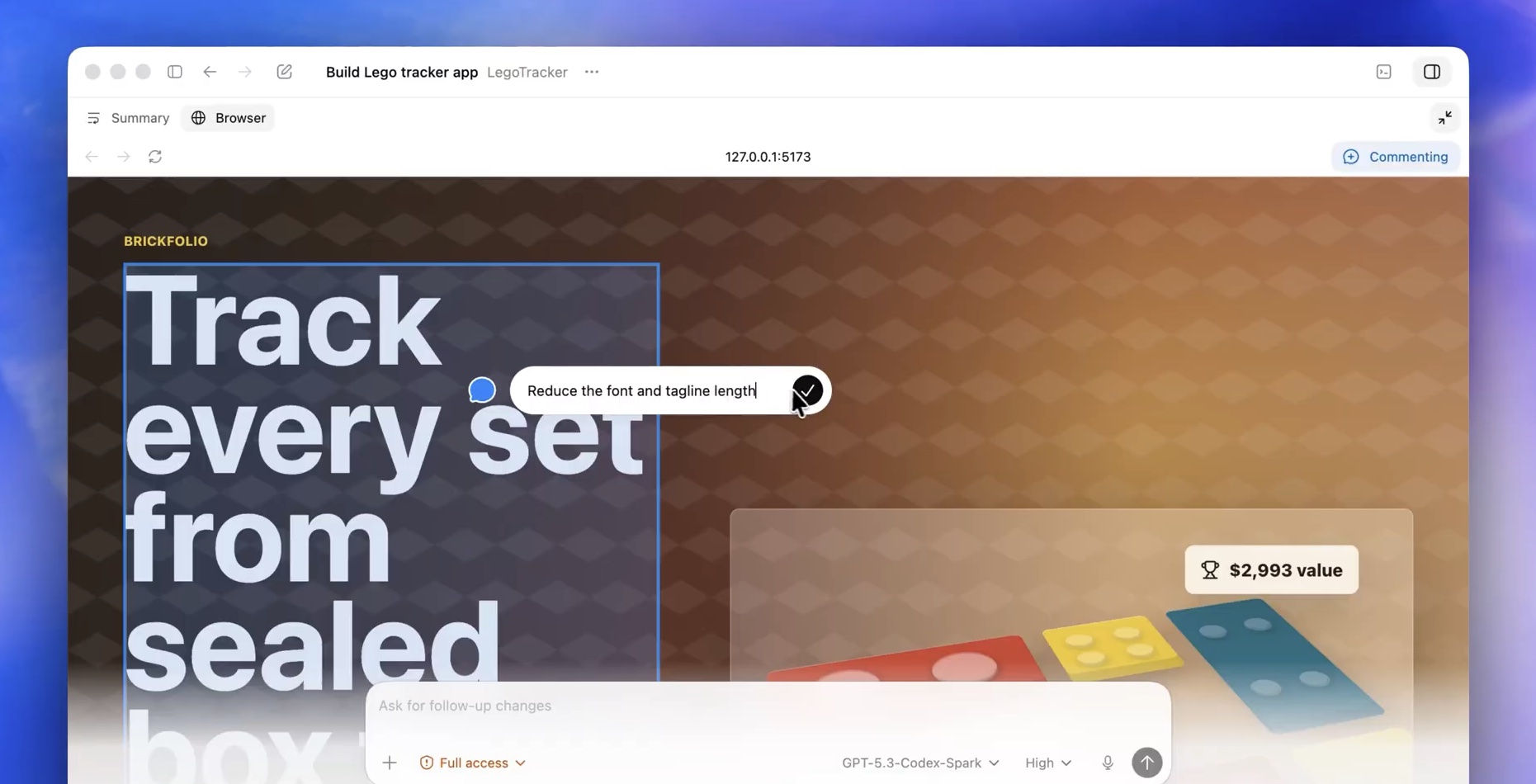 Providing feedback in the in-app browser.
Credit:
OpenAI
Providing feedback in the in-app browser.
Credit:
OpenAI
“Over time we plan to expand it so Codex can fully command the browser beyond web applications on localhost,” OpenAI wrote.
Now that it’s more in the realm of software development, Codex can run multiple terminal tabs and take action based on GitHub review comments, among other things.
The addition of 90 new plugins expands the existing workflows it can slot into, including for more general knowledge work tasks and applications outside the realm of software development.
On the surface, all this appears as an almost random platter of disparate changes, but there is one unifying theme: A lot of these changes are additions that one might expect to see in OpenAI’s eventual “super app” that would combine elements of the company’s Atlas web browser, Codex, and other agentic tools for use in a wide range of contexts.
In a media briefing, Codex lead Thibault Sottiaux said, “We’re actually doing the sneaky thing where we’re building the super app out in the open and evolving it out of Codex.”
 Samuel Axon
Senior Editor
Samuel Axon
Senior Editor
Samuel Axon is the editorial lead for tech and gaming coverage at Ars Technica. He covers AI, software development, gaming, entertainment, and mixed reality. He has been writing about gaming and technology for nearly two decades at Engadget, PC World, Mashable, Vice, Polygon, Wired, and others. He previously ran a marketing and PR agency in the gaming industry, led editorial for the TV network CBS, and worked on social media marketing strategy for Samsung Mobile at the creative agency SPCSHP. He also is an independent software and game developer for iOS, Windows, and other platforms, and he is a graduate of DePaul University, where he studied interactive media and software development.
55 Comments
Samuel Axon
Senior Editor
Samuel Axon
Senior Editor
Samuel Axon is the editorial lead for tech and gaming coverage at Ars Technica. He covers AI, software development, gaming, entertainment, and mixed reality. He has been writing about gaming and technology for nearly two decades at Engadget, PC World, Mashable, Vice, Polygon, Wired, and others. He previously ran a marketing and PR agency in the gaming industry, led editorial for the TV network CBS, and worked on social media marketing strategy for Samsung Mobile at the creative agency SPCSHP. He also is an independent software and game developer for iOS, Windows, and other platforms, and he is a graduate of DePaul University, where he studied interactive media and software development.
55 Comments