요약
In this review I cover whether the SB200 is a worthwhile upgrade over the existing SB20, as well as everything you need to know from ride feel to accuracy.
본문
JUMP TO:
- Start
- What’s New
- Quick Company Update
- Unboxing & Setup
- Bike Fit Bits
- Daily Usage
- App Compatibility
- Power Accuracy
- Upcoming Accessories
- Wrap-Up
- Discussion (46)
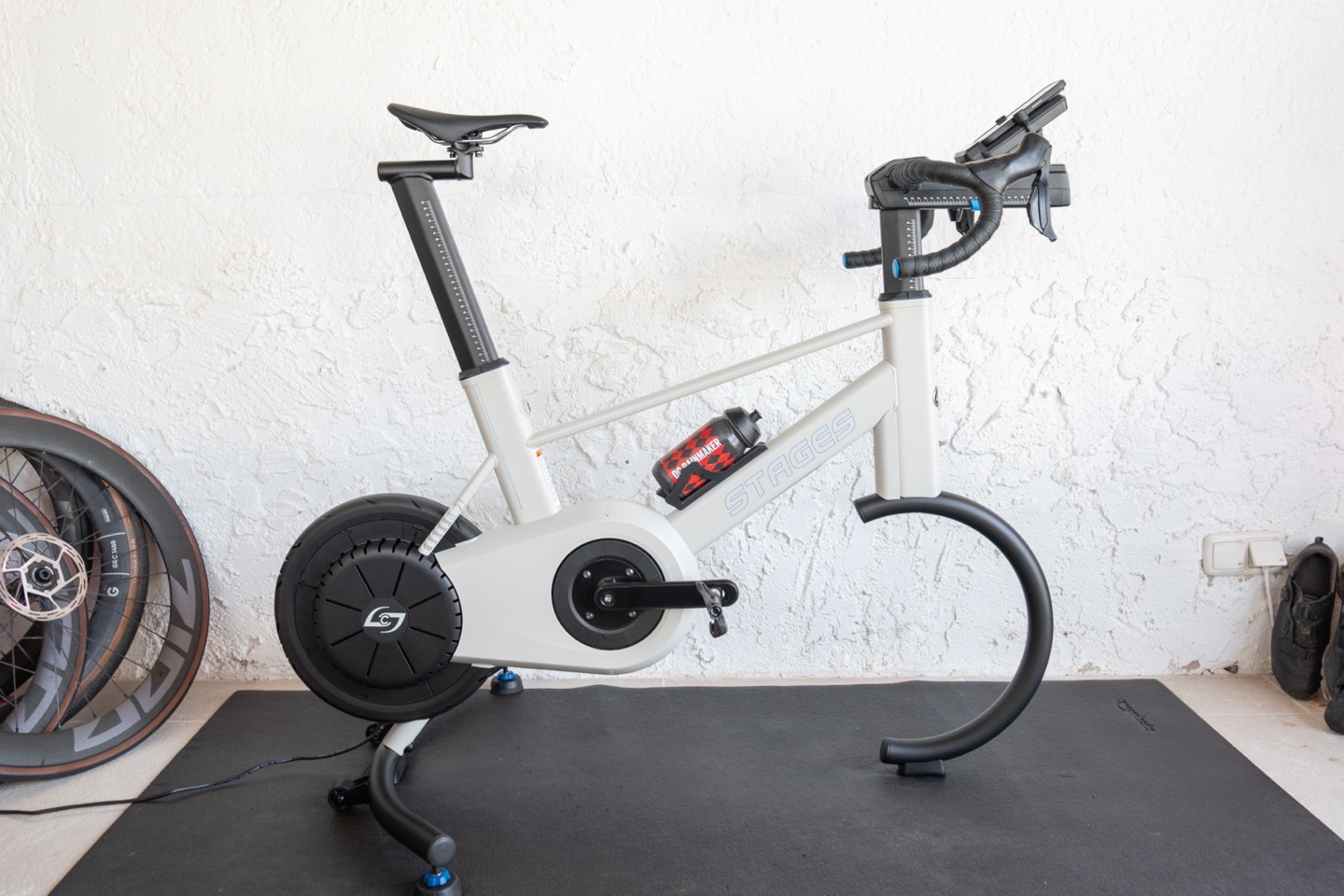
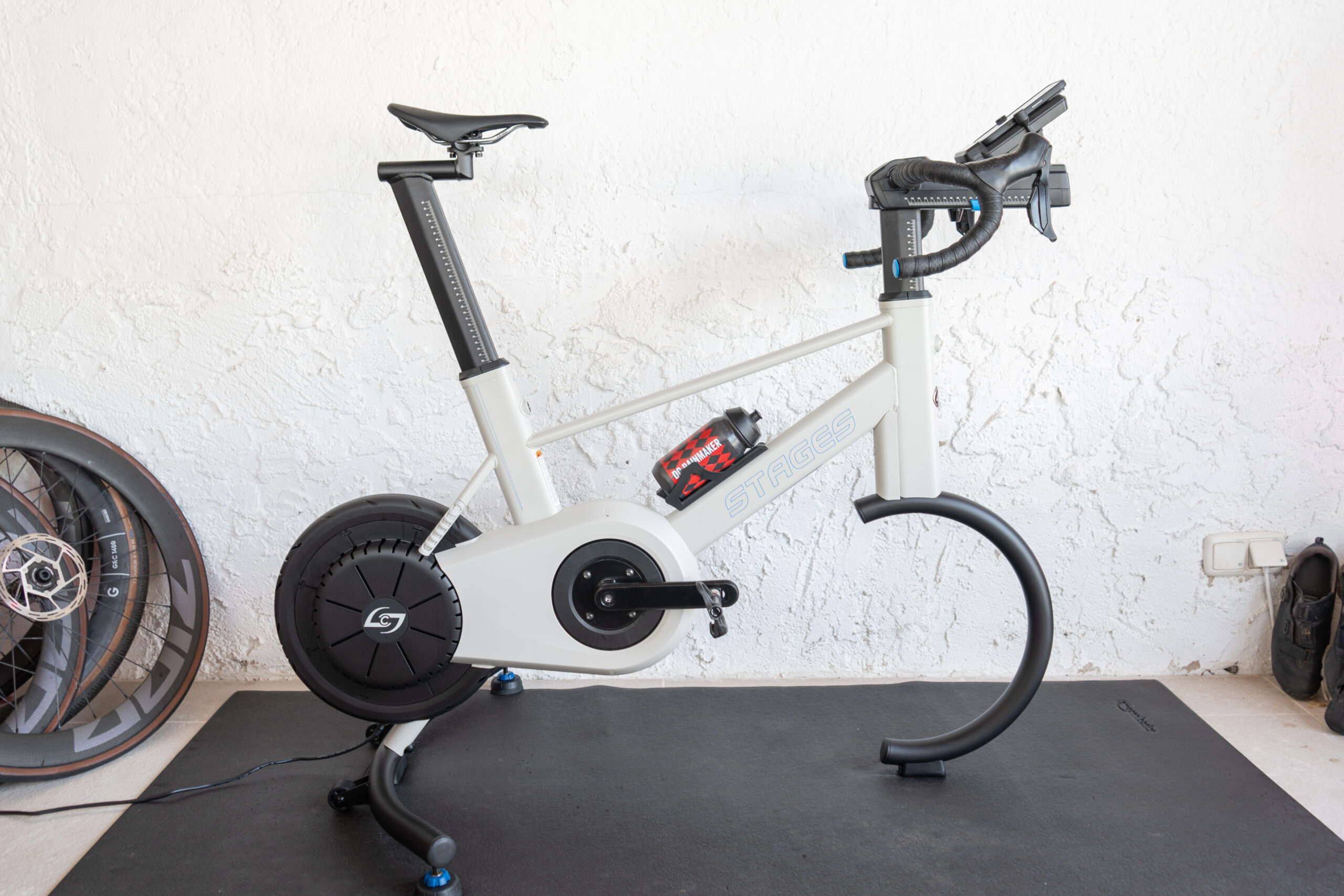
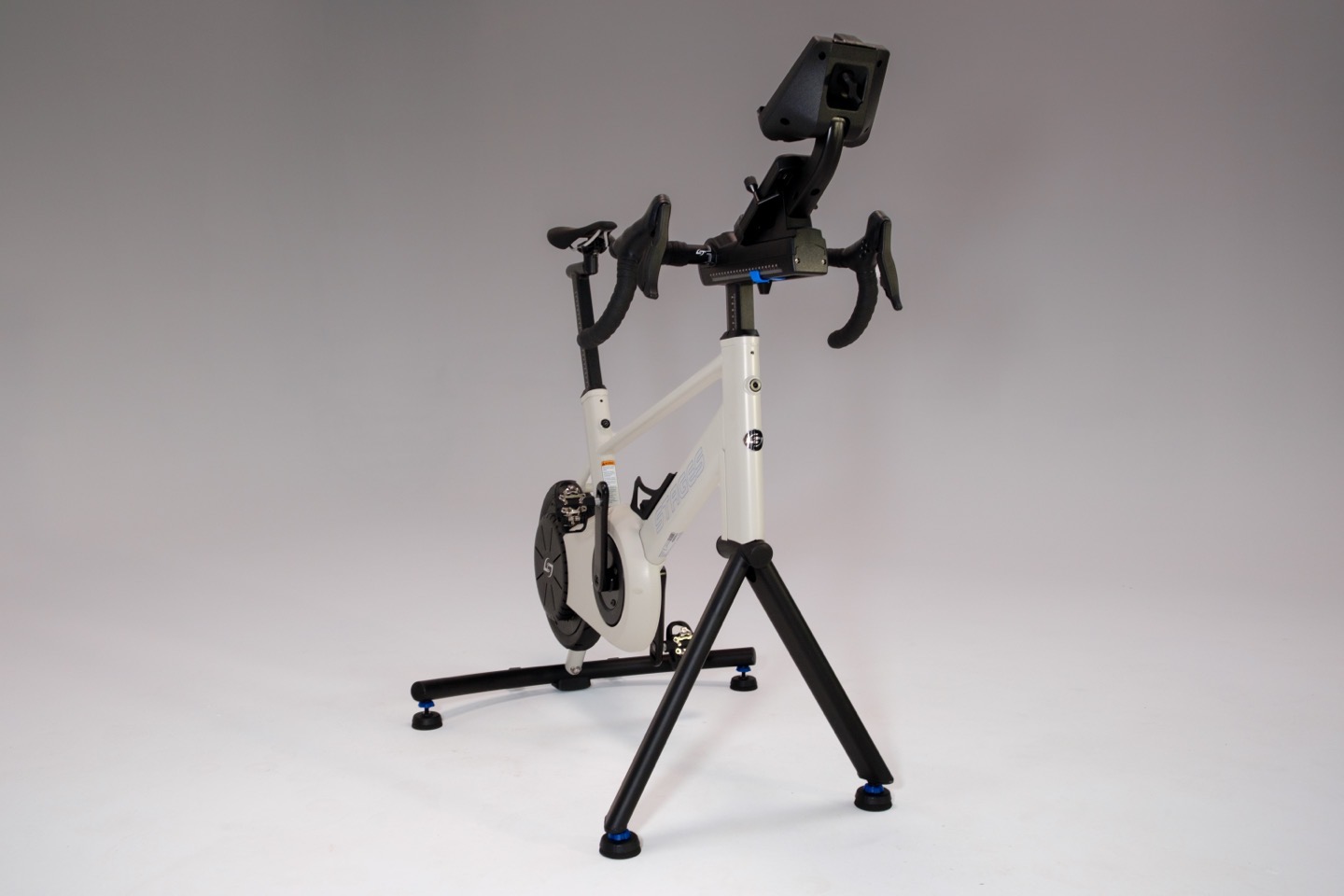
Stages is back. Though they’ve actually been back for a year or so now. But more specifically, they’ve just launched the new SB200 indoor smart bike, which has many ties to the older Stages SB20 launched in 2020, but in reality looks nothing like it.
Now I’ll dive into some of the company bits below (see the section titled ‘Quick Company Update’), but the new SB200 follows much of the indoor cycling trend of focusing on a streamlined design, greater rider fit aspects (e.g., serving both a small rider and a taller rider on the same frame), as well as better handlebar button integration with 3rd party apps. It’s a pattern we’ve seen implemented on full smart bikes from the likes of Wahoo, Technogym, and Wattbike, as well as trainer-mounted smart bike-like frames from Zwift, Elite, and others.
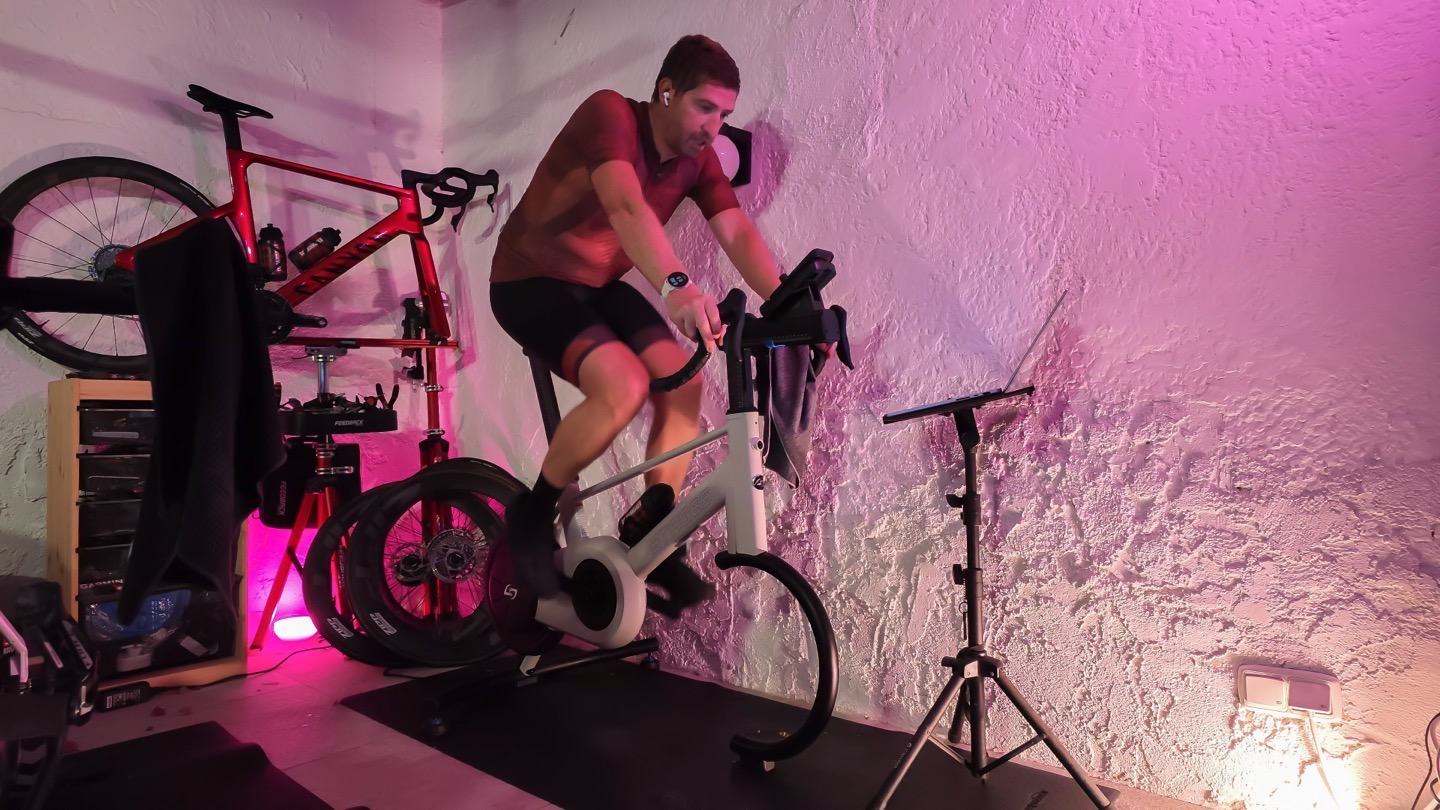
In this case, both me (tall) and my wife (vertically challenged) have been riding the SB200 for all our recent indoor cycling rides. Albeit, admittedly, the bike is technically outdoors. But we won’t let that get in the way of the indoor trend. So I’ve got a pretty good idea of what works well, and what I’m not in love with.
With that, let’s dive right into the newness!
What’s New:
While the SB200 is certainly an evolution of the existing SB20, I’d argue for the most part that’s really only in name. Almost everything else is different. One thing to remember, though, is that when it comes to making indoor bikes, Stages has made far more indoor bikes than literally everyone except perhaps Peloton. And even there, Stages is literally making the newest Peloton commercial bike (you’ll notice it looks a heck of a lot like Stages existing commercial bikes). So…yeah.
However, one of the ‘complaints’ about the previous SB20 was that it felt too much like a gym bike, and less like a bike that would fit in your living room (or garage). And indeed, the thing was a tank. Sure, it could last forever, but equally, it was overkill to the extreme for home usage. Like driving a tank to school.
So, here’s how it’s different:
– Added side-to-side pivoting/movement within the frame (about 2°, adjustable)
– Reduced the weight by 55 pounds/25kg (compared to SB20)
– Added roller wheels at the back of the frame for moving/relocating around the house
– Increased flywheel inertia 5x compared to Stages SB20
– Switched to dual-stage belt drive (versus 1x belt drive on previous unit)
– Adds front LCD/display, showing in-ride stats
– Adds a slate of customizable buttons, also preconfigured for Zwift, Rouvy, TrainingPeaks Virtual
– Adds 5 custom shift/bike profiles, selectable right from display
– Added full shifters, customizable to either SRAM or Shimano-style shifting (previously was just buttons)
– Has braking for in-game usage, as well as just adjusting resistance
– Added WiFi support (including connectivity across trainer control “standards”)
– Added 10hz Race Mode over WiFi (data 10x a second)
– Added 4hz Race Mode over Bluetooth (data 4x a second)
– Added heart rate monitor/sensor bridging (into WiFi/etc)
– Added fully internally-routed wiring to all components
– All hidden-cable wiring, no exposed wires/cabling
– First indoor bike to support OpenBikeControl
– Also supports Bluetooth (including FTMS), Zwift Protocol (No ANT+, though)
– Optional swappable seat post accessory
– Tool for adjusting now built into frame
– Changed from previous bear claw crankset design to different adjustable crank arm design (previous design was susceptible to failure when overtorqued, or sweat pooled in holes driving corrosion faster)
– Changed to measuring power at the brake, versus previous dual-pod crankset design
– Claimed power accuracy of +/- 1%
– Supports both spin-down calibration and manual calibration
– Added built-in spring-loaded phone holder above LCD
– Added secondary tablet holder option
– Added free Stages app that includes craptons of structured workouts for free
– Added support for syncing in TrainingPeaks workouts to app
– USB-C charging ports built-in (2 AMPS)
– Added a simple on/off switch to rear of bike
– Price is $2399USD/ £2199/ €2399
For context, the previous SB20 retailed initially at $2,899, though, like all bikes, it shifted in price over time, especially in/out of COVID. Either way, the SB200 being at $2,399 is quite competitive in the full smart bike realm. Obviously, trainer+frame bikes (like the Zwift Ride) tend to be cheaper, though they also tend to offer less fit adjustability than dedicated smart bikes. There are, of course, other pros/cons to weigh as always. For reference, the KICKR BIKE PRO is at $3,999
Finally, as for general specs (rather than the newness above), here’s the quick and dirty of the core indoor bike specs:
– Internal dual-stage belt drive
– Resistance system: Single coil electromagnetic braking
– Power support to 2,500w (1,500w @ 120RPM, 400w @ 40RPM)
– 2.23” display (128 x 32 dot matrix)
– 40cm handlebar with 31.8mm standard tube
– Handlebar customizable buttons (10 total)
– Handlebar braking and shifting (normal bike style)
– Audible feedback when reaching the end of the cassette/shifting
– Free Stages app for control, customization/setup, structured workouts
– Control over Bluetooth Power, Bluetooth FTMS, OpenBikeControl, WiFi
– 4 concurrent Bluetooth Connections
– 2xUSB-C power (5V @2.0A)
– Q-Factor: 153mm
– Rider range: 147cm to 208cm (4’10” to 6’10”)
– Steel frame, phosphate plating with powder coat
– Bike weight: 70lbs/32.3kg
– Bike length: Min is 127cm (49.9”), max is 137.3cm (54.0”), plus tablet holder is 10cm (3.9”).
– Bike Width: 80.4cm (31.6”)
– Bike Height: From 97.9cm (38.5″) to 117.2cm (46″) (+ tablet holder is 14.8cm)
– Maximum rider weight: 300lbs/136kg
With that, let’s just briefly touch on the company aspects.
Quick Company Update:
One can’t talk about Stages without at least talking about Stages going under. Which they did back in 2024. Like many cycling companies coming out of COVID, they over-invested in inventory, which simply sat around for a market that didn’t materialize.
However, unlike some of the other brands that made this mistake and then went under forever, Stages only temporarily disappeared. Later that year, Giant acquired what was left. Keeping in mind that Giant previously built Stages bikes, and was one of the biggest companies left holding the empty bag.
One could probably argue that in some scenarios, Giant would have done the acquisition prior to bankruptcy, but I’m sure lawyers decided this method was better. Either way, Giant ended up acquiring Stages, and much of the top engineering that was at Stages ended up at Giant. For example, all the same product leads that I knew at Stages for the past 15 years are still there.
Of course, in the short term, none of this made existing Stages customers super happy. There was unquestionably a time period where Stages customers were the ones that got shortchanged here. No service, no parts, no nothing.
However, despite no legal requirement to do so, Stages has gone back and manufactured parts for the previous SB20 (you can find them all here). They’ve opened up support lines for it, and they touted that the current average customer support time is under 4 hours, and the average ticket closure time is under 48 hours. They wholeheartedly agree the customer support situation (meaning, no real situation) a few years ago sucked, but equally they note that if you have an existing SB20 and haven’t tried support in a few years, you should give it a whirl.
Looking at some of the Stages SB20 Facebook owner groups, people generally seem pretty darn happy with the current support situation. Obviously, there are some folks that were wronged years ago, and are still holding that grudge (rightfully or otherwise). But it seems like the situation today isn’t really any different than calling Wahoo, Elite, or otherwise.
Plus, it’s pretty darn unlikely that Giant’s going to disappear anytime soon. Should that happen, we’d have a whole lot of other much bigger problems in the bike industry.
Anyway, take those tidbits for what you want.
Unboxing & Setup:
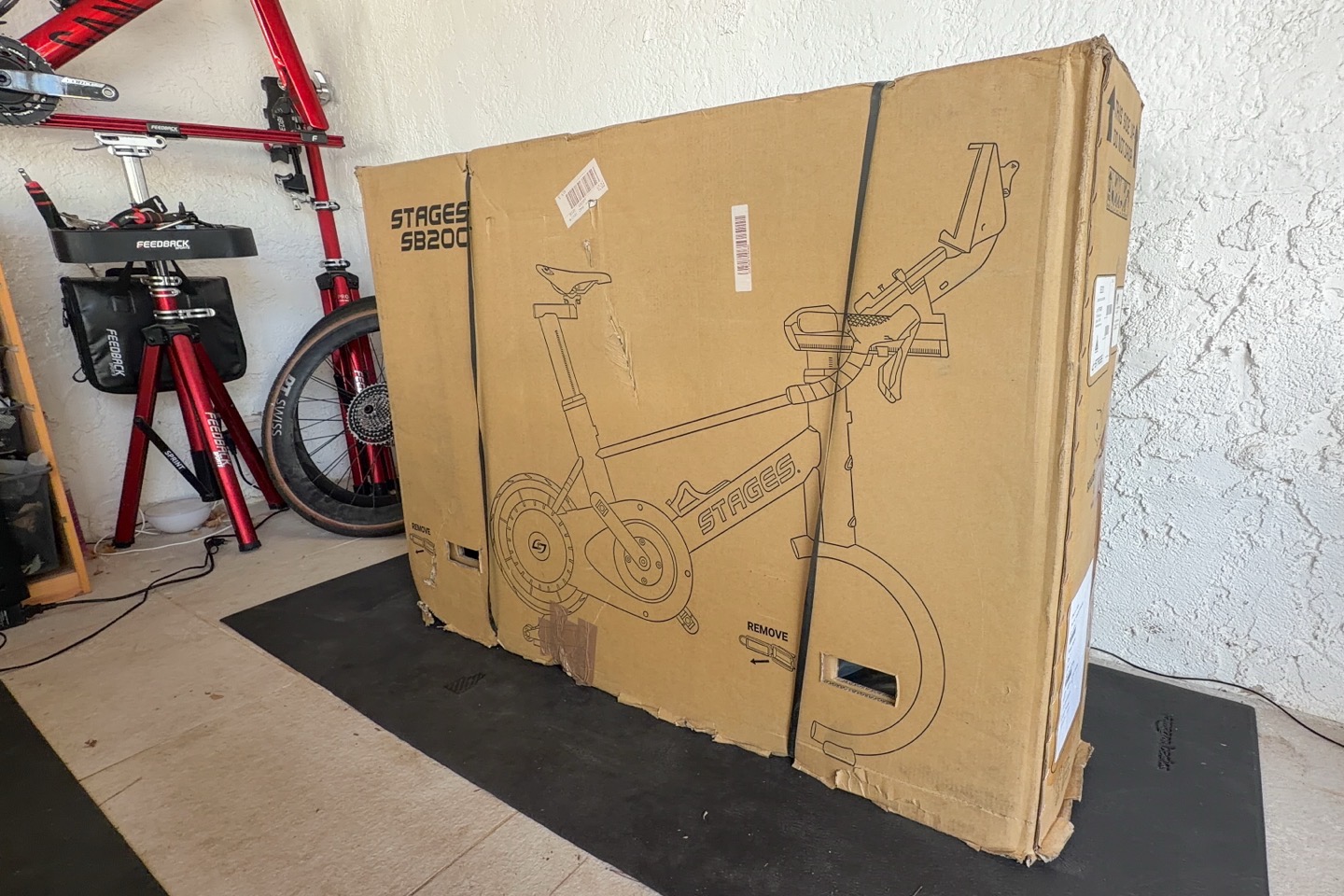
Man, what a difference this bike is. I remember so clearly getting the Stages SB200 bike all unboxed and set up 6 years ago. It was just so…overly everything. An overly built bike, overly packaged for apparently being dropped out of an airplane at cruise altitude, and an overly long, cumbersome process to get set up. Not hard, not difficult, just a general pain in the butt.
This time though? A world of difference.
The total packaged weight dropped from 160lbs/72.5kg to 103lbs/46.7kg. And the bike itself dropped from 126lbs/57kg to 71lbs/32.3kg. And more than that, Stages has clearly followed in the footsteps of Zwift’s consumer-first assembly aspects.
While it always takes me longer to do unboxing and setup compared to a regular person since I’m filming/photographing it, it’s probably balanced out by me having done so many of them. This one though, was just simply fast, even despite the camera work. After removing the cardboard, you’re left with these pieces:
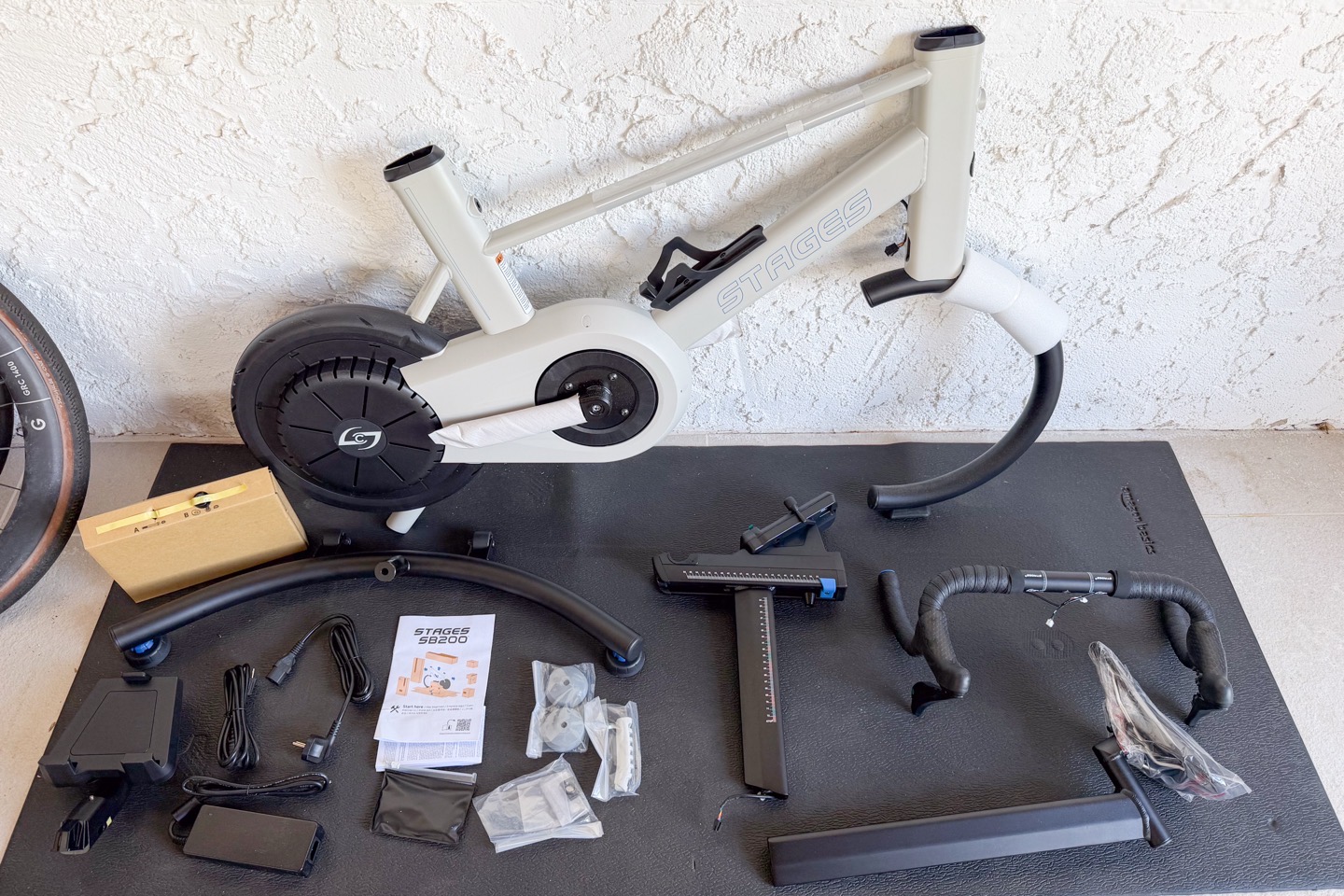
Above you’ve got:
1. Main frame portion
2. Seatpost + saddle
3. Handlebar
4. Front assembly (that holds the handlebar)
5. Rear base
6. Some power cabling stuff
7. Extra set of feet
8. The tools to assemble it all
You’ll start by attaching the base to the frame, which is just two bolts. Quick and easy.
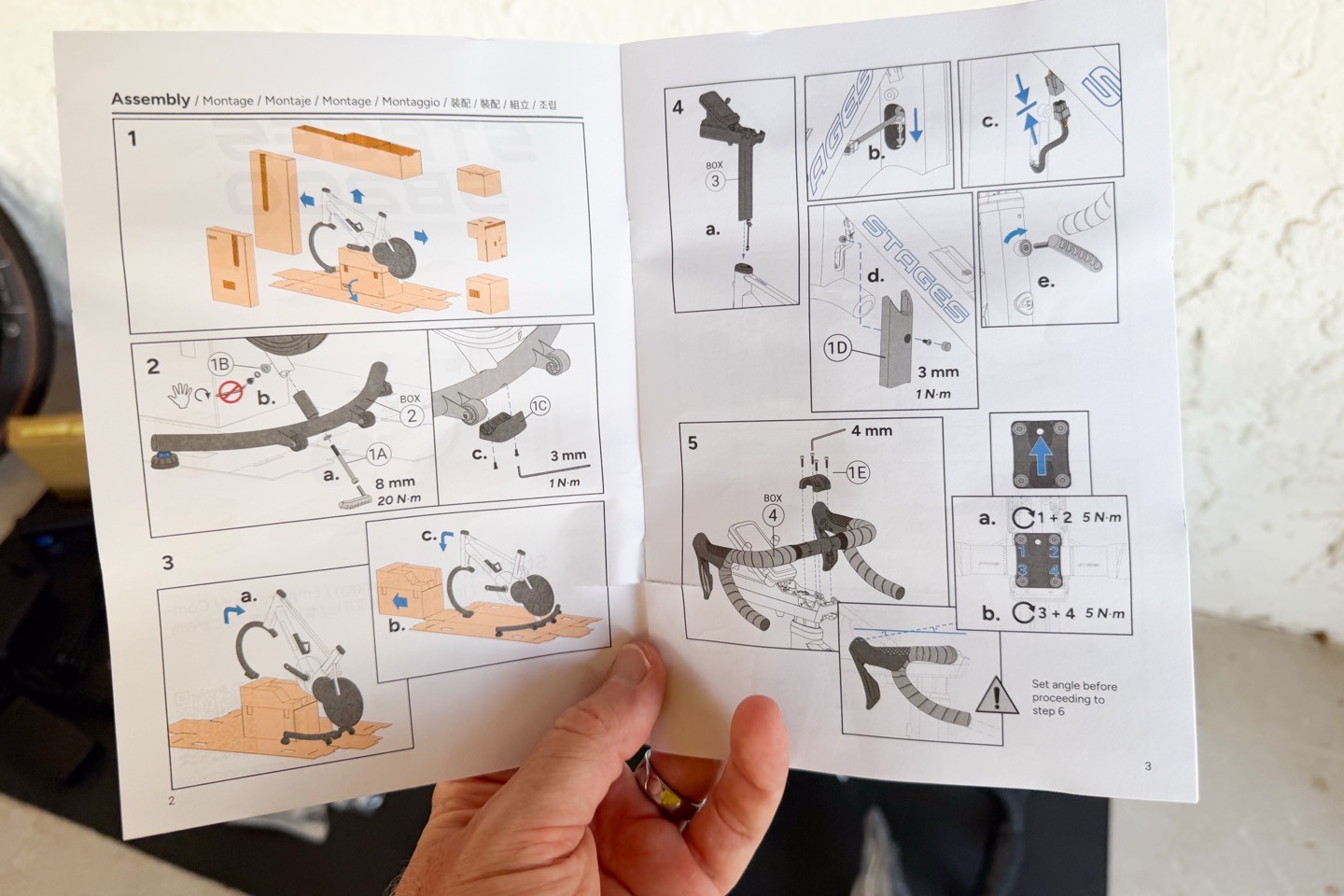
Side note: on this 2nd step, it has you finger-tighten the bolt. However, in the almost-last-step, you’ll crank that bolt down nice and snug with a tool. If, however, you forget this last step, your bike will soon squeak like an adult movie. I mean, just letting you know from a friend.
Next up, you’ll insert the front handlebar holding assembly, and with it, the wires. This is where I want to point out how clean this setup becomes, with all the wiring internal. You can then see the cover I’ll place over it.
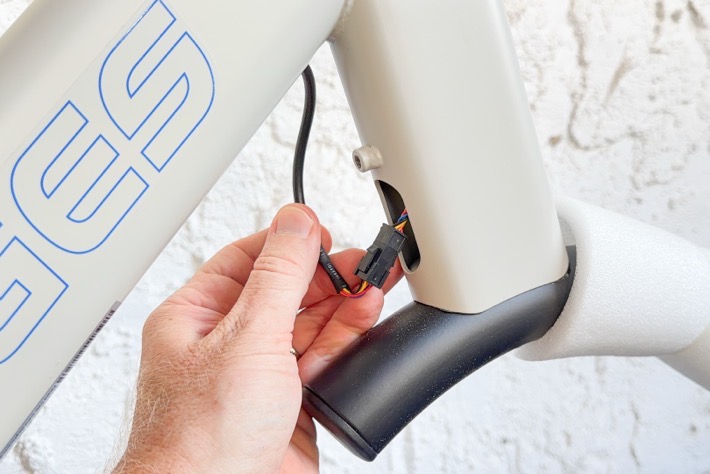
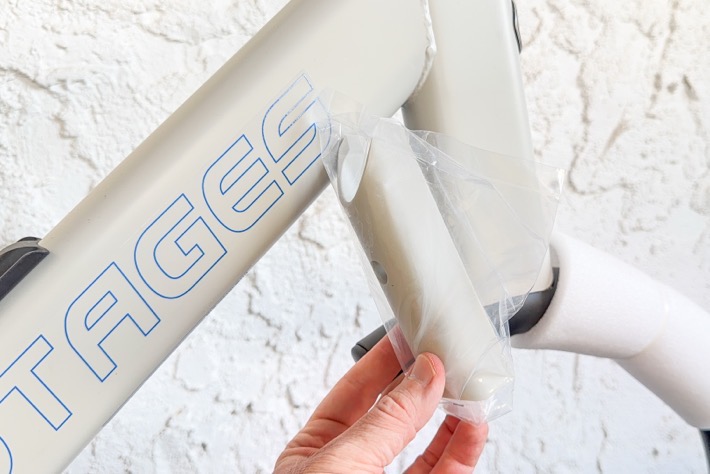
There was just so many little details while I was building it up, that were like “Oh wow, that’s super clever engineering”.
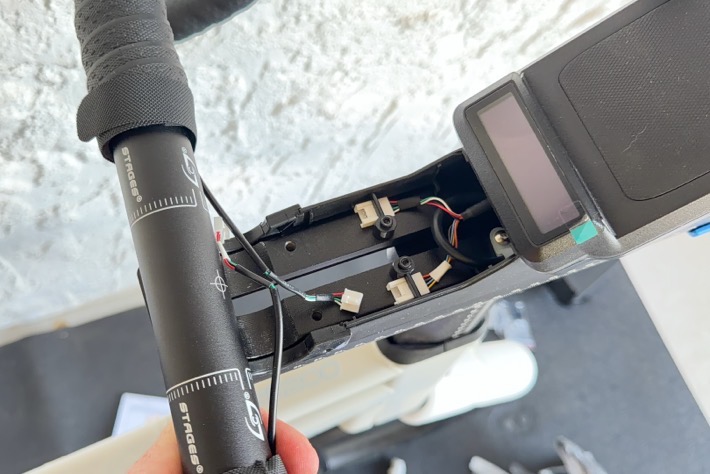
Up top, you’ll do the same thing. You’ll simply connect the two wires together. This is a 4-8 second task. And then the wires are now hidden from view. After that, you’ll install the standard handlebar (which you can swap out), and then snap on/screw-in the cover.
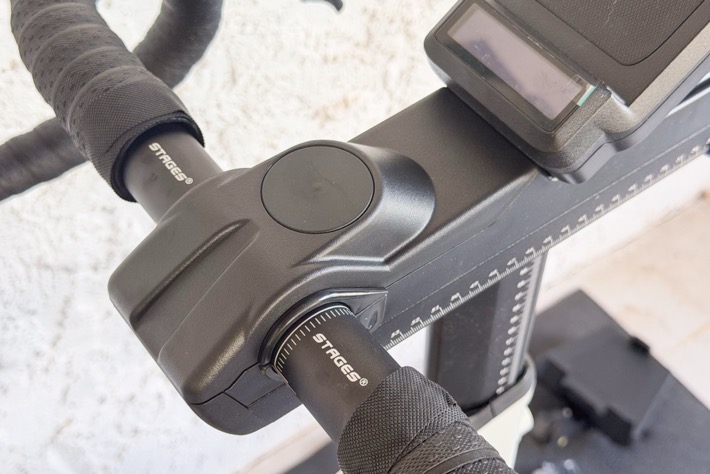
What’s cool here is that hidden under that small circle is a mount for your Garmin or Wahoo unit (or anything else that uses those two mounting types…which is everyone).
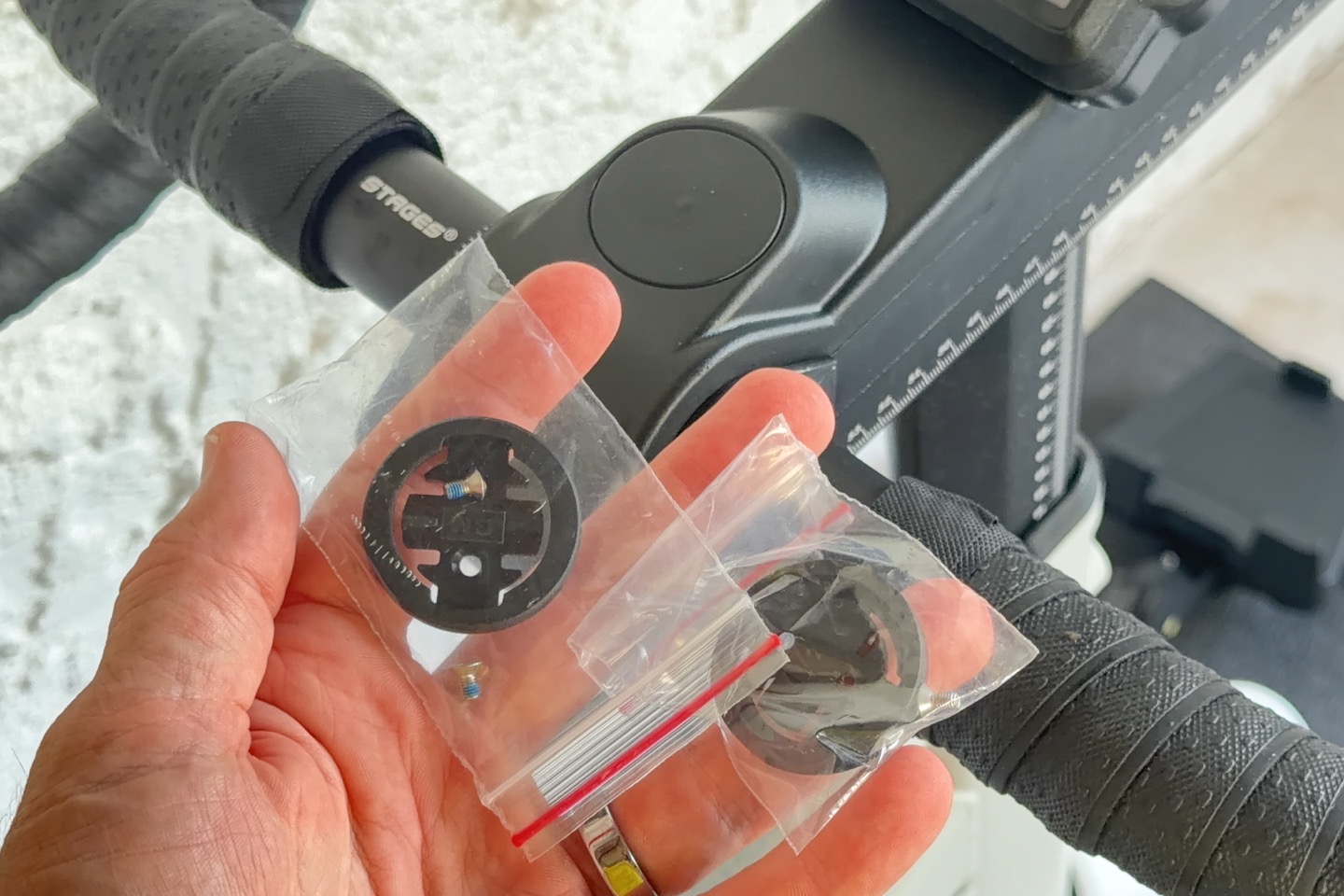
At this point, the last piece to do is simply sticking in your pedals and plugging it in. I’ll cover crank arm adjustability bits in the next section.
Again, my entire assembly video file I had recording the entire time is about 25 minutes, and that includes taking a slate of extra photos as I assembled, taking extra close-up video of parts, repositioning a few cameras/things, etc… I bet someone not doing that could probably assemble it all in 15-18 minutes tops. And all of it was silly easy.
Bike Fit Bits:
Next up, let’s talk about adjustability of the bike. As with all indoor bikes, one of the key reasons you choose an indoor bike over your regular bike + trainer, is for multi-person adjustability. Obviously, not everyone is sharing a bike, but it’s a main driver for many people getting such a bike. Starting off with the main adjustable specs, you’ve got:
Rider Height Range: 147cm to 208cm (4’10” to 6’10”)
HB Stack Range: 53.5cm to 72.8cm (21.1” to 28.7″)
HB Reach Range: 34.1cm to 56cm (13.4” to 22.0”)
Crank Length Adjustability: 165mm/170mm/172.5mm/175mm
Rider Weight Allowance: Up to 136kg/300lbs
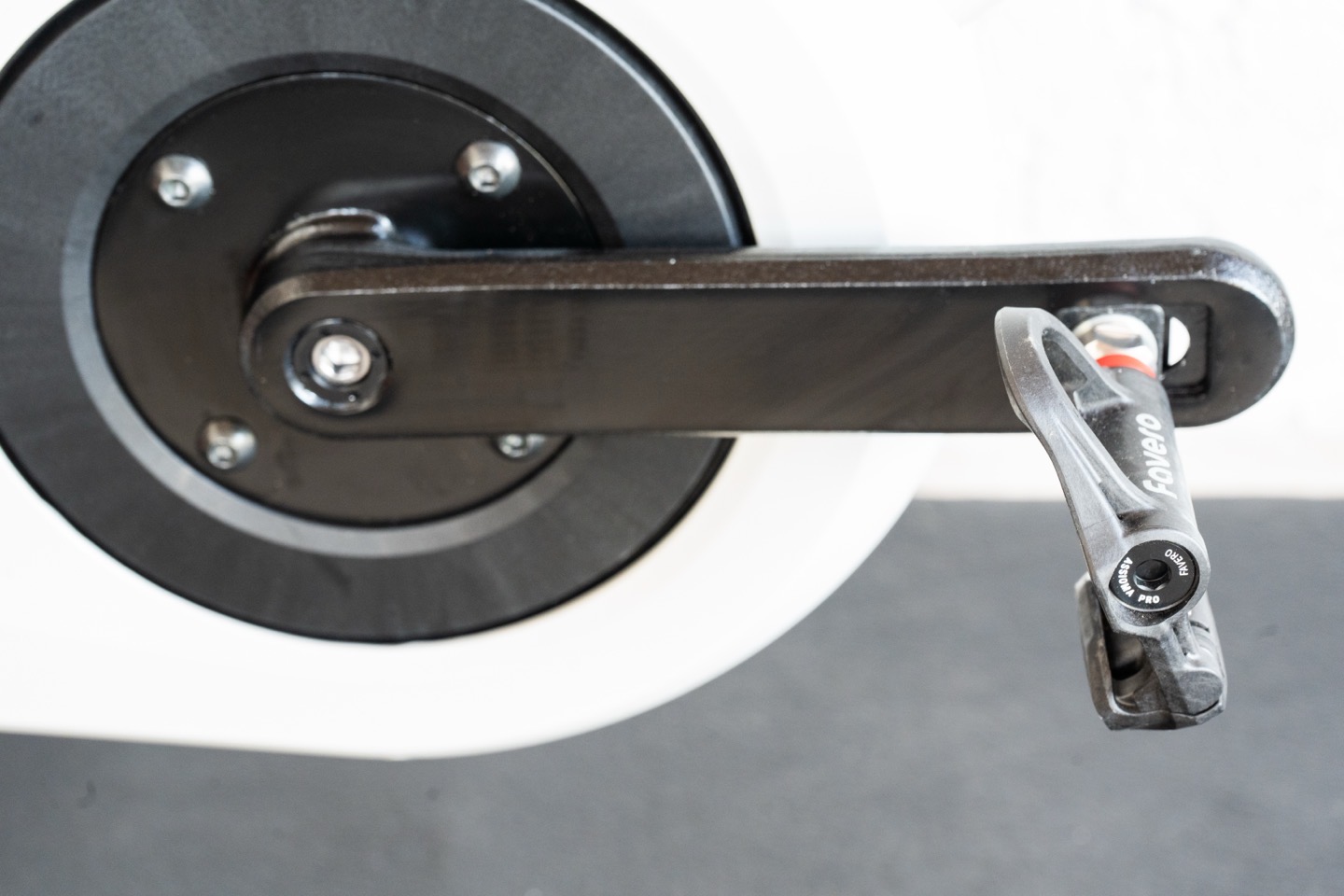
So let’s go through some of these different areas, starting off with the crank length adjustability. This area has been redesigned, specifically to address issues with the previous bearclaw-style crank arms snapping (mainly when they were over-torqued, and then combined with sweat pooling in the other holes and speeding up corrosion). This new system has two small plates that you match together to pick one of the supported crank lengths above:
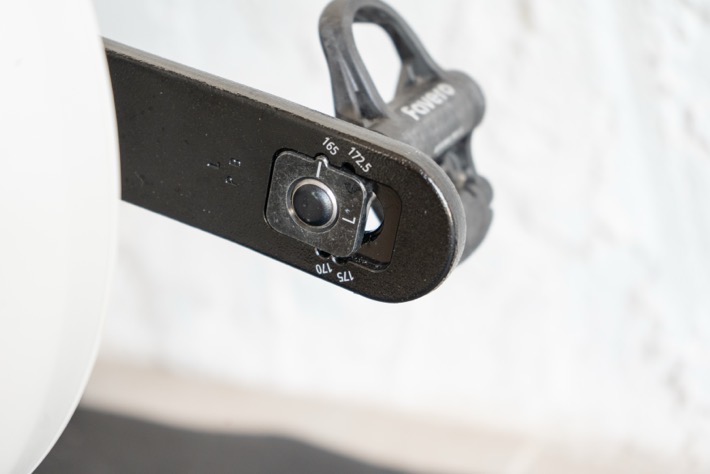
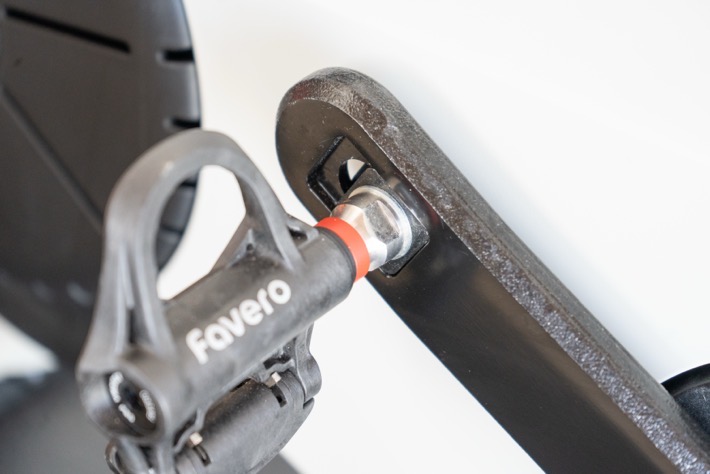
It’s a perfectly functional system, though I still kinda prefer the bear claw design. But that’s more due to personal preferences than anything else (and probably a touch that when I test things, having a single piece of crank arm metal means I can usually get power meters torqued on more properly). But again, from a normal user standpoint, this is perfectly functional.
Next, there’s the front-end adjustability. There are two core pieces here. First is the up/down piece of the front handlebars, and then the second is the forward/back piece of those same handlebars.
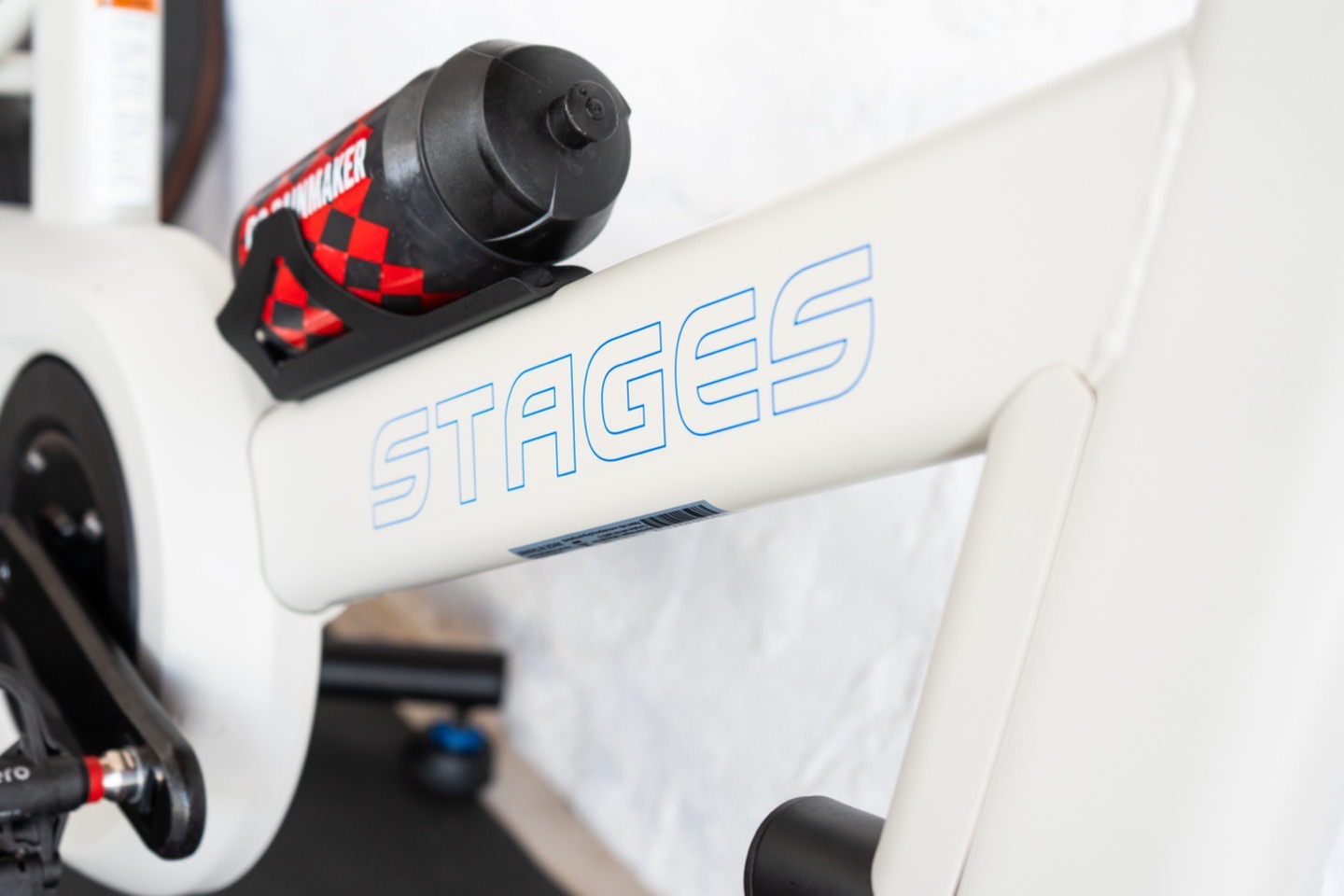
To adjust the up/down pieces, there’s a bolt down on the fork near the Stages logo; simply rotate that, and up/down you go:
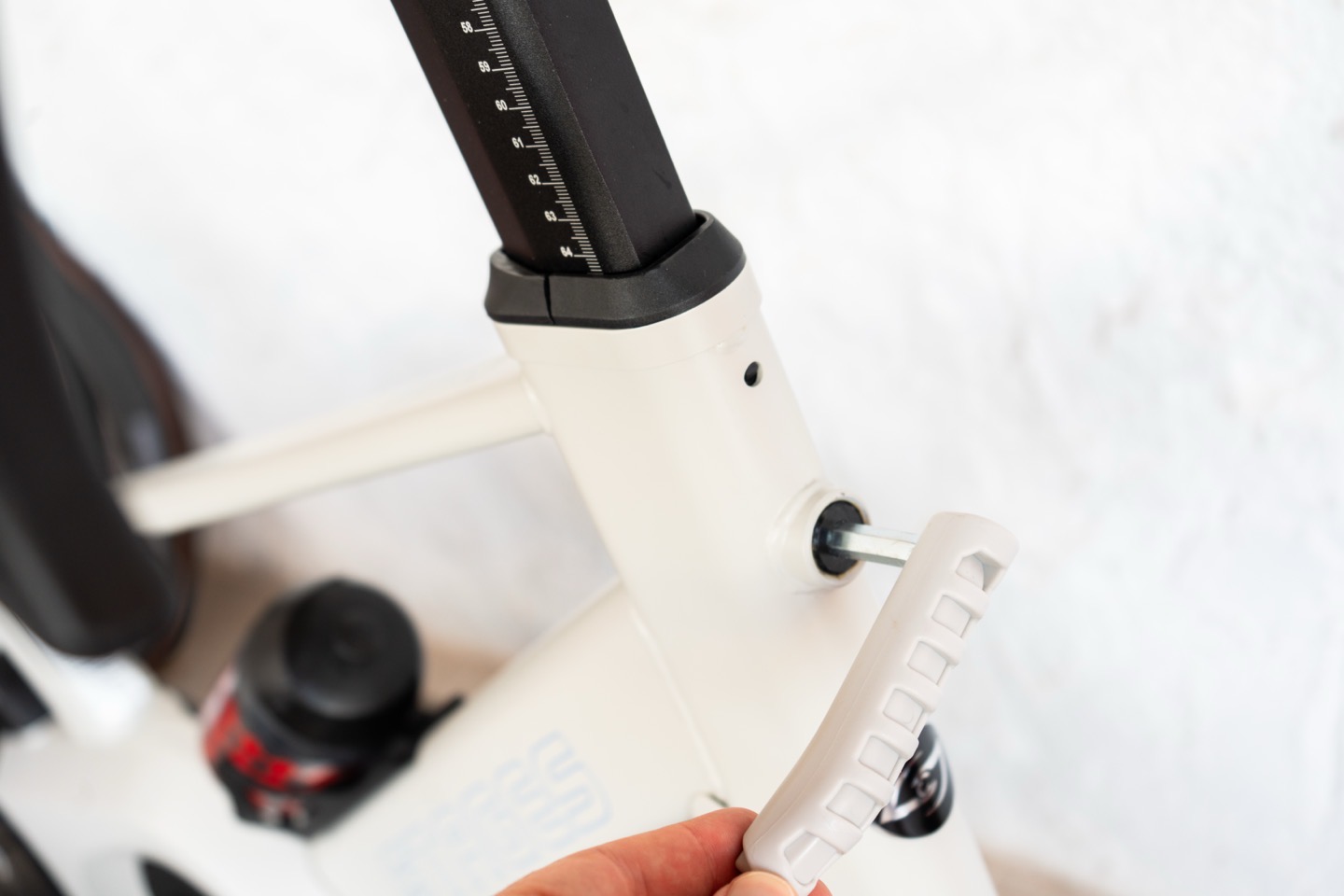
Note that you’ve got this nifty wrench that’s just hanging out in the back seat-stay area, always ready:
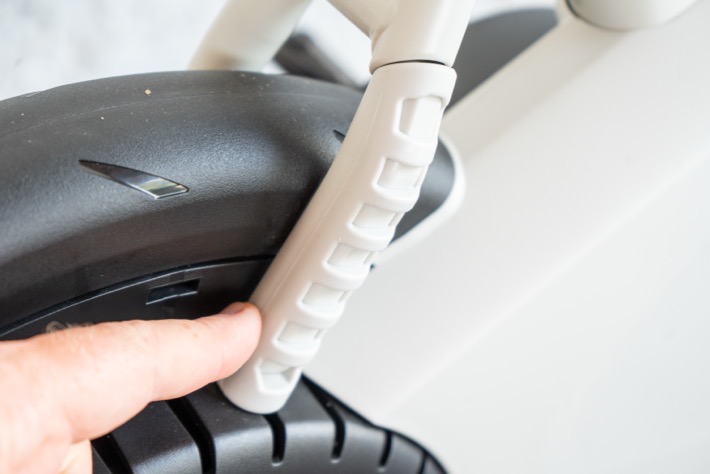
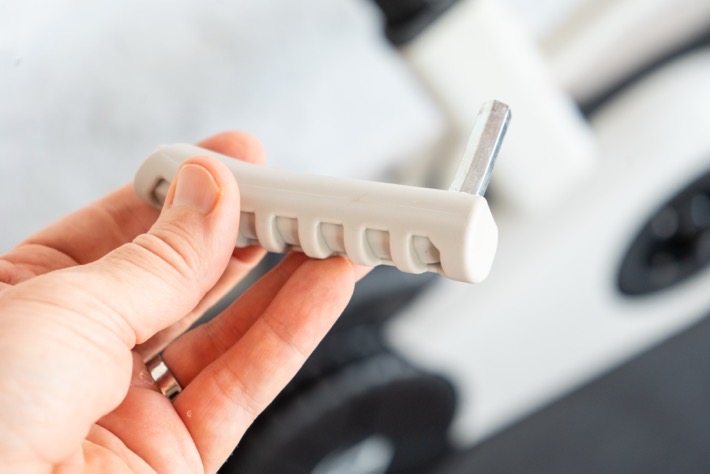
Next, there’s the forward/back piece of the entire handlebar assembly (including the phone and/or tablet holder you have there). You’ll adjust the bolt under the front portion of the assembly to tweak this:
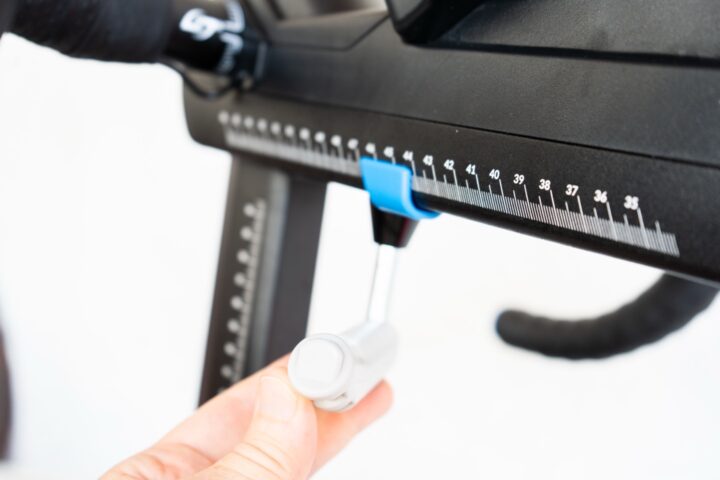
And then off you go to wherever you want. Super simple.
While having a hand-clamp like you’d find on the Wahoo KICKR Bike SHIFT/PRO might seem appealing at first glance, the reality is it’s not long-term. The KICKR Bike has long suffered from seatposts that slide, and the front-end adjustably can also be finicky. So as much as I prefer a tool-less design, having a tool that simply has a home in the frame means it takes mere seconds, and the seatpost/front-end/etc. just doesn’t move. Thus, ultimately, it’s a better solution.
In any case, for both myself (6’2/188cm) and my wife (5’2/158cm), we had no problems moving back and forth between us. Once you write down those preferred measurements, then it’s easy to do.
I will say that one gap here is a lack of a simple fit sizing chart, which Zwift provides as a starting point for getting the right sizing. I had attempted to measure my wife’s bike and align it all up, but sometimes getting those things to match can be tricky at best. Same goes for trying to match bike-fit coordinates (especially if those fit coordinates are more for a triathlon bike than a road bike).
Again, there’s obvious benefit to getting a proper bike fit, but the simple reality is that most people aren’t doing that for their indoor bike (or perhaps at all). And thus having a company give a rough estimate of a starting point is really handy.
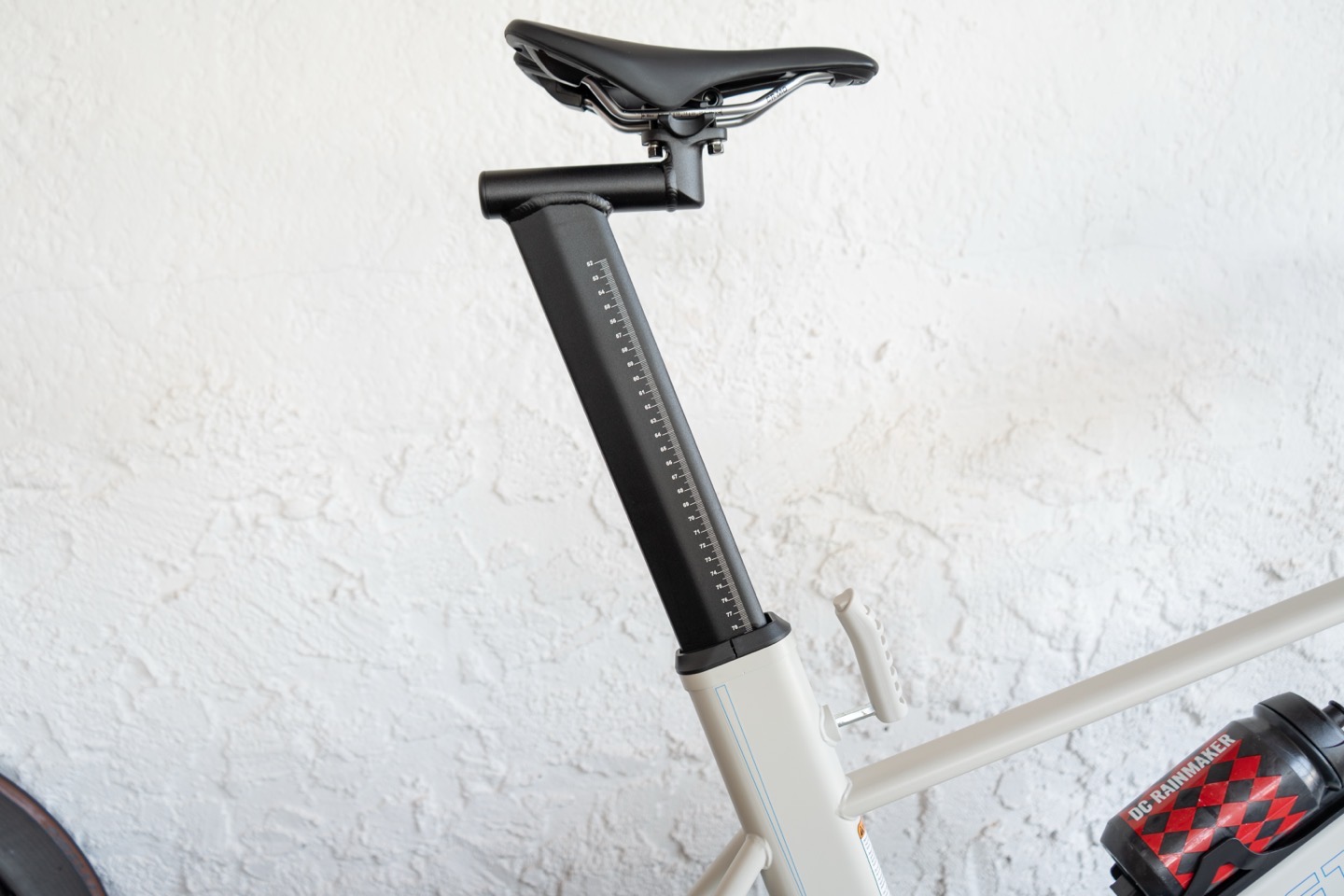
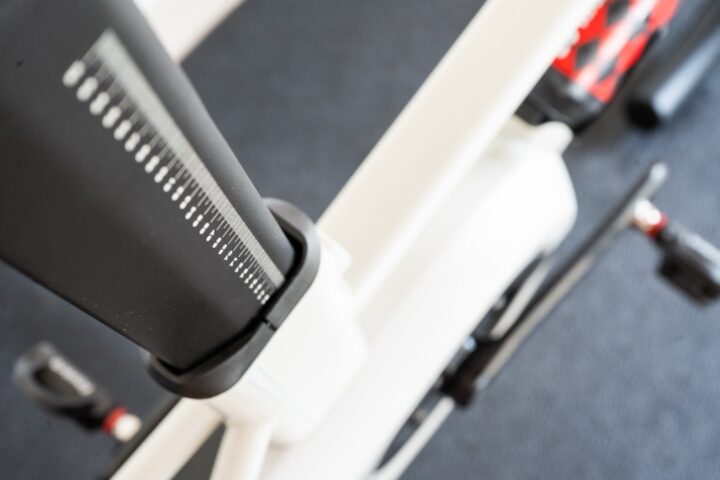
In any case, finally, there’s adjustability of the saddle itself. While this follows the industry-standard bike seat/saddle rails, it doesn’t follow a normal seat post adjusting system (which uses hex wrenches). Instead, it uses these bolts, which suck for adjusting. I’m just gonna say that straight up, they’re annoying to rotate without hitting the rest of the assembly.
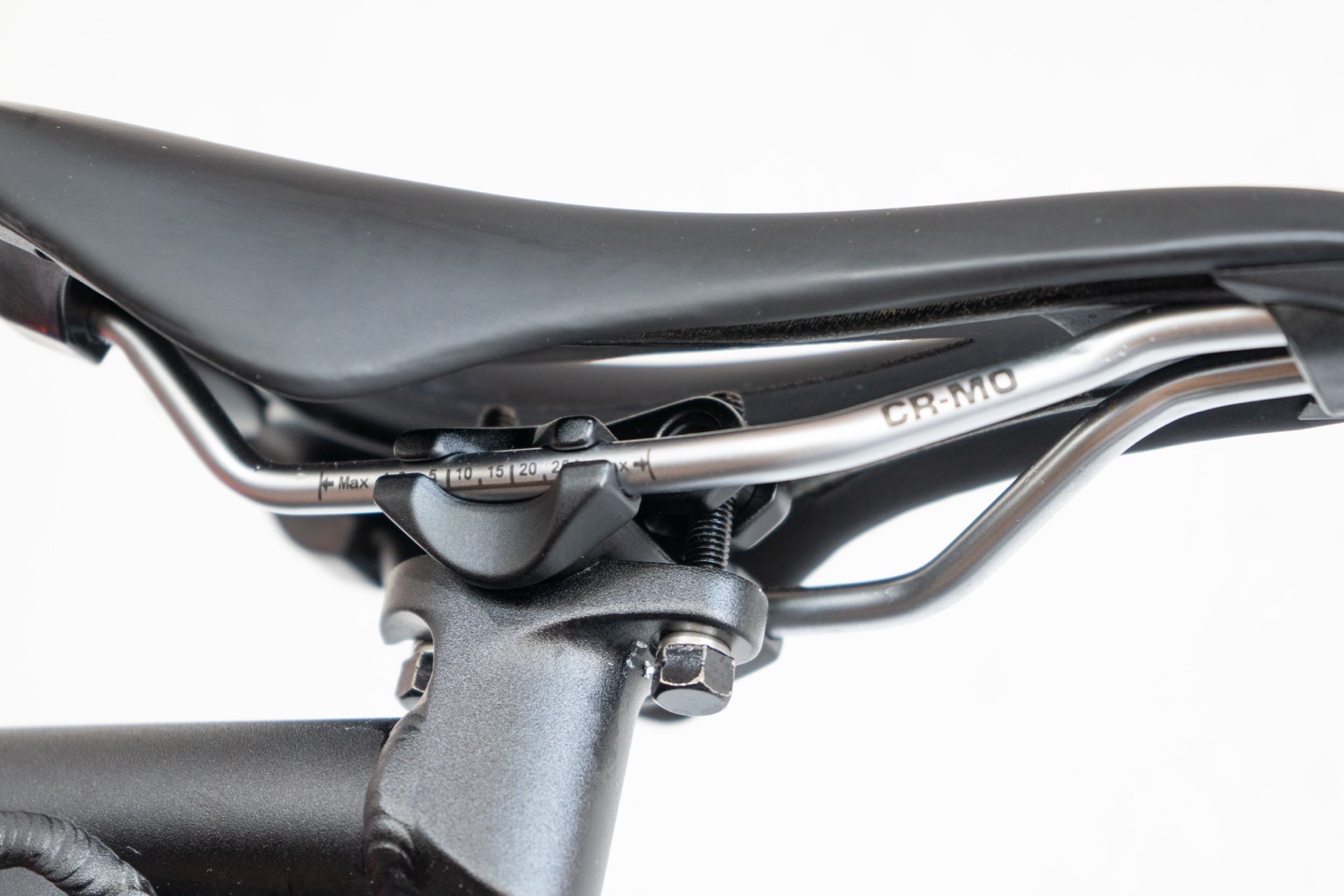
Setting that aside, the other gap here is adjustability of the seatpost fore-aft. By default, you can’t do that. That’s somewhat ironic because Zwift literally just came out with the Zwift Ride V2 addressing this complaint. Of course, Stages has a *TON* of experience in gyms with seatpost adjustability, and their previous SB20 had seatpost fore-aft adjustability.
As a stopgap, you can go ahead and purchase an accessory seatpost that does allow for fore-aft adjustability. But that’s an extra cost. In any case, neither my wife nor I felt it was a deal-breaker, but equally, I do feel like so many other bikes include it by default, and I was kinda surprised this didn’t.
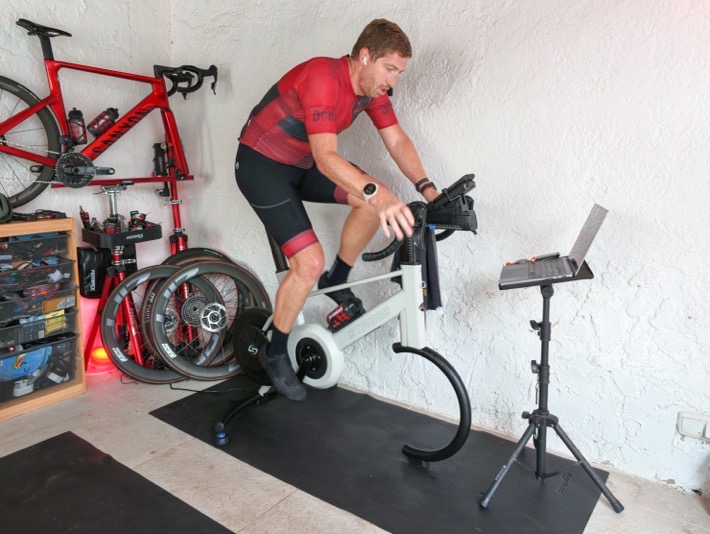
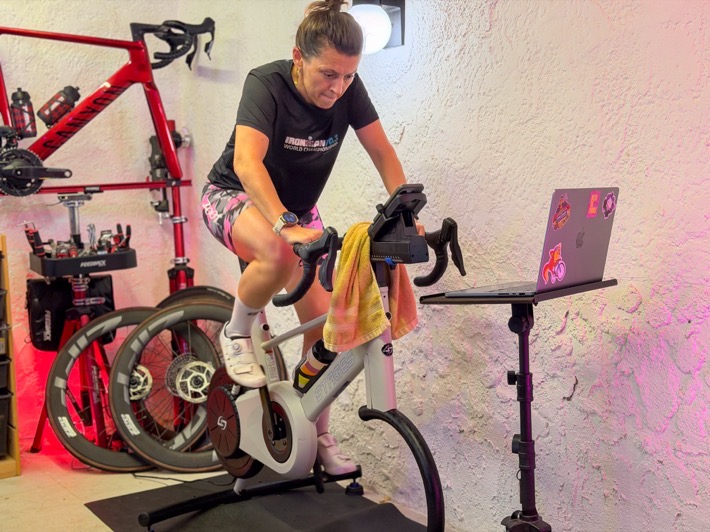
Nonetheless, we had no issues quickly moving it between our different positions. Neither of us has perfected the bike fit numbers yet on this specific frame, probably because both of us can pretty easily ride on any frame roughly in our range without an issue (at least for ride durations up to a few hours at a time).
Daily Usage:
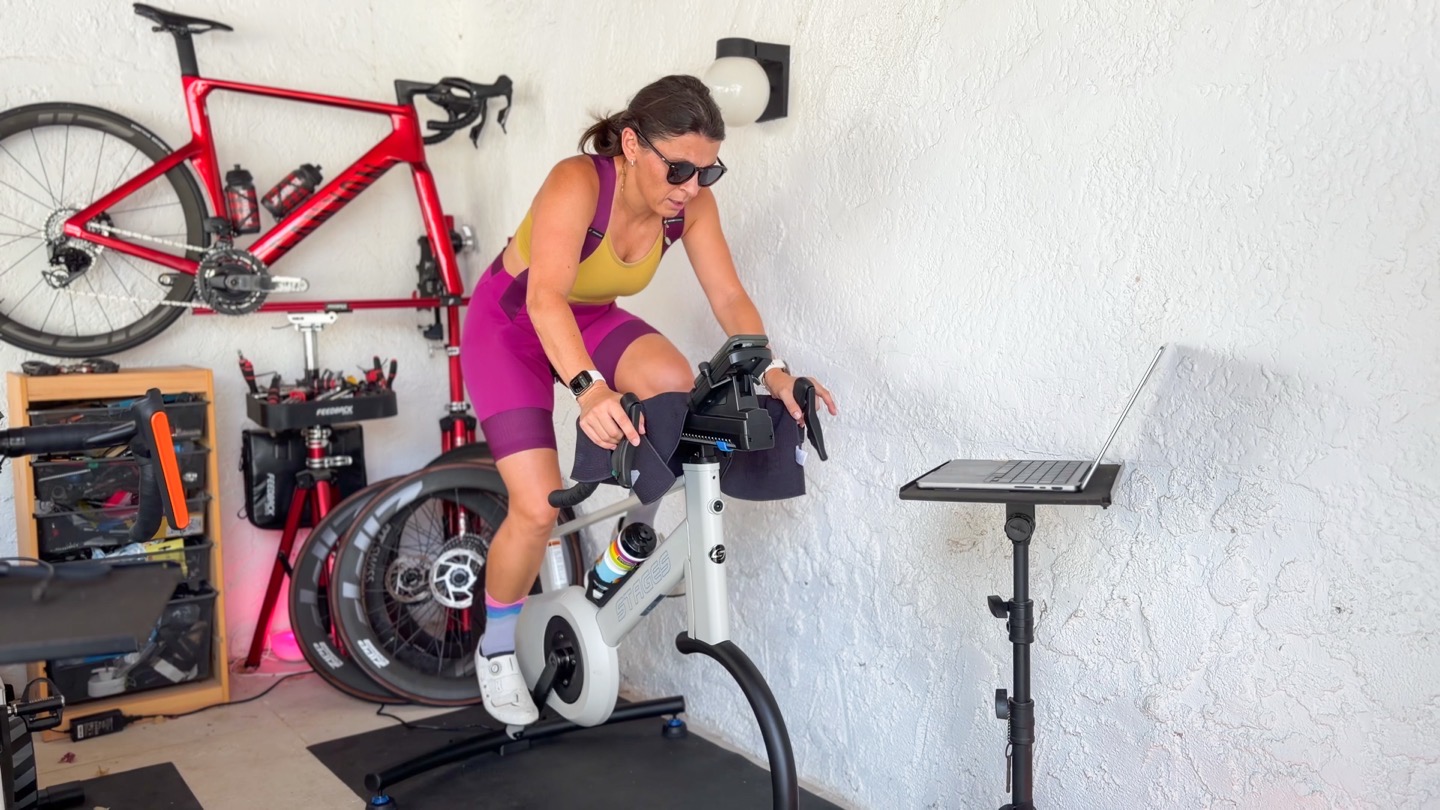
(Yes, sunglasses are sometimes needed here, as this is technically outside, just under a cover)
In this section I want to dive into some of the day-to-day usage bits, including aspects around the handlebars/shifting/etc. First though, I’ll start with the ride feel.
The new SB200 now includes a two-stage belt drive system (compared to one stage previously). Stages says this new system gives them 5x the inertia of the previous SB20. While I don’t have an SB20 handy anymore, I can say the inertial feeling here is very very very smooth. It accelerates well, and I’m quite happy with that. For fun, here’s what it looks like inside:
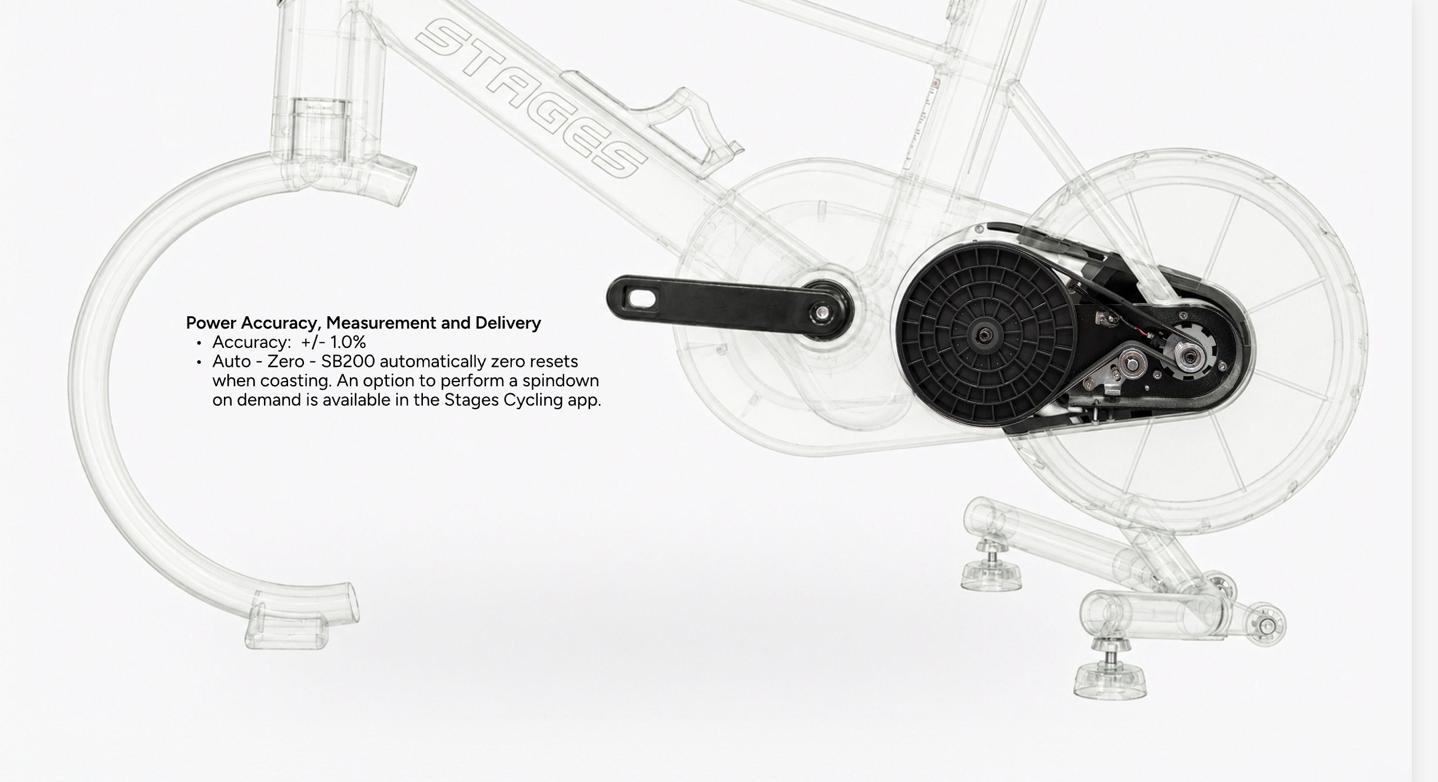
I’ve actually got to take it apart later today (more details on that in the accuracy section), so I’ll take some of my own shots and update here.
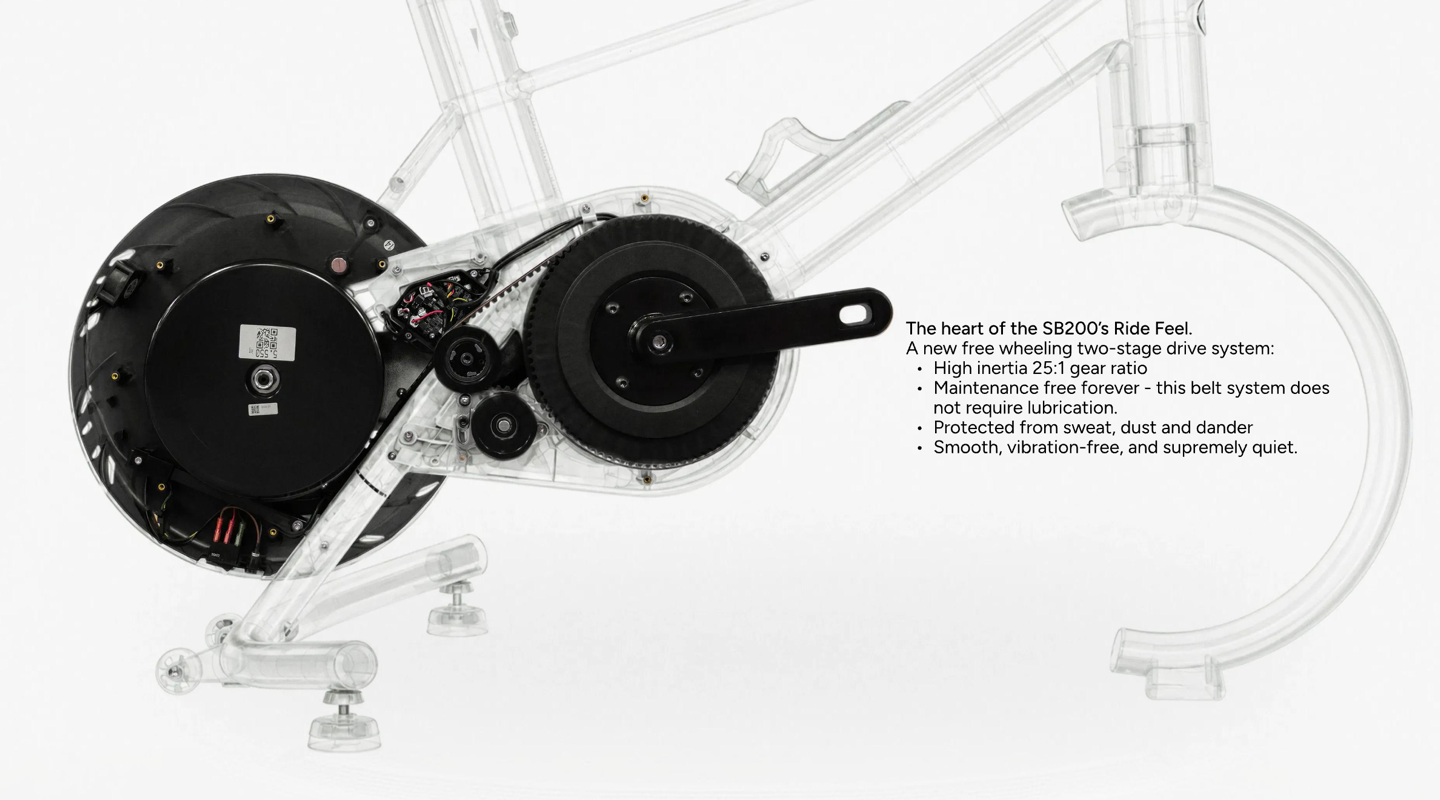
The only downside, though, to the SB200 system is the freehub sound when coasting. While certain outdoor bikes (within the freehub) have that high-pitched clicking sound when you coast down a hill, most indoor bikes don’t. Mainly because nobody actually wants to hear that inside. Yet, the SB200 does, and it’s rather loud when coasting. You can hear this in the video at the start of the post.
This isn’t a deal breaker by any means, but equally, I just kinda wish it wasn’t there. Apparently, you can mitigate this a bit by packing some more grease into the freehub, which reduces the sound notably; though it’s not something I’ve attempted yet. To be honest, this is really the only hardware-specific complaint I have about the SB200.
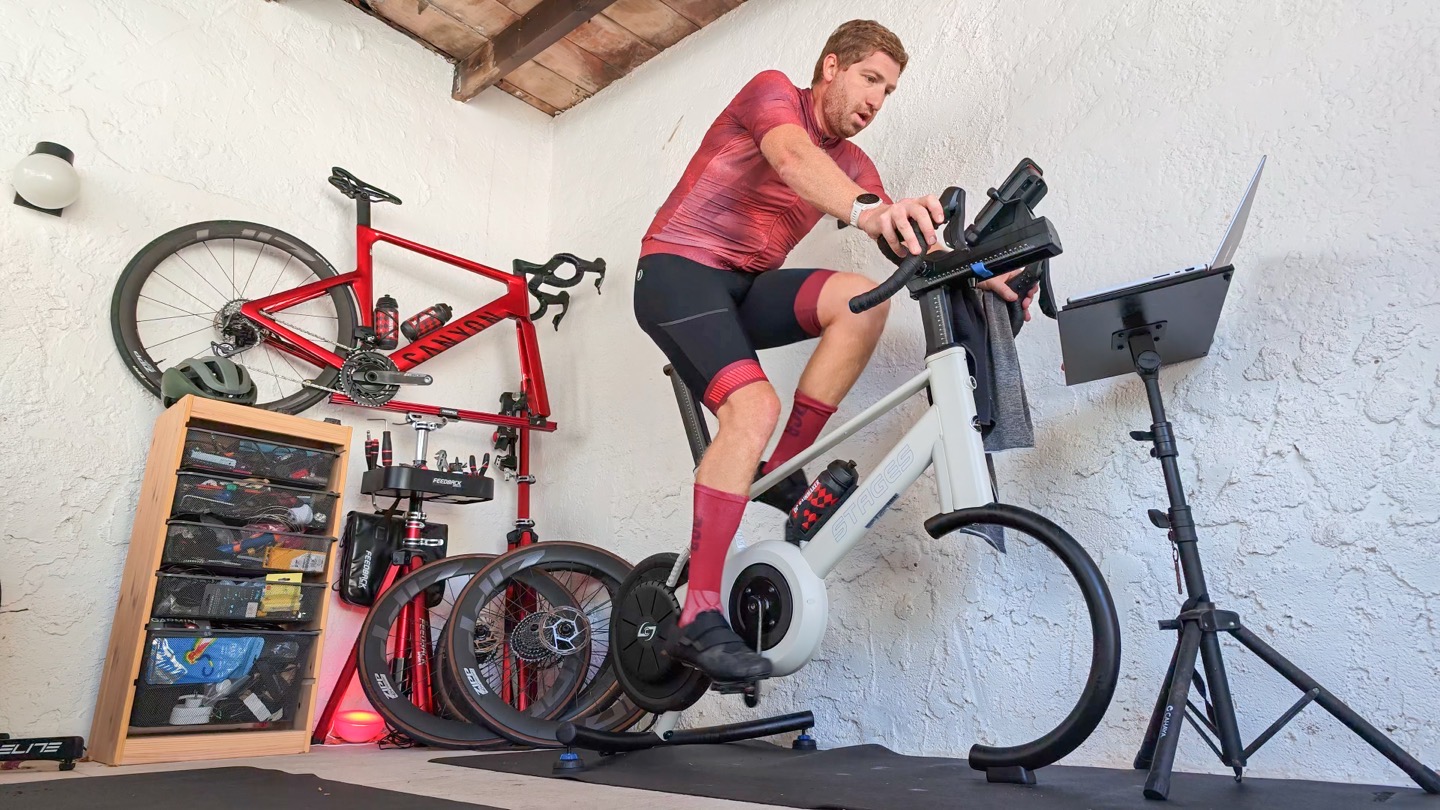
Otherwise, it’s very quiet, like most indoor bikes these days – essentially quieter than the fan you might have running.
So then, since I already covered adjustability in the previous section, let’s talk about the handlebars here. The new handlebars include proper shifters (the SB20 had lame buttons), as well as braking (which the SB20 did have). But the star of the show is arguably the small display here. I know some people don’t care about displays (and most manufacturers dislike them due to added cost and complexity), but it’s just such a simple practical thing:
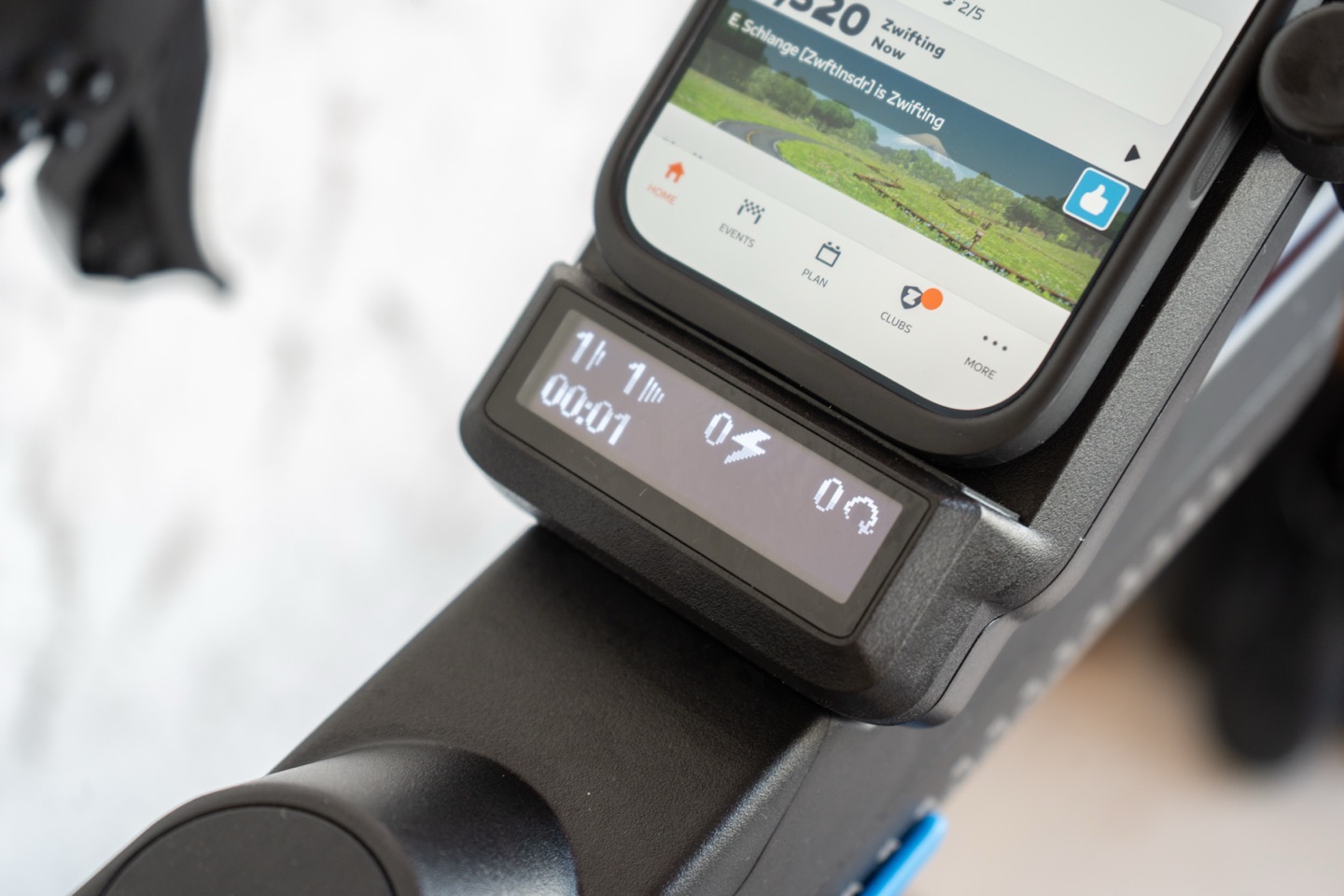
This is less so about seeing your power in real time (since whatever app you have likely already does that), but actually useful for selecting your gear configuration. That’s because the SB200 supports up to 5 custom profiles, with different gearing arrangements for each one. That could be two for me and three for my wife. Or it could be five different bikes for me (e.g., road 2x SRAM configuration, gravel/MTB Shimano 1x configuration, etc.). The world is your oyster here, and you can create these in the Stages App. You can see these profiles named on the left page here (along with the ‘Shift Beeps’ setting when you reach the end of range), as well as the options to the right.
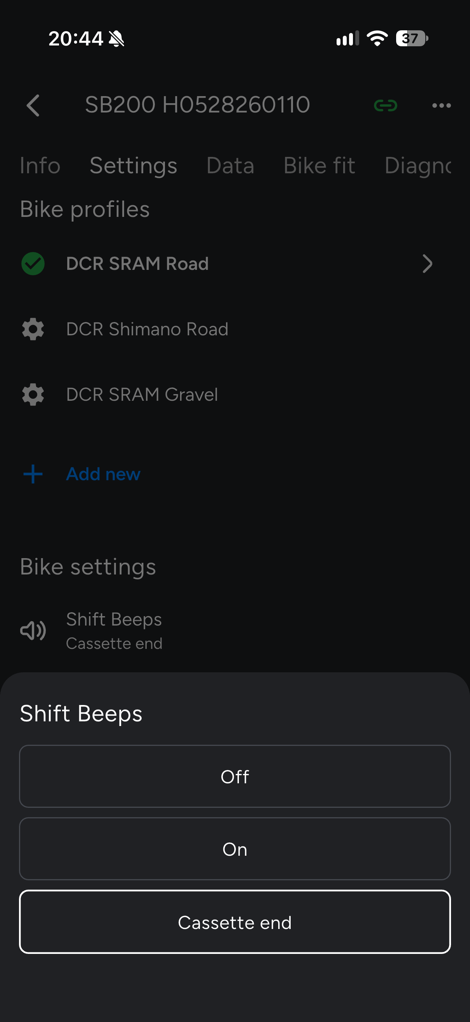
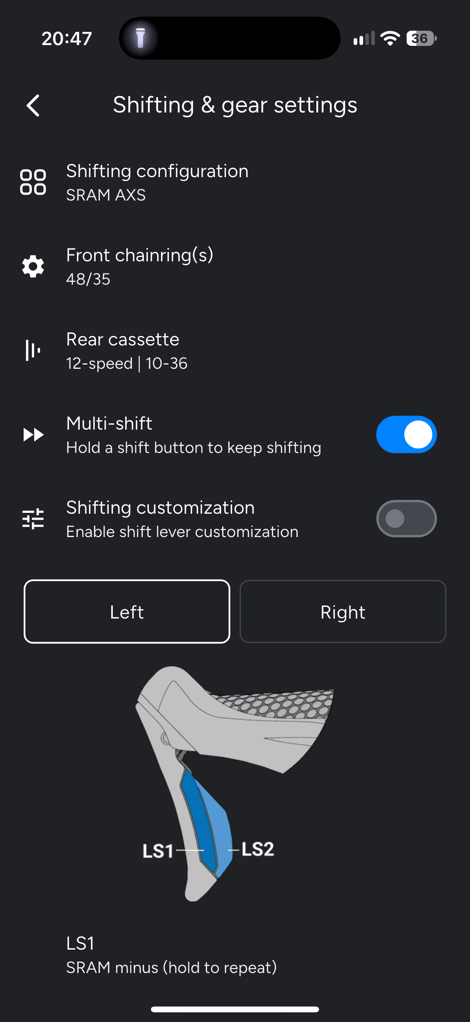
Then when you power on the bike, it asks which profile to use, and you simply use the buttons to iterate through them. Brilliantly simple, yet super useful – especially for more than one person sharing a bike.
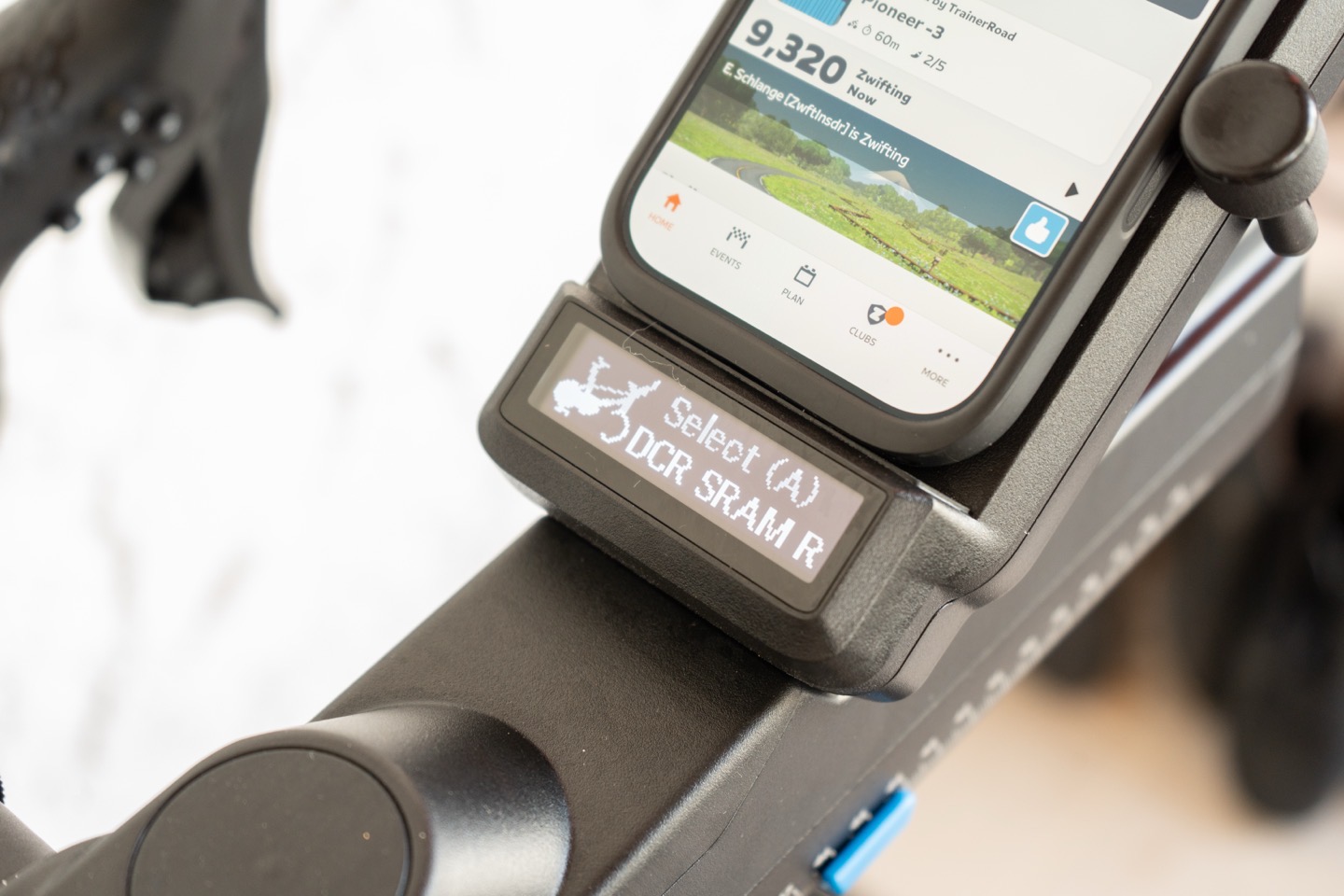
Otherwise, while riding, it shows your stats. Though I do wish there was more customization here for the data pages/fields. There are a handful to choose from, but I kinda want them to channel their inner Stages Dash bike computer data field geekery. After all, why hold back? It’s just a software list of data fields. Go wild.
In any case, above that is the phone holder, which both my wife and I have really appreciated. Again, simple things, like a simple place to stick your phone (she often reads on her longer trainer workouts). Or the Zwift/etc. Companion app. Love it.
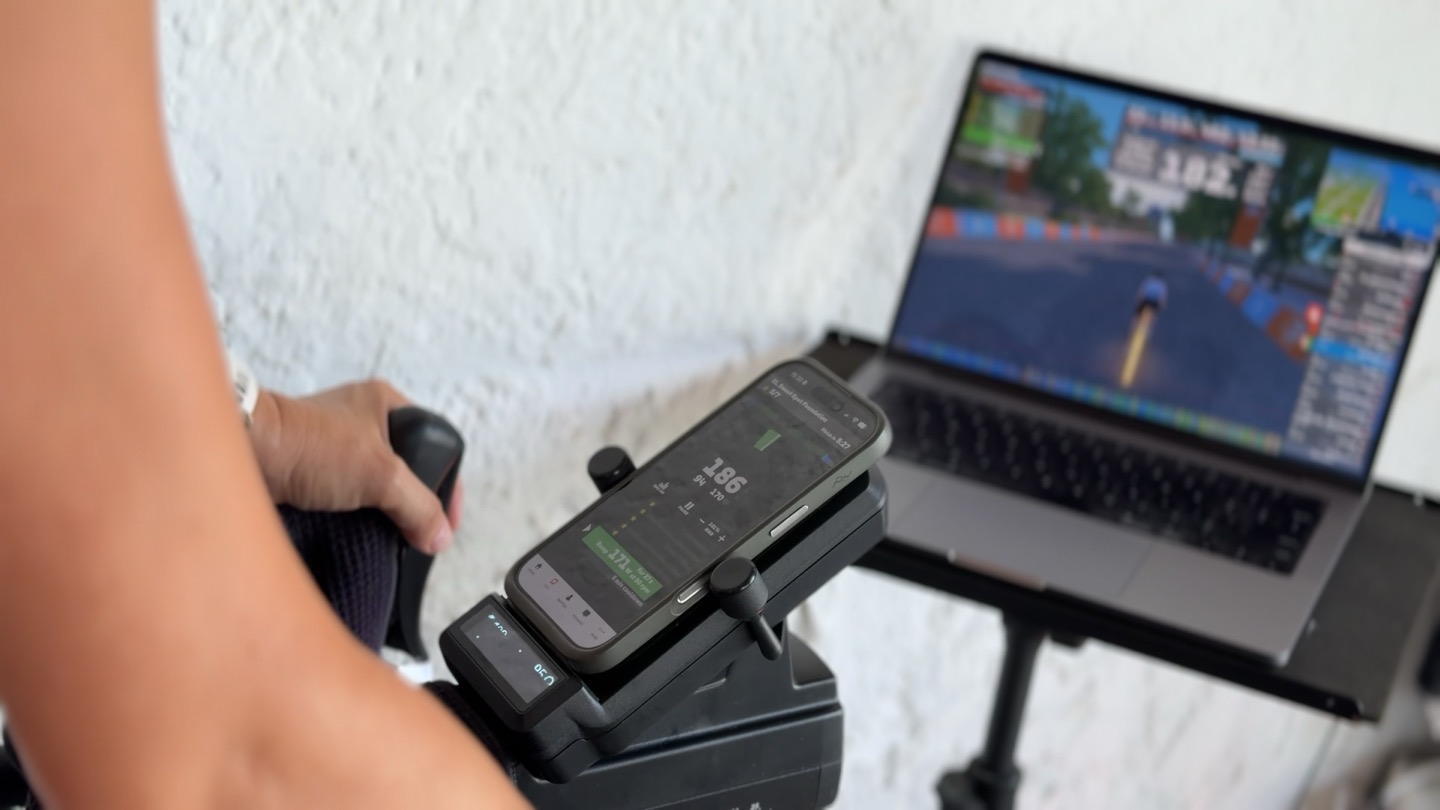
The two posts to the left/right are spring-loaded arms that keep it in place, either vertical or horizontal. The only minor nitpicking I have with it is that when I place my phone horizontally (landscape mode), it’s got a smidge too much force and actually pushes the phone buttons. You can find some slightly off-center placement that manages not to do it, but…it’s not quite perfect.
Of course, the box also includes a full tablet holder. I didn’t use it, simply because my wife and I were mostly using my laptop on my cheap projector stand:
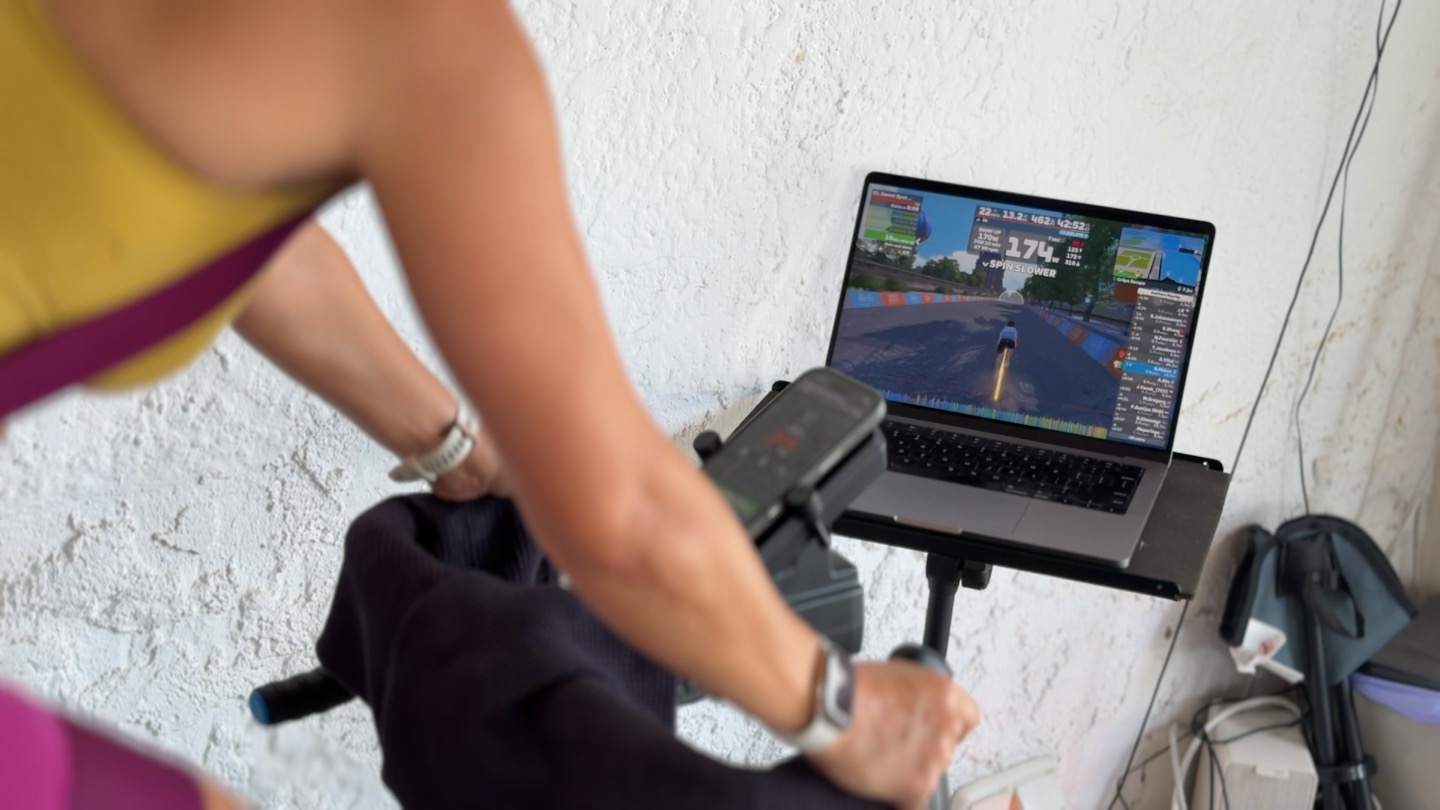
I’m not sure how exactly it came to be that I went from like 5-7 trainer desks to zero trainer desks and a $28 projector stand. But here I am. Ultimately, I suppose space was the main thing for me with my current setup for us.
Oh, and below that phone holder are two USB-C ports:
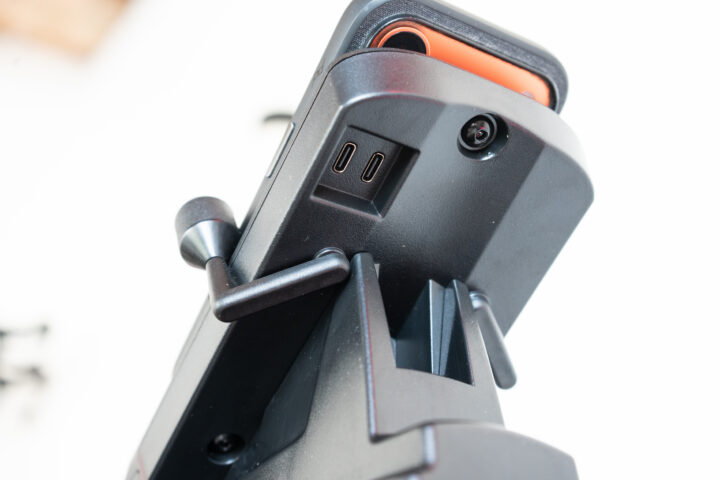
Next up, the handlebars: I’m totally good with the stock grip tape here, and of course, being 31.8mm standard, you can swap things out if you want.
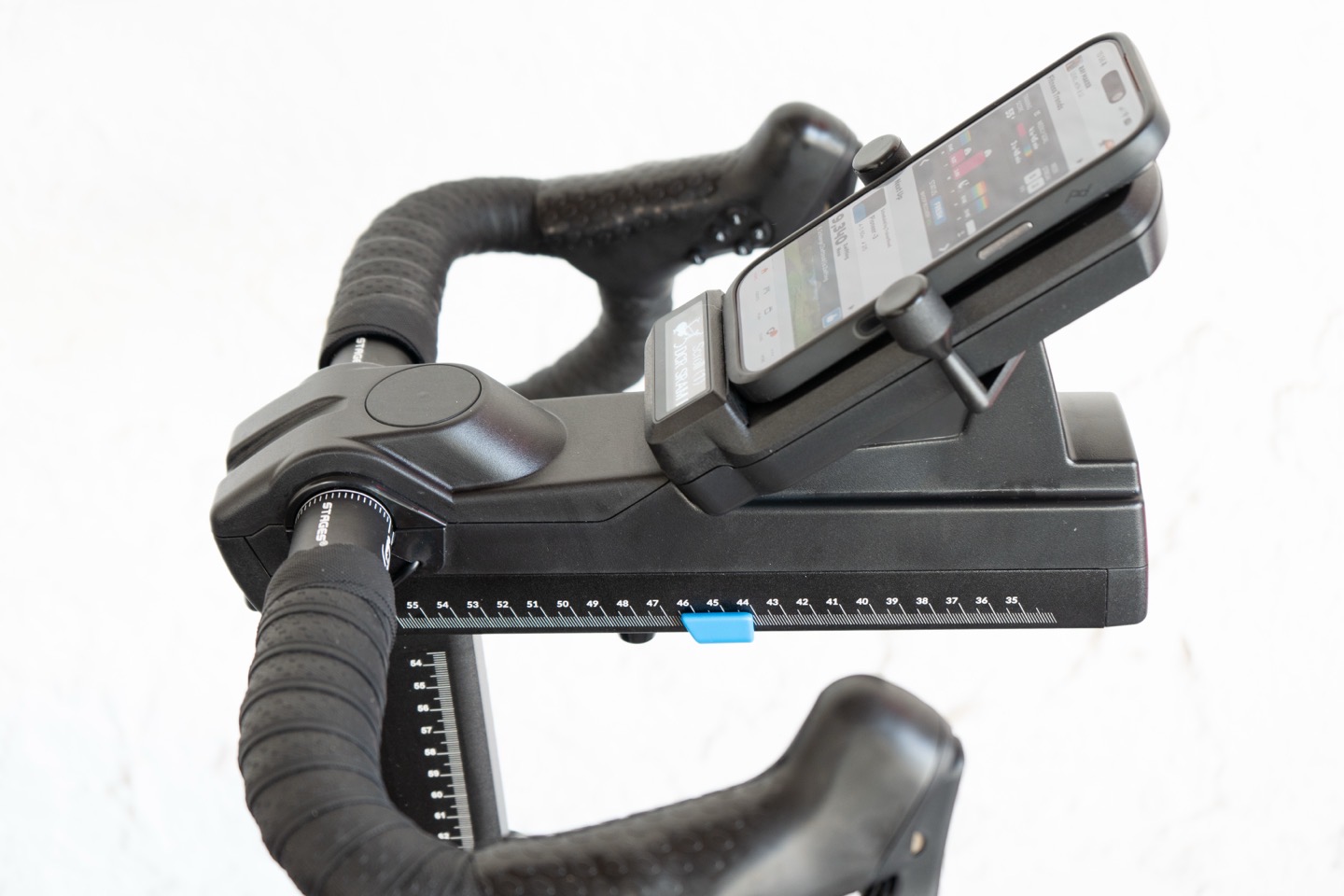
Meanwhile, the biggest change aside from the LCD is, of course, the full shifters, which feel just like real-world bike shifters. They click nicely, though there’s no drivetrain pulse/vibration like you get on some bikes (such as the KICKR Bike) confirming a shift. But given the tiny display there, it’s not a big deal.
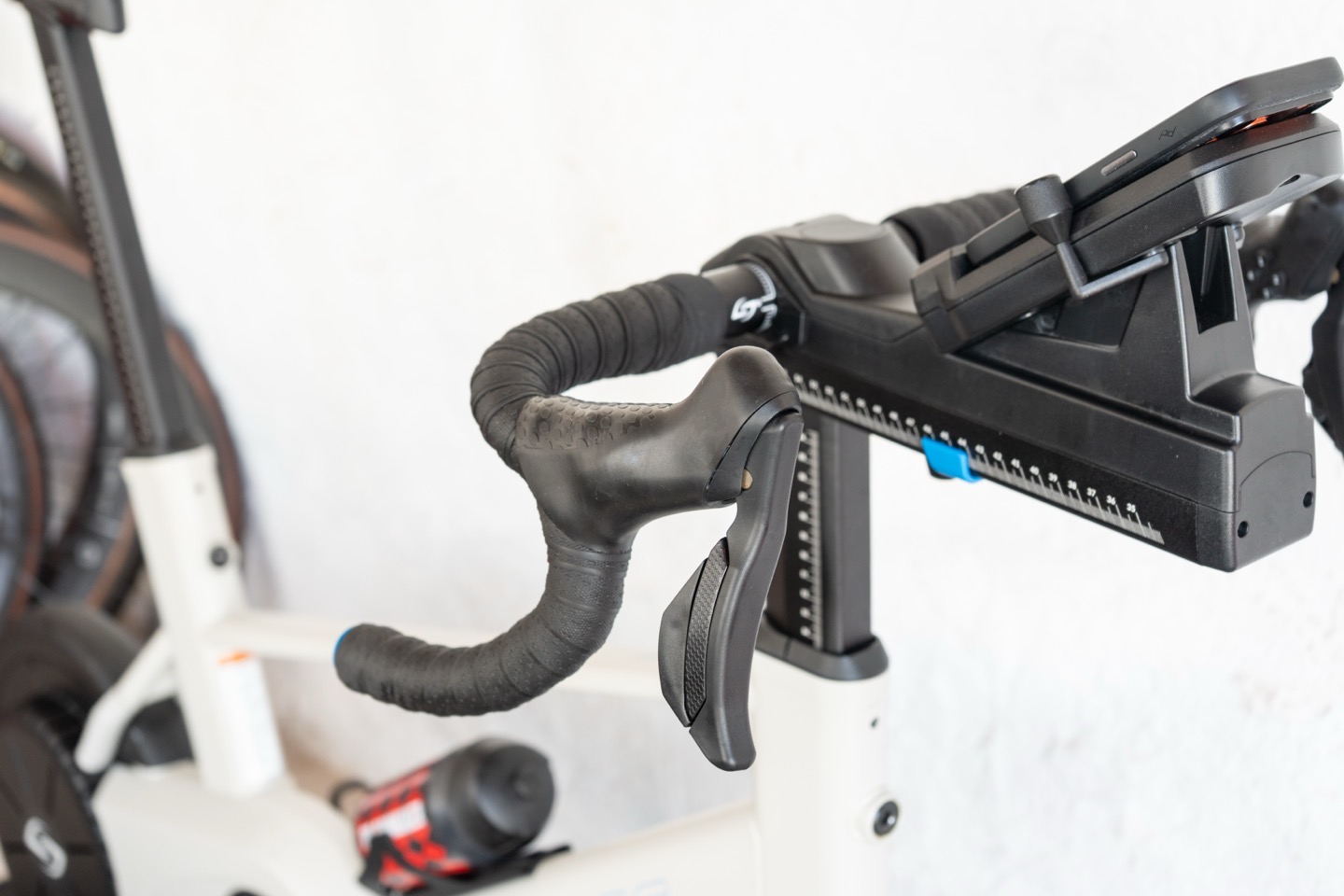
There are also brakes, which will do exactly what the name brakes implies. This is mainly handy for quieting the bike when it’s coasting if you stop pedaling (obviously doing this mid-Zwift ride, though, will stop your avatar…so…beware).
Meanwhile, on the side of the handlebars are the customizable buttons. Five per side, and they are designed to roughly mimic those of the Zwift buttons – and they match directly up to that.
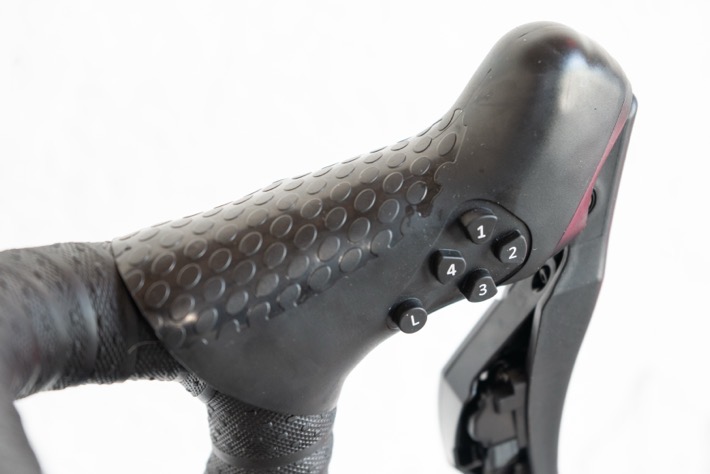
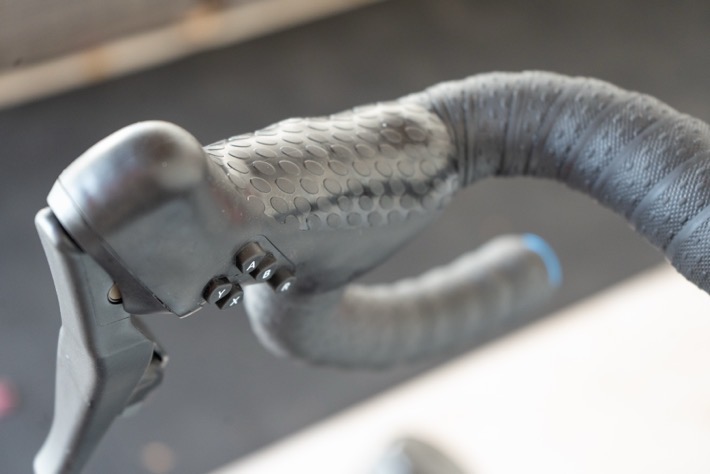
You can customize these within the Stages app, and on a per-app basis (e.g., Zwift, Rouvy, etc.).
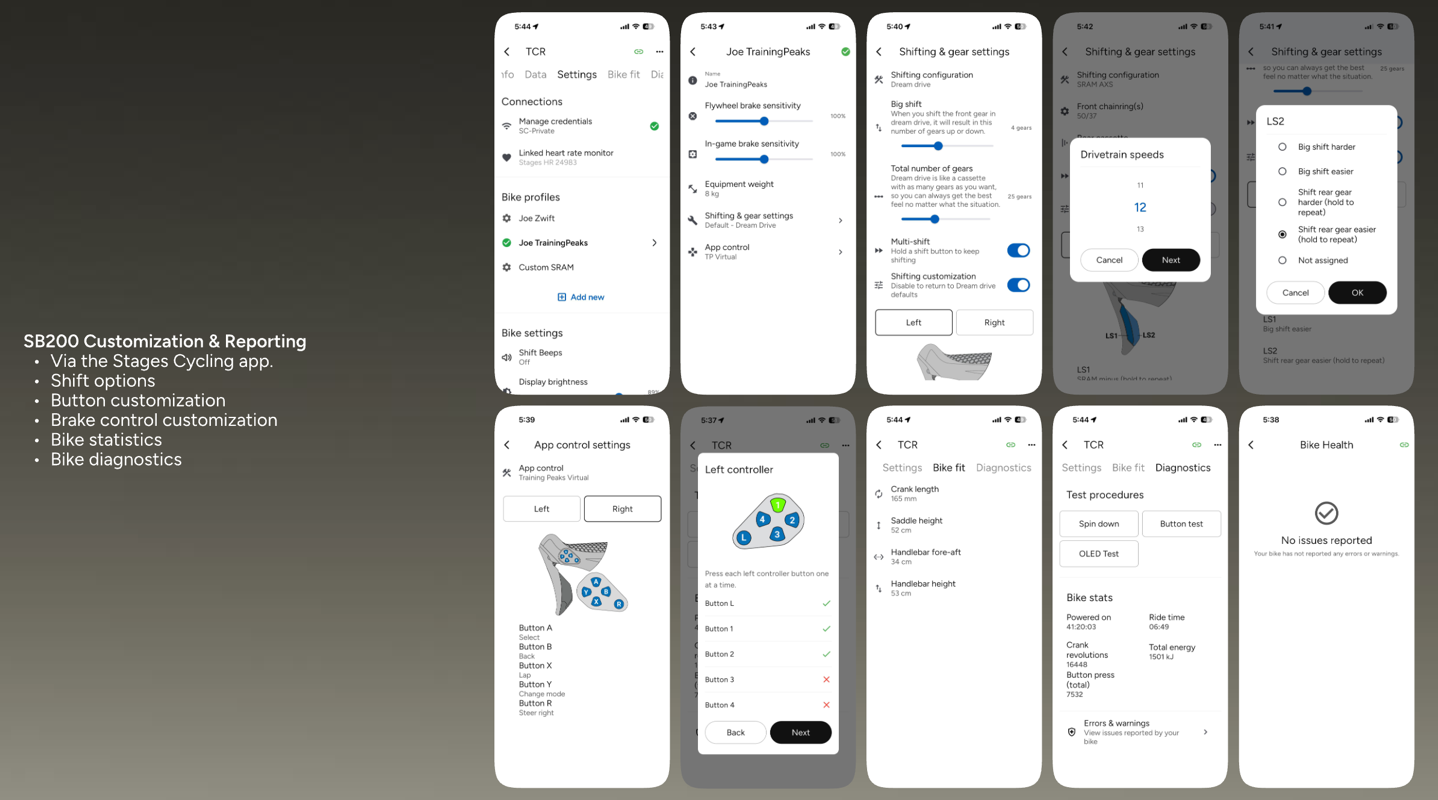
From a shifting/etc. standpoint, I’m pretty happy. All things handlebar are good for me.
The last area to mention is movement, as well as sprinting. The SB200 includes feet that compress slightly and allow the entire frame to tilt side-to-side up to 2 degrees (officially). These are similar to numerous other trainers/bikes we’ve seen adopt this in recent years:
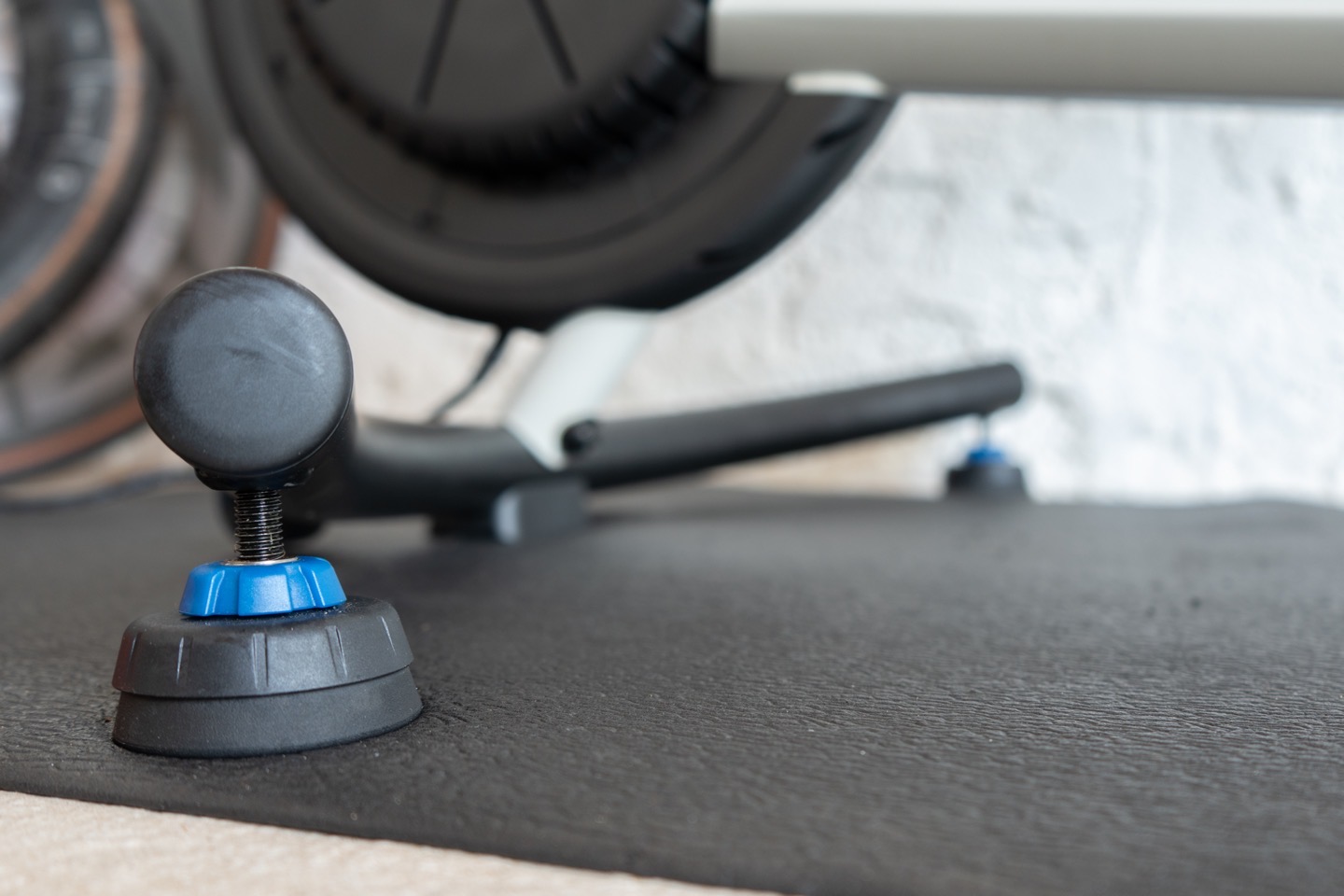
In reality, it’ll be more than that, especially if you have a trainer mat there, since that compresses too, allowing (far) more movement, as seen below. But at no point did it feel like it was going to tip over. The back base area is pretty stable there.
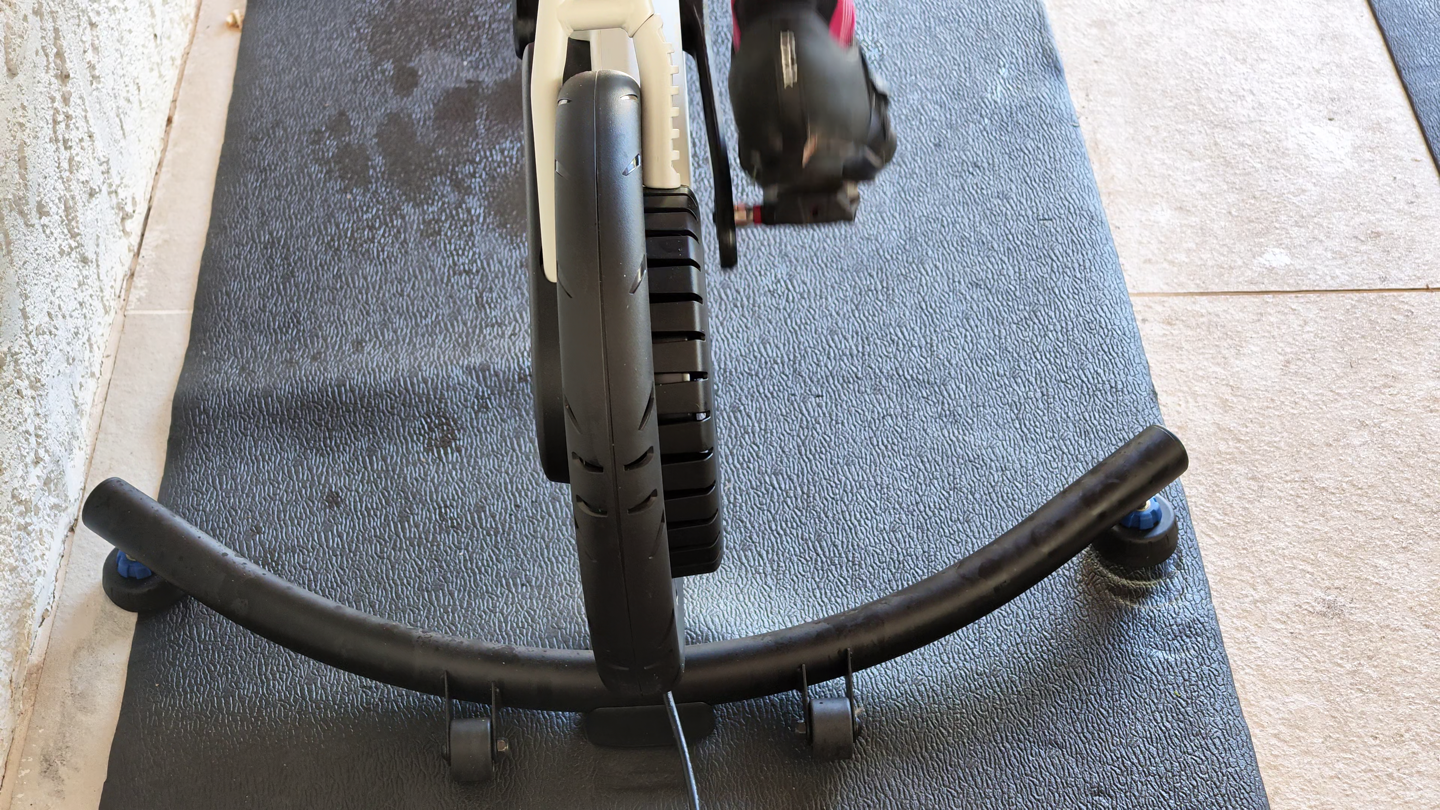
Again, the main point of side-to-side tilt/sway is so that it feels like a bit more movement, like on your real bike outside. If a bike has zero movement (e.g., the Tacx NEO Bike), it’s like riding a concrete wall. It just doesn’t ‘give’ and feels unnatural. So, the movement is good here.
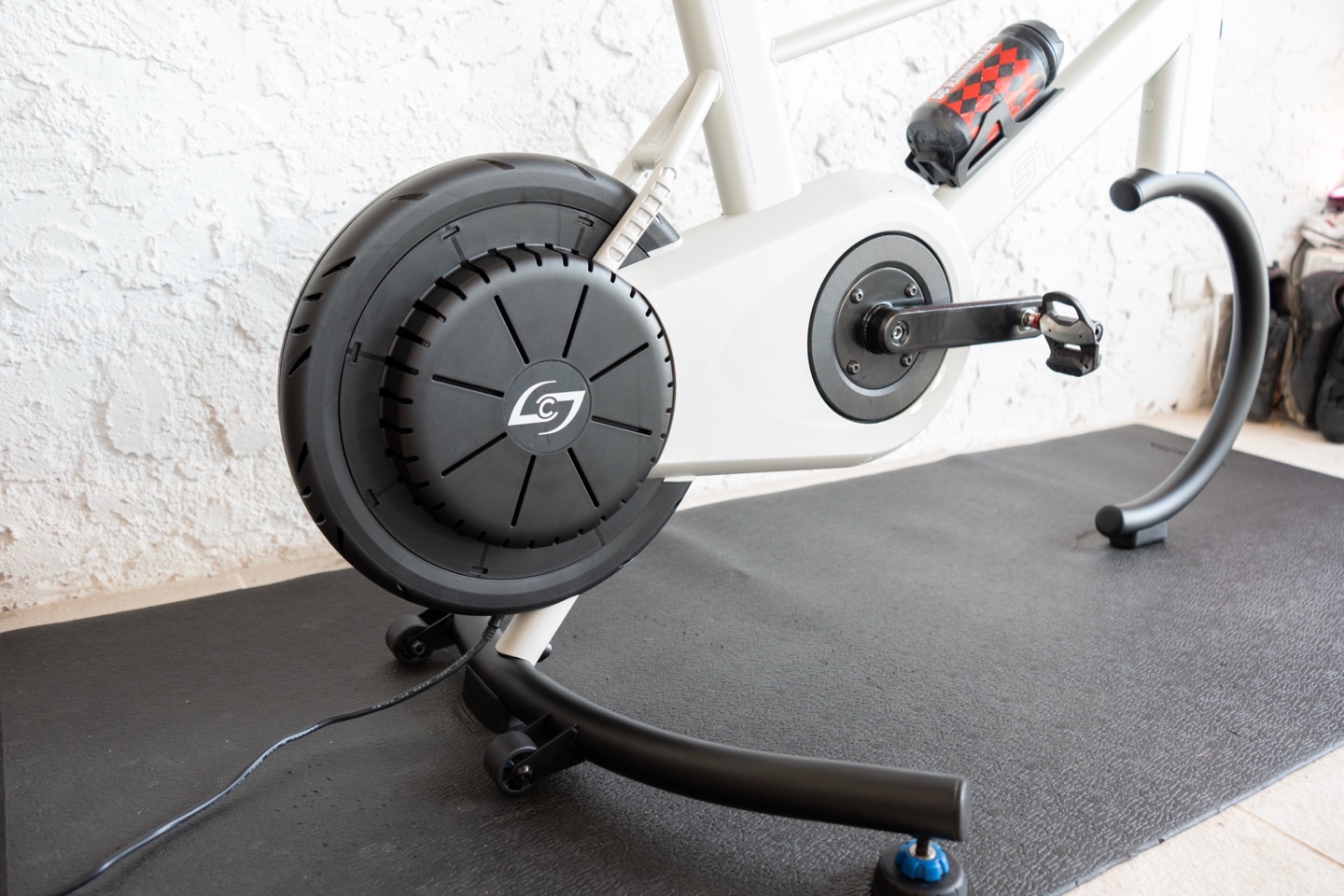
Meanwhile, the one downside to the front end being rather skinny and lightweight is that it’s kinda easy to throw it around on a sprint, and it tends to bump up/down a bit on hard sprints. Now as always with sprinting, there’s a portion of the population that believes sprinting is best accomplished by relocating your indoor bike halfway across the living room with exaggerated motions. The other portion simply puts out the power, without the relocation. If you fall into the first category, this bike might not be for you.
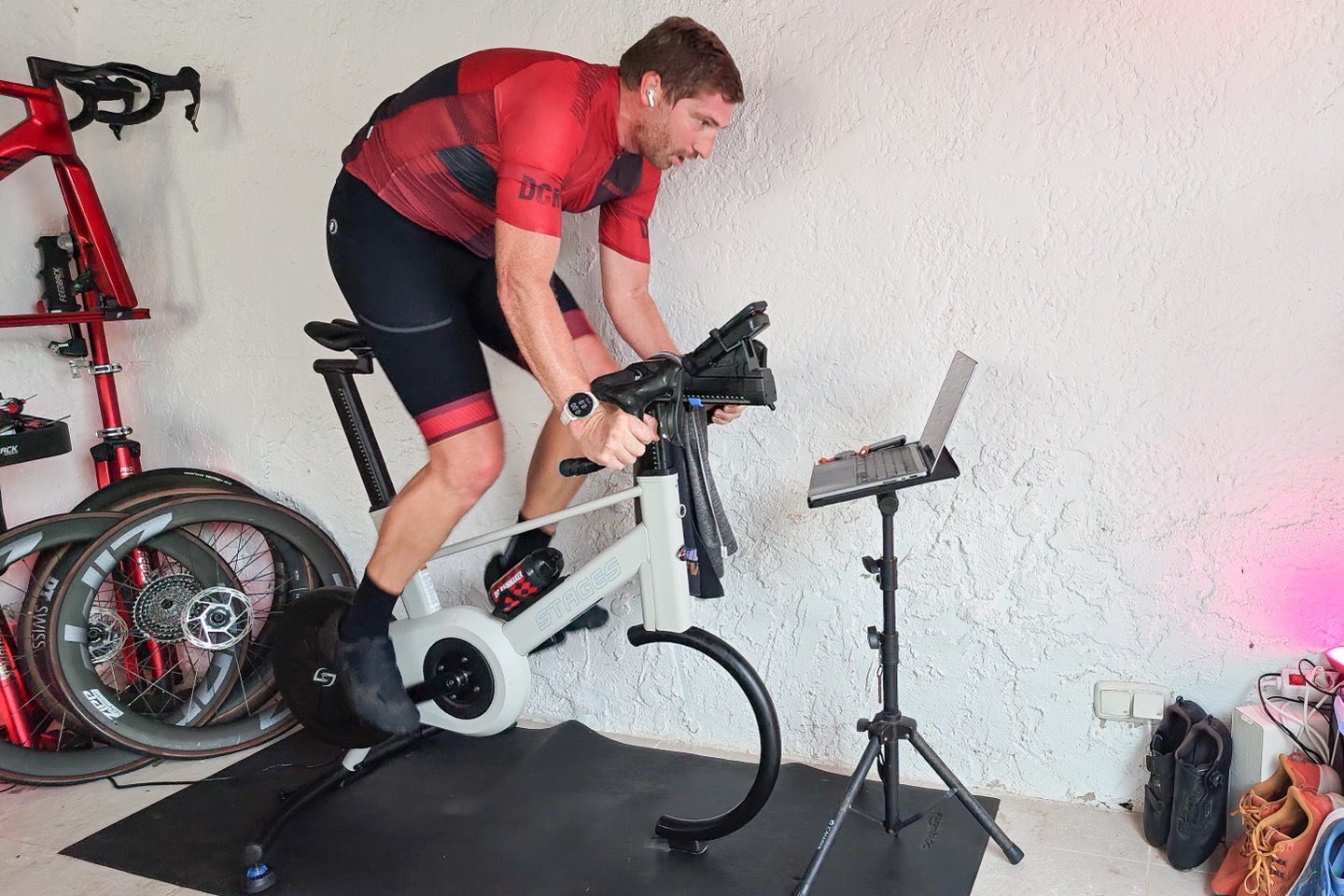
In my case, I found that frequent hard sprinting would actually end up shifting the bike forward, causing my cheap $29 Amazon trainer mat to bunch up a bit. You can see it occasionally in the video. I’ve had Amazon mats for years and never quite had this issue; thus, while one might blame it on the cheaper aspect (or perhaps because the legs spread out a bit wider than mine), I think it’s mostly because the whole bike bounces a bit.
One thing that might help here is the RigidRide front fork accessory that Stages is offering, which is mostly meant to cut off the side-to-side front movement. But perhaps that’d also make the front a bit more stable. Nonetheless, this isn’t really an issue that I personally think is a big deal, but just throwing it out there for those that might be more ‘agile’ or ‘robust’ in their sprinting performance.
With that, I think I’ve covered all of my daily riding thoughts, so let’s get into some of the app compatibility bits.
App Compatibility:
The new Stages SB200 bike is very unique in one aspect: It’s the first piece of hardware to support the new OpenBikeControl protocol, which is an emerging standard that gives apps and hardware makers a single open standard again. Previously, that was ANT+ FE-C, then Bluetooth FTMS. But these days, with Zwift and their Zwift Protocol, the openness in the indoor cycling industry (or the entire cycling industry for that matter) is falling apart. Of course, this is mostly due to Zwift and their pushing the Zwift Protocol (which drives trainer/bike companies to support it), but ultimately these same companies are kinda part of the problem, due to them being unable to formally agree on anything.
In any event, the OpenBikeControl protocol is a great first step, and seeing an actual hardware company support it is huge. On the software side, it’s already supported by TrainingPeaks Virtual, MyWhoosh, and a number of smaller apps. I’d love to see Elite, Tacx, and Wahoo make quick work of supporting it. Whether or not Zwift will convince them otherwise remains to be seen.
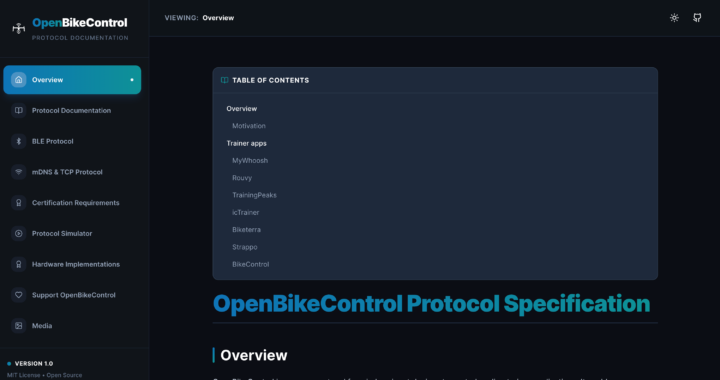
As a reminder, the main reason OpenBikeControl is interesting isn’t for clean/simple power and trainer control, but rather all the other things that indoor trainer/bike companies want to do around buttons, power validation, etc. Basically, stuff that today they add extra special sauce to make happen (like Zwift does with the Zwift Clicks/Play/Handlebars).
In any case, as for the Stages SB200, it supports the other protocols you’d expect to see today. The only notable exception is not having ANT+ support. But given the discontinuation of ANT+ nearly two years ago. I don’t think that’s really an issue here, though. Here’s what it does support:
– Bluetooth Power (clean)
– Bluetooth FTMS
– Zwift Protocol (BT/WiFi)
– Open Bike Control (BT/WiFi)
– WiFi: Power meter & trainer control
In addition, it also supports heart rate bridging. This helps save you a channel on Apple TV… Though given the WiFi/etc. aspects, that’s really becoming an issue of the past. You can pair any Bluetooth heart rate monitor to it, and it’ll funnel it in over Bluetooth/WiFi/etc., as a single channel along with the rest of the SB200 data/control.
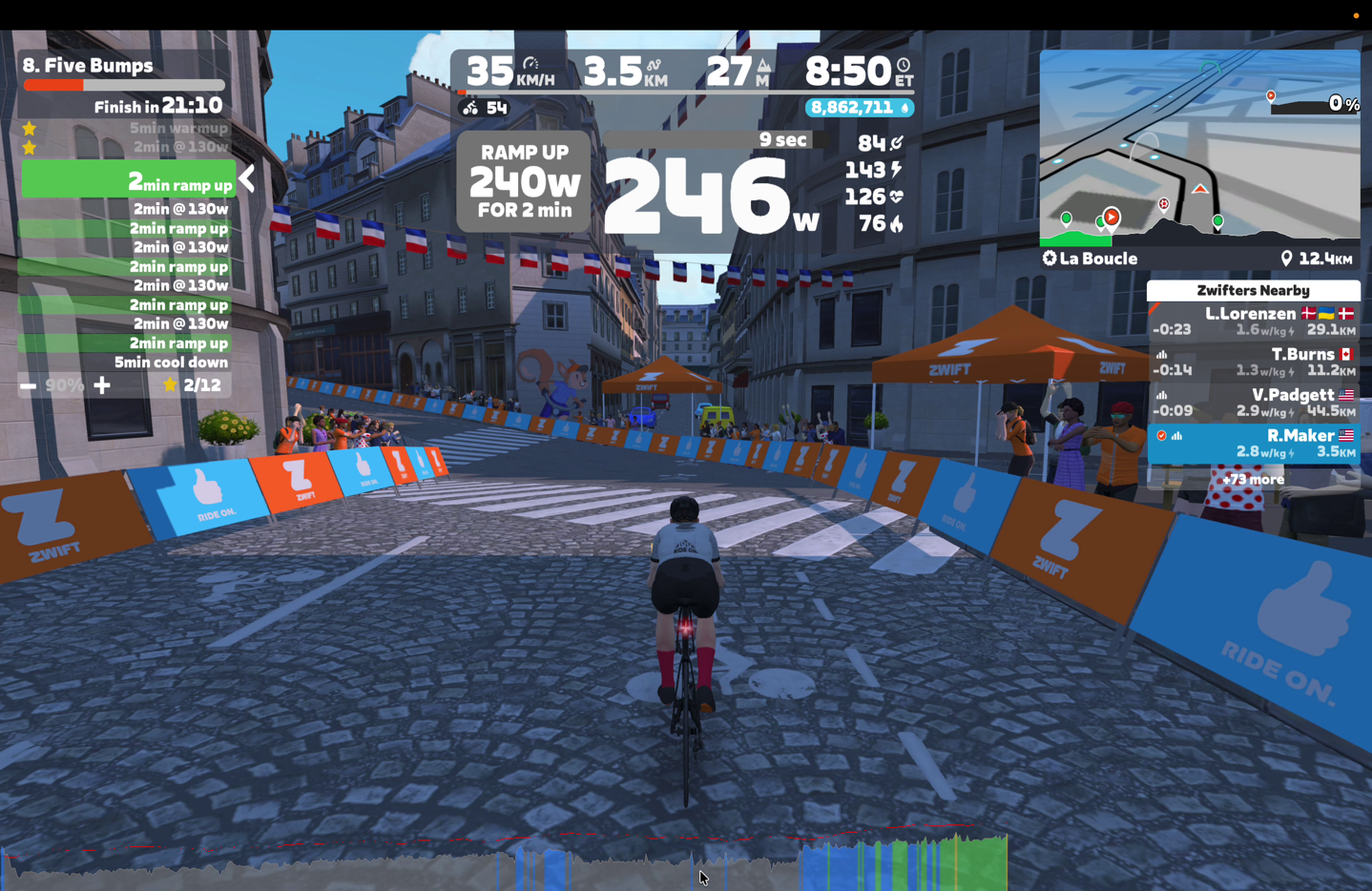
In my case, I used it with a number of the big apps today without any issues. This included Zwift (all these screenshots are from my rides on the SB200) in both SIM & ERG mode:
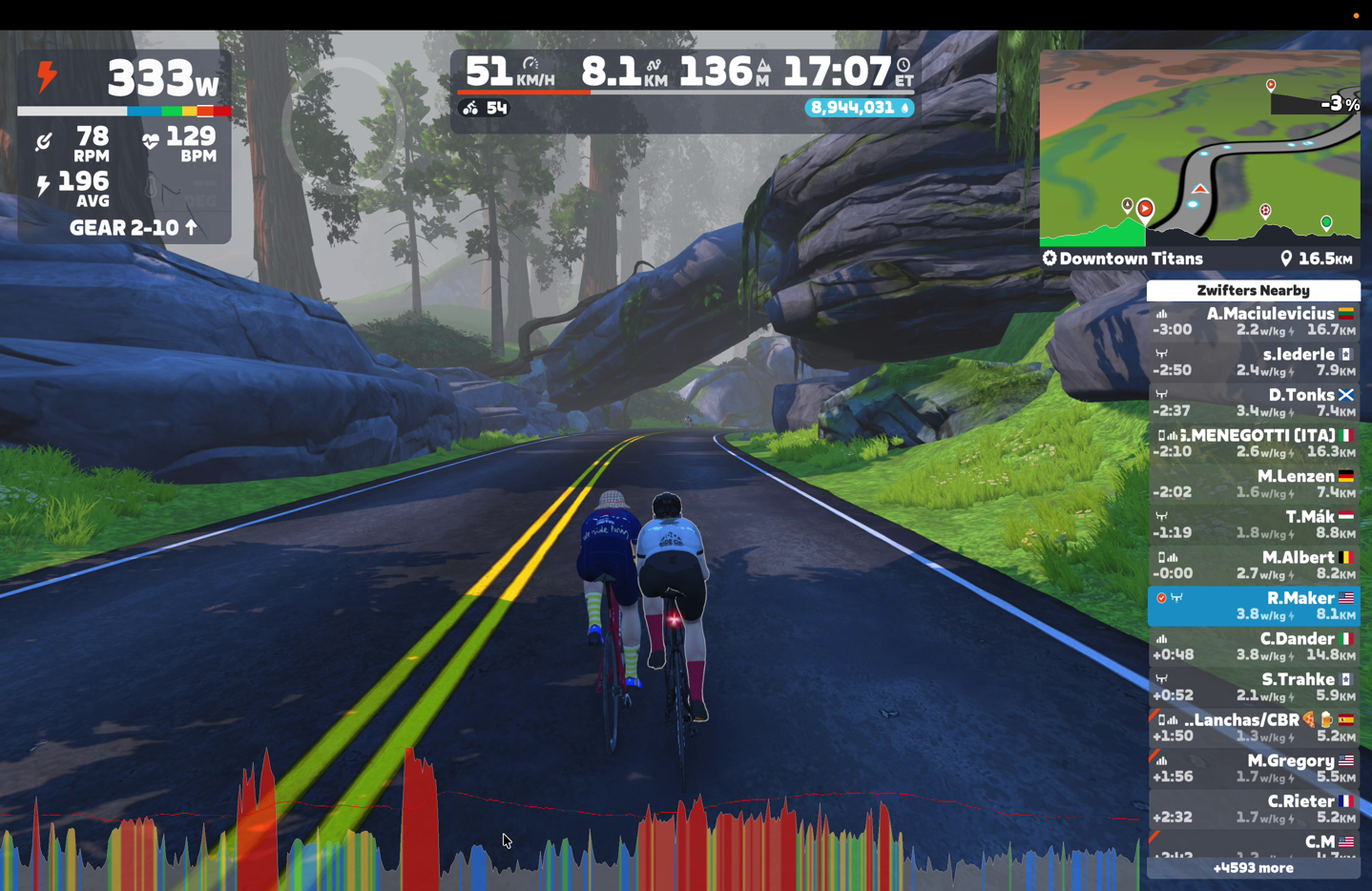
As with all the apps in simulation (SIM) mode, it showed gearing without issue, as you can see below (Gear 2-10):
I used it in TrainerRoad in structured workout (ERG) mode:
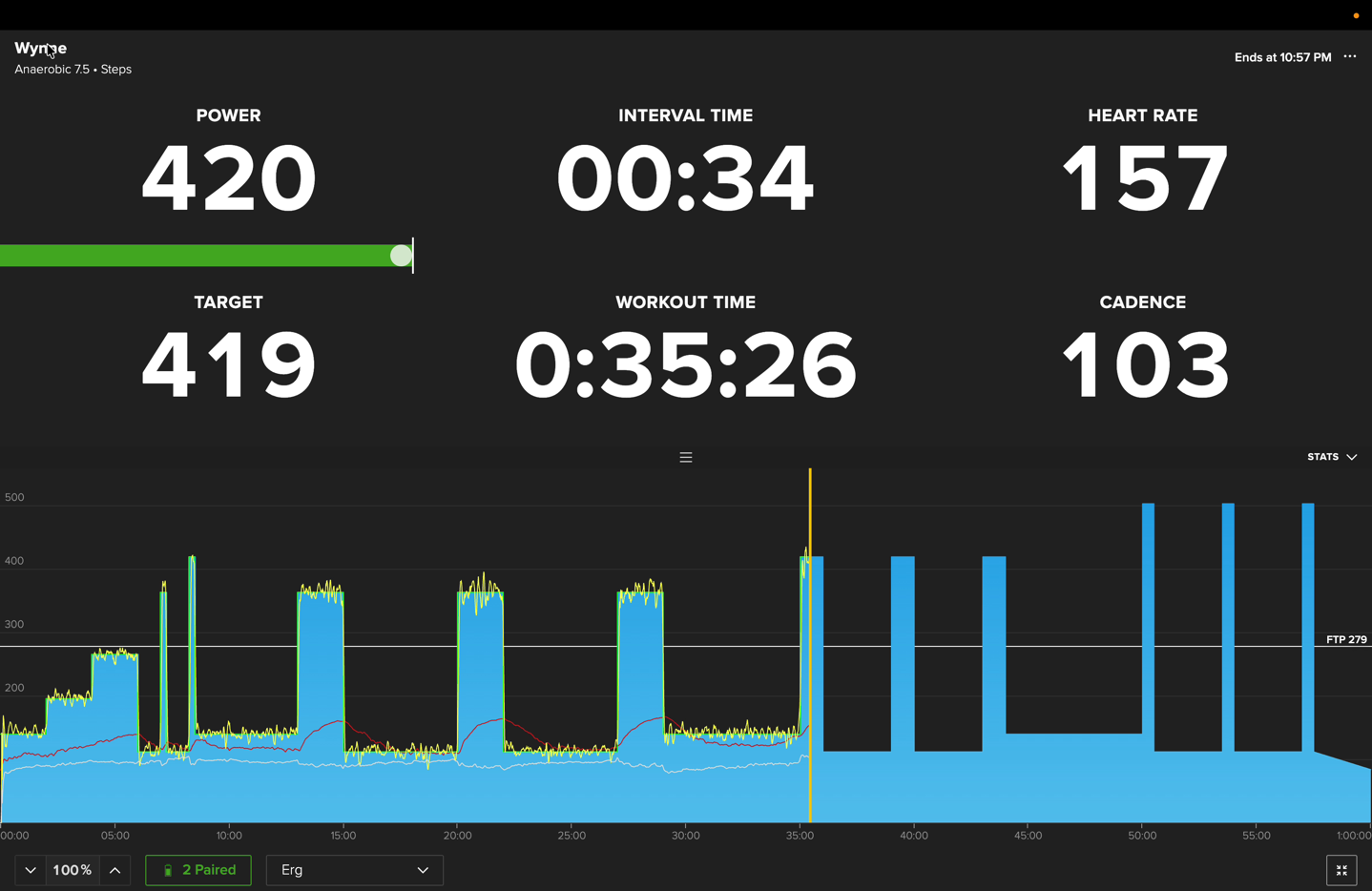
I used it with TrainingPeaks Virtual in both ERG mode and Simulation mode:
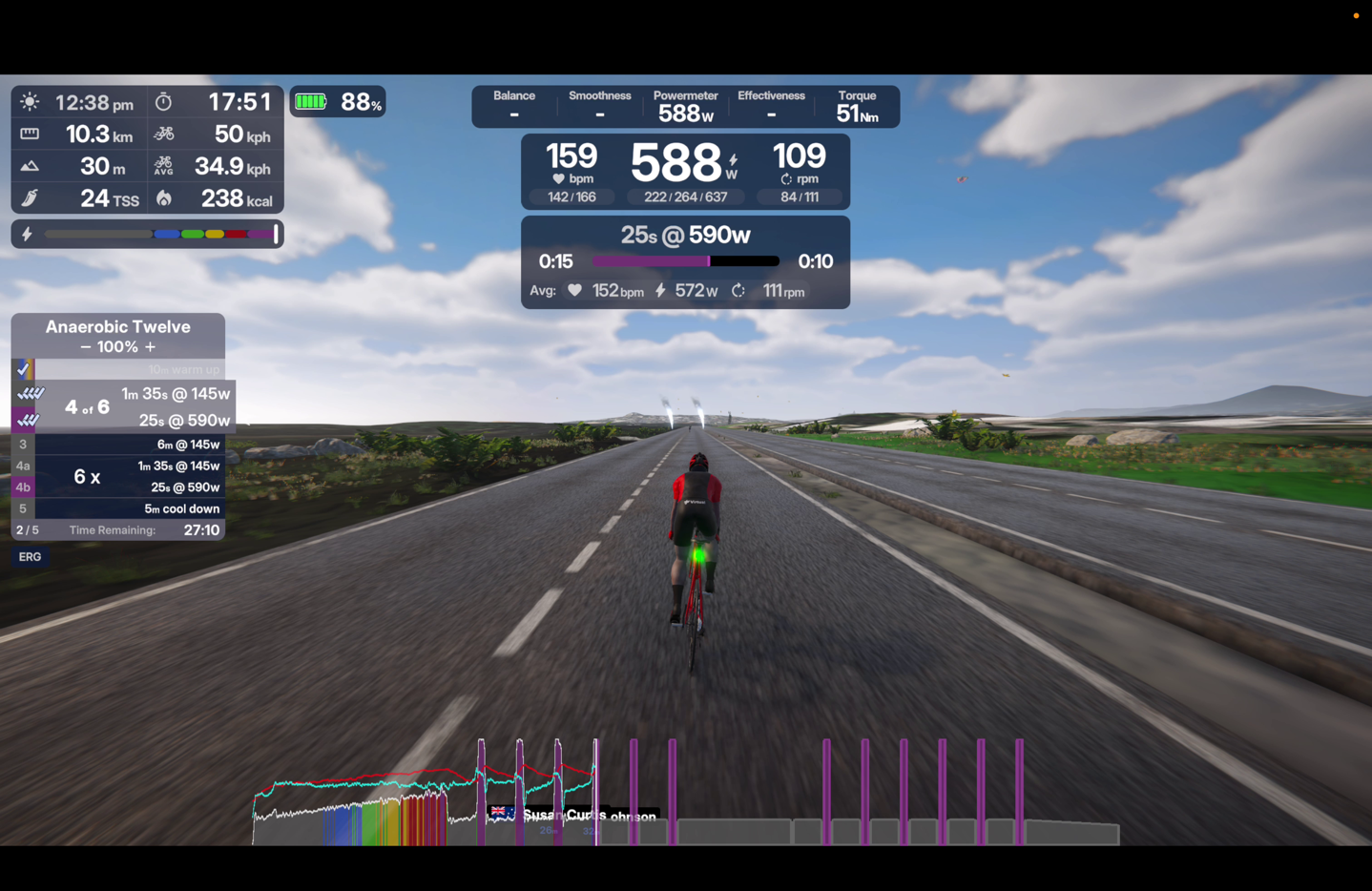
And I used it with Rouvy in simulation mode:
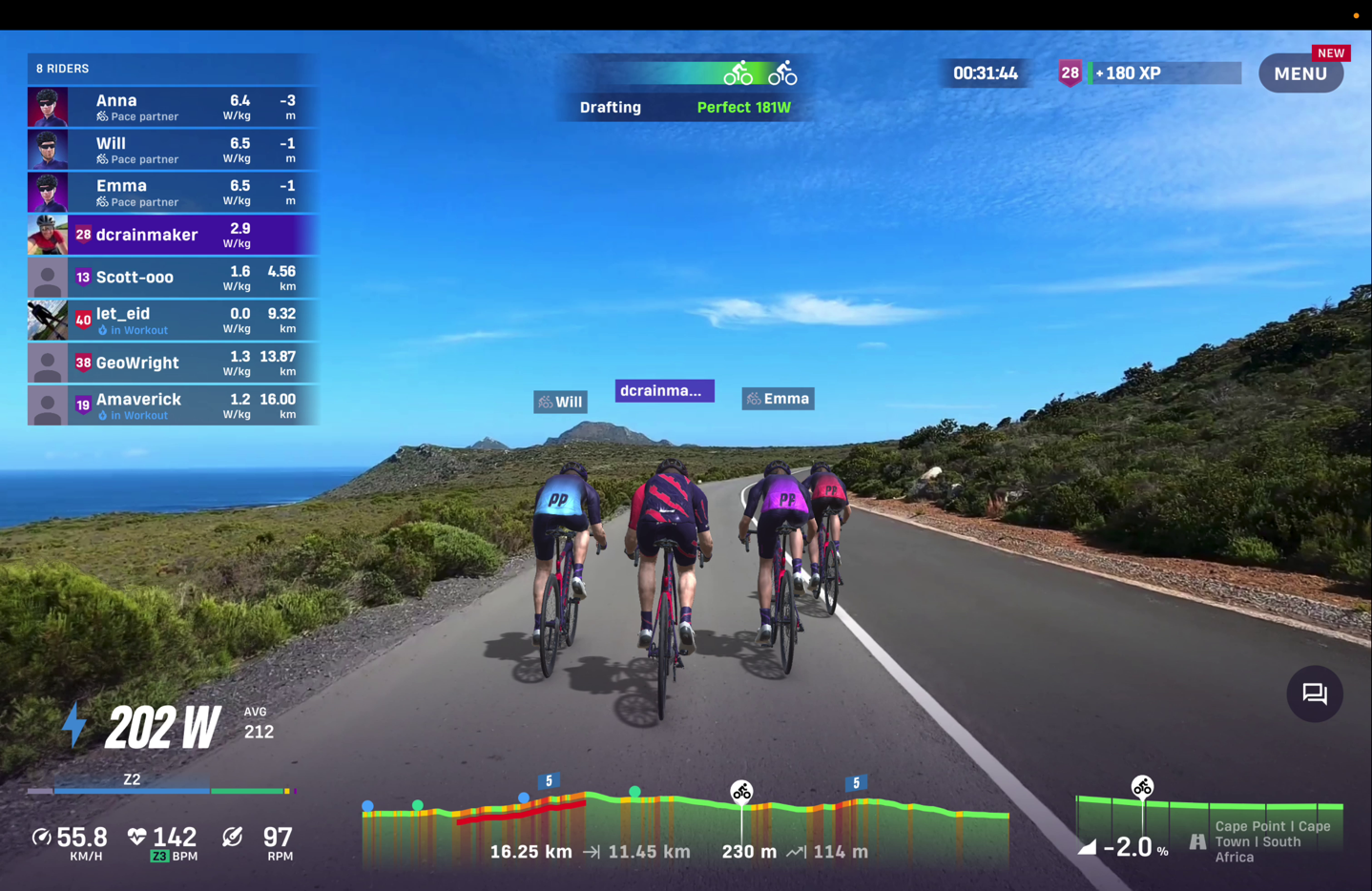
I had no issues pairing it with any of them, nor any issues with shifting/braking/etc. Everything there worked perfectly fine.
Power Accuracy:
As it seems with so many other trainer or indoor bike reviews, things got off to a slightly rocky start here, with the unit not quite being spot-on. Nothing horrendous, but about 5-8w too high in the most common ranges for me (200-350w). Slightly higher above that, slightly lower below that.
I’ll save you tons of extra data sets, but after a lot of throwaway rides, it became clear issue was that when my unit originally left the Stages factory for me some 1.5 months ago, the calibration rig wasn’t yet final. Long story short, Stages was actually able to send over an updated inertia value, based on the inertial data from within the app paired to my bike (it’s kinda neat; it gets a QR code that the app can read and download). Notably, Stages did not actually have any of my comparison data sets at this time, just my note saying things seemed off.
In any event, once I got that value, then doing a short warm-up, followed by a zero offset, and then a calibration (plus a new/final firmware update), the unit was finally sticking the landing. So, let’s look at those numbers.
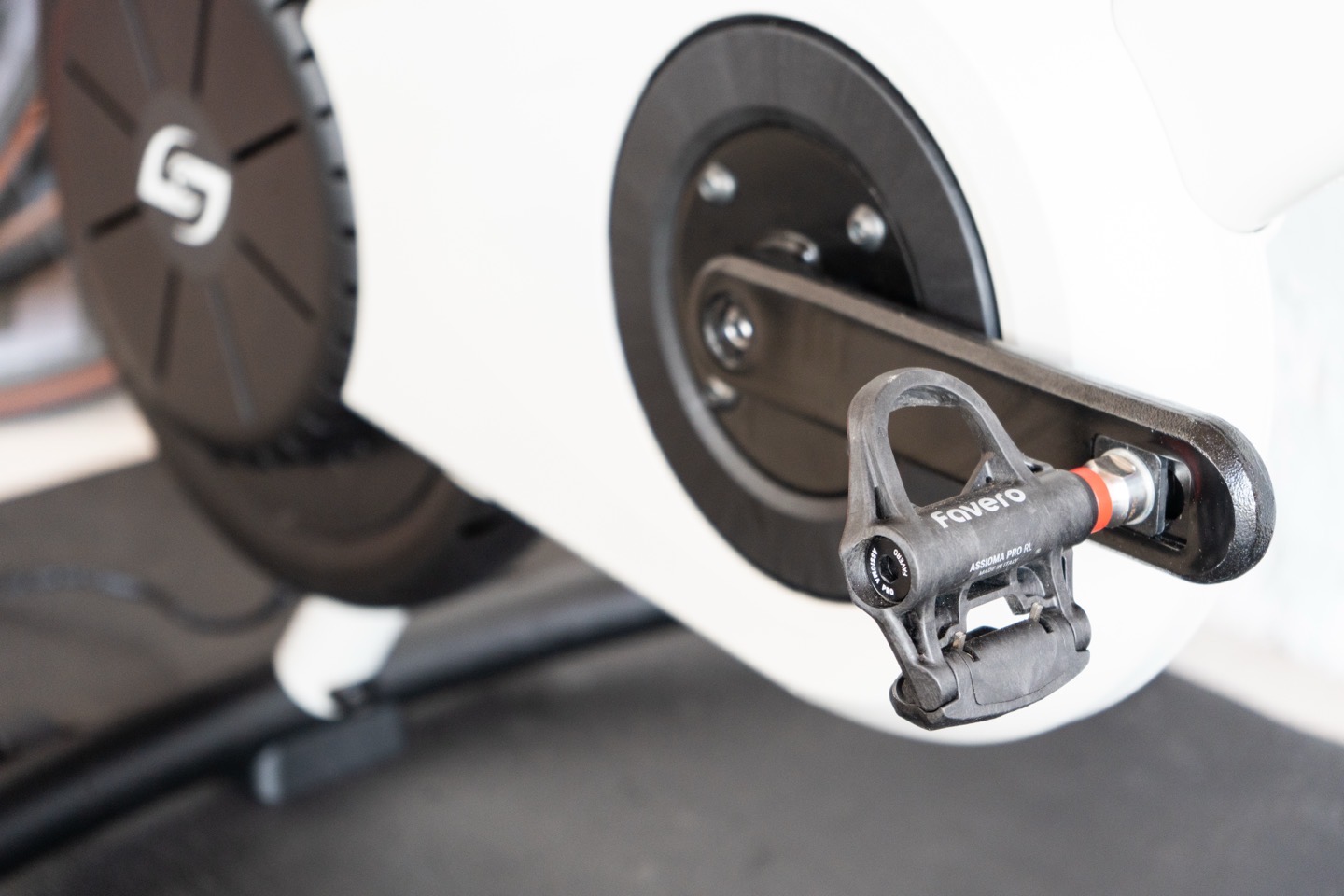
Note that in this case all data is compared to a set of Favero Assioma Pro RL power meter pedals (dual-sided). I usually like to compare against multiple sets of power meter pedals, but frankly, I spent so much time chasing down offset issues that I didn’t really have the desire/time to deal with some other power meter pedals being a PITA.
We’ll start with a SIM ride first (meaning, just following the virtual gradient, not a structured workout). This ride was done in TrainingPeaks Virtual; here’s that data set:
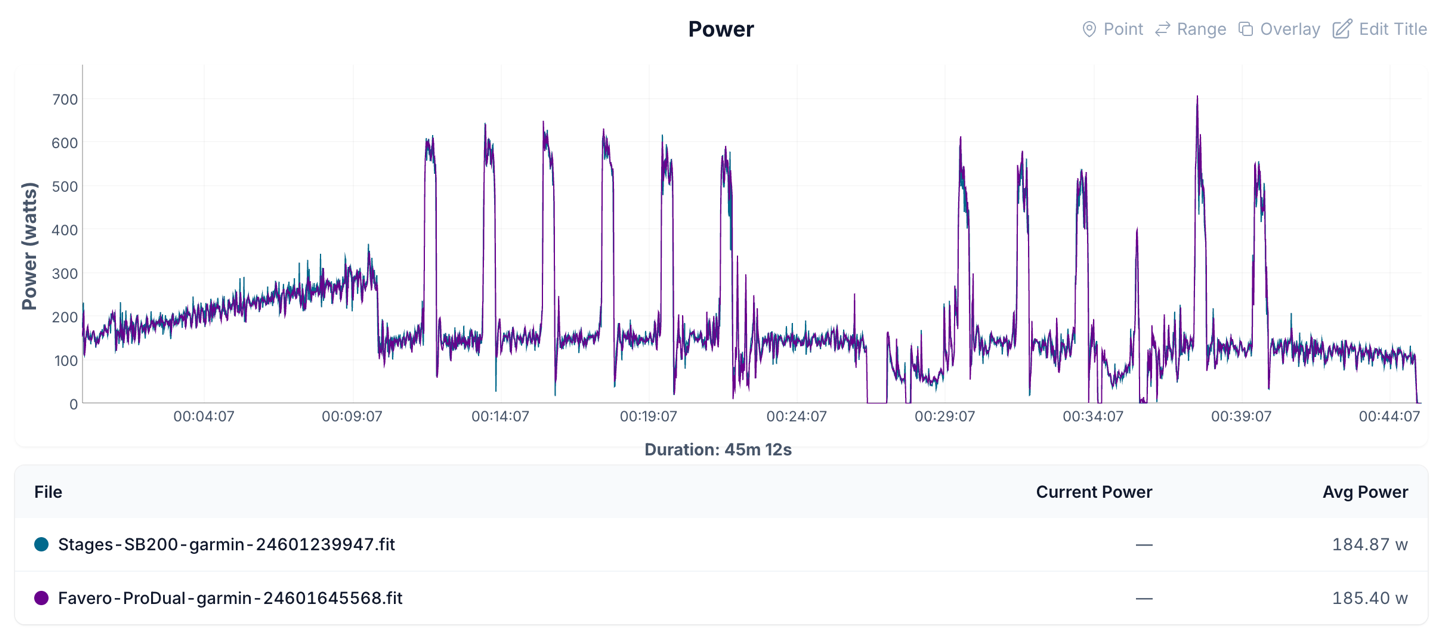
Above you can see the workout structure, which was a bunch of 590w intervals. Ignore the 4th interval in the second set; I had briefly stopped during the recovery period prior for a few seconds to it to grab a towel slightly out of reach, and TrainingPeaks Virtual had disengaged ERG mode but I didn’t realize it (since the power was so low that my easy pedaling felt basically the same). Once the interval started, there was no viable way to spin up to 590w in that short time period with all the shifting required. Anyway, point being, that was me.
Otherwise though, looking at the above, things look pretty much the same at a high level.
So, picking one of the intervals below, you can see that the power between the two units is quite close. I have no concerns there at this point. Though, you can see there’s quite a bit of variability in the power levels being held. While the jump from 150w to 590 was properly efficient (2-4 seconds), it did overshoot a fair bit initially, then undershot, and then wobbled a bit.
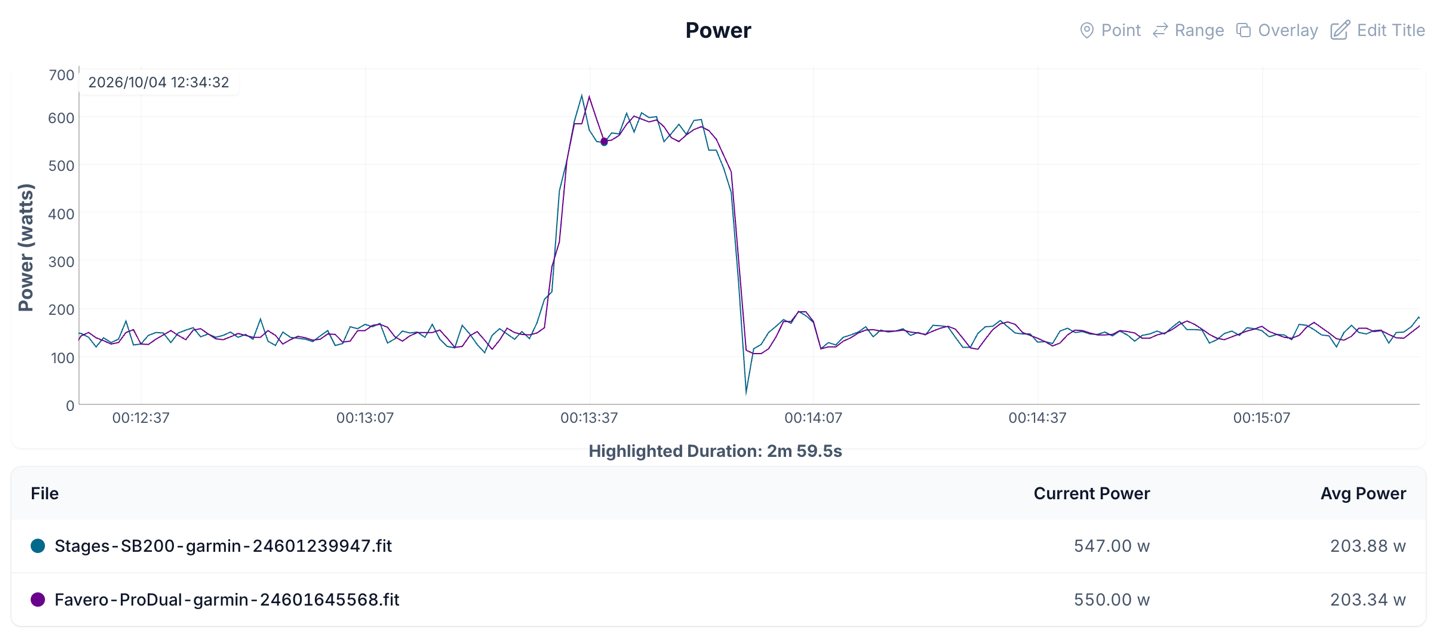
Part of that is due to the flywheel’s inertia. Generally speaking, more inertia makes for a smoother ride (and it does), but it also tends to make it trickier for ERG mode to stick the landings, or be super stable.
In talking to Stages about this (from looking at all my other ERG mode sessions), they noted that different folks prefer different levels of smoothing. I’ve often talked about this in my reviews, and can certainly concede that I generally don’t want much smoothing applied to my ERG workouts. But to me, this just seems too volatile (my wife very much dislikes it).
As a result of my feedback and other reviewers, Stages is going to be introducing a three-toggle system to allow a bit more smoothing to find some middle ground there.
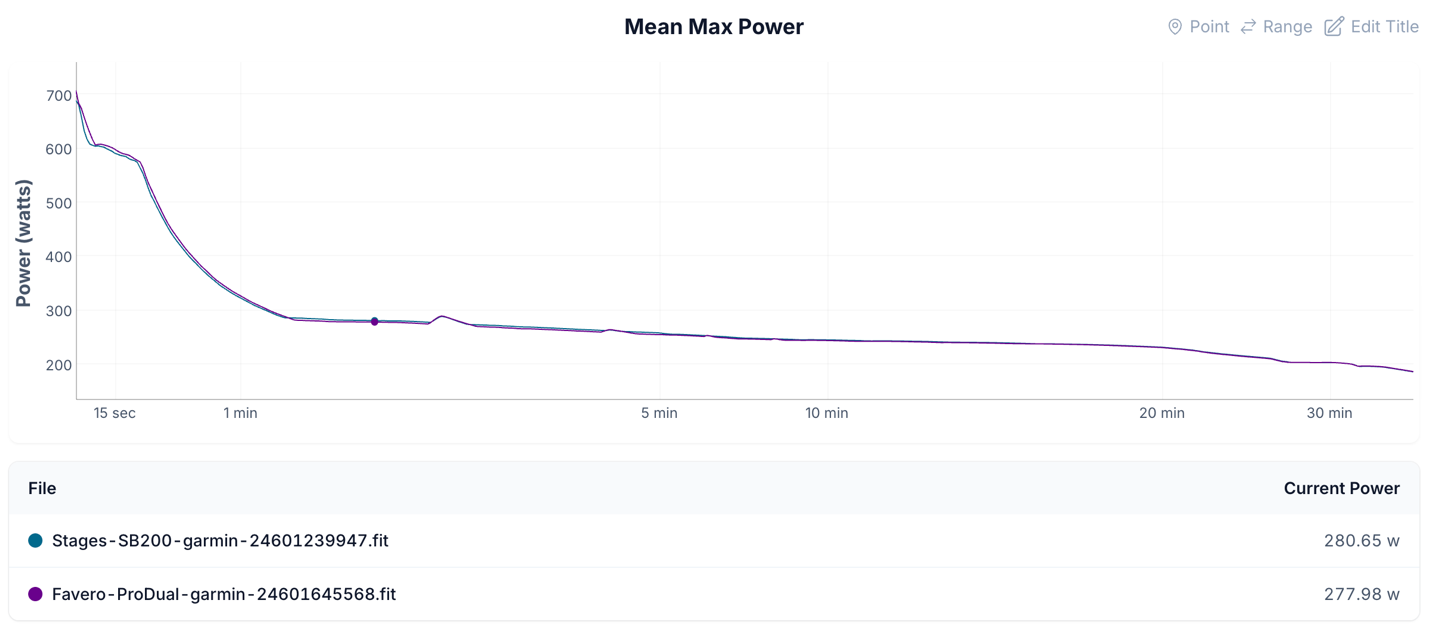
In any case, back to the power accuracy here. Looking at the mean-max graph for this, it’s very close, easily within 1.5% of the pedals (which are measuring upstream, and thus should be slightly higher than the bike drivetrain):
And then likewise, here’s the cadence graph. The cadence on the Faveros appears to be ever-so-slightly smoothed more than the Stages, where the Stages floats about 1RPM up/down most of the workout. You don’t notice it when looking at a single unit by itself (either unit). Only on a chart like this. Either way, not an issue.
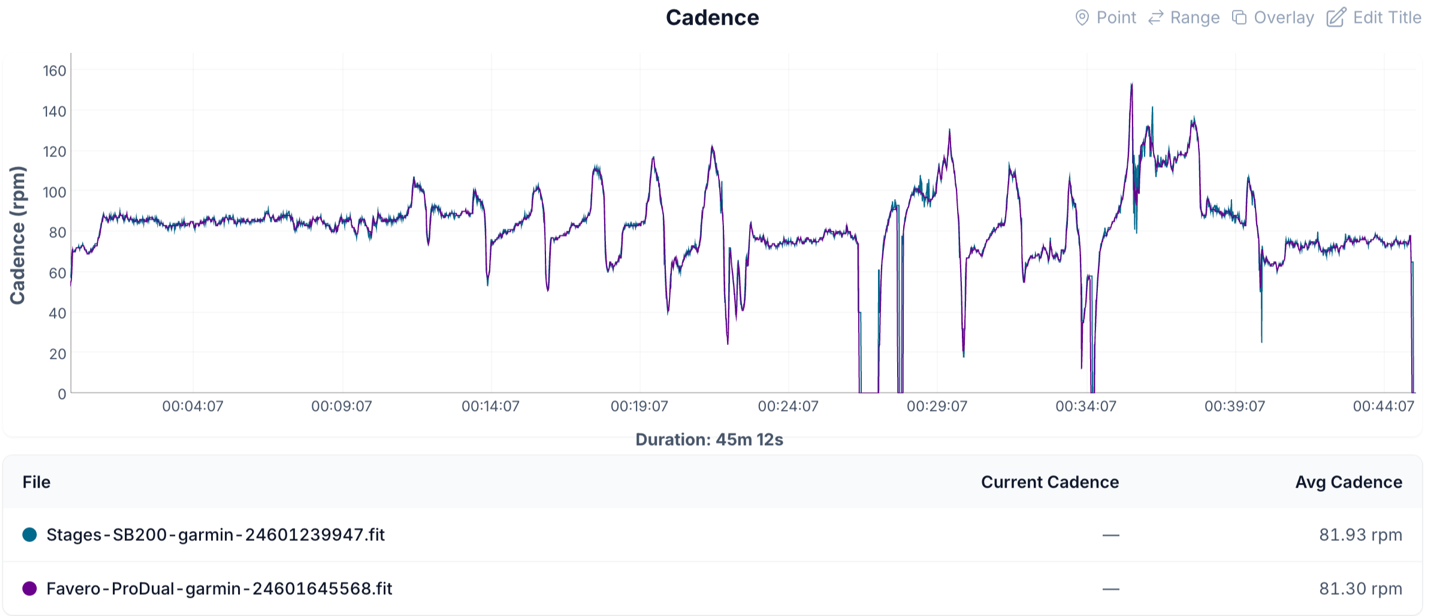
Above, the discoloration around the 36-minute marker is when I tried to manually ramp up for that interval I missed, but obviously failed to react fast enough to make it work.
Next, let’s look at a Zwift SIM-mode workout. This one includes a few sprints in there, plus some sustained power bits. Here’s that data:
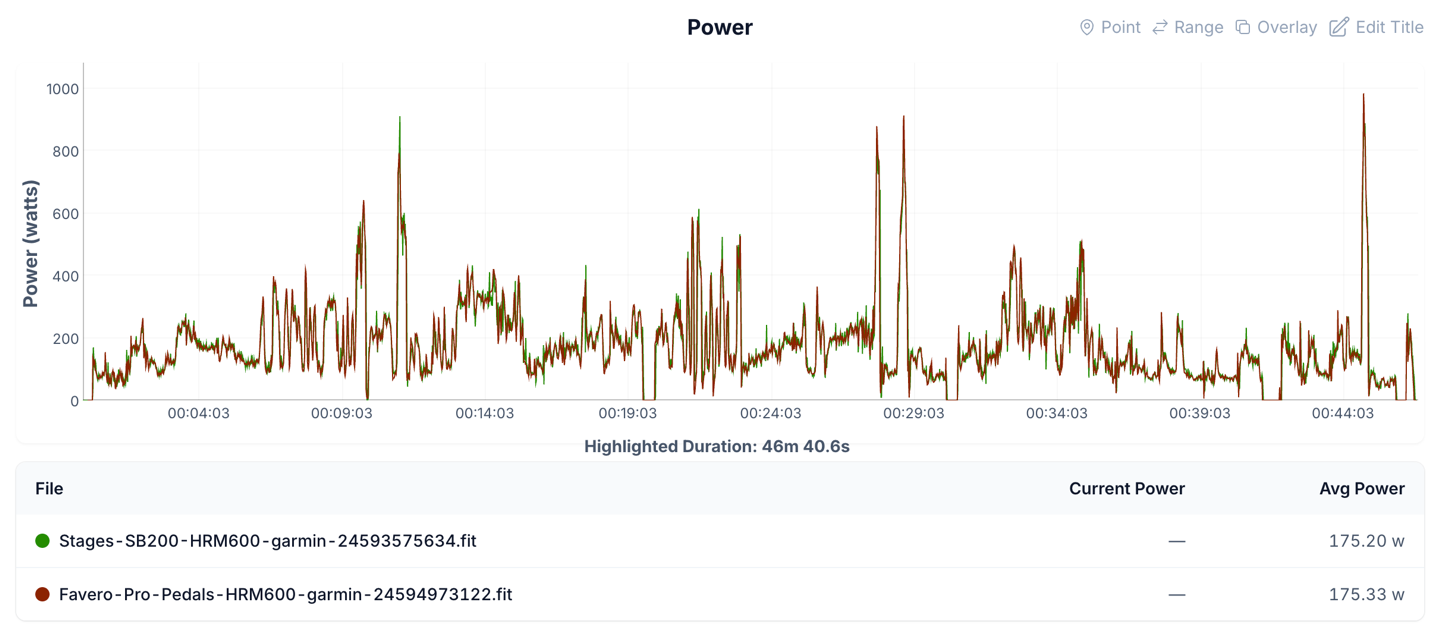
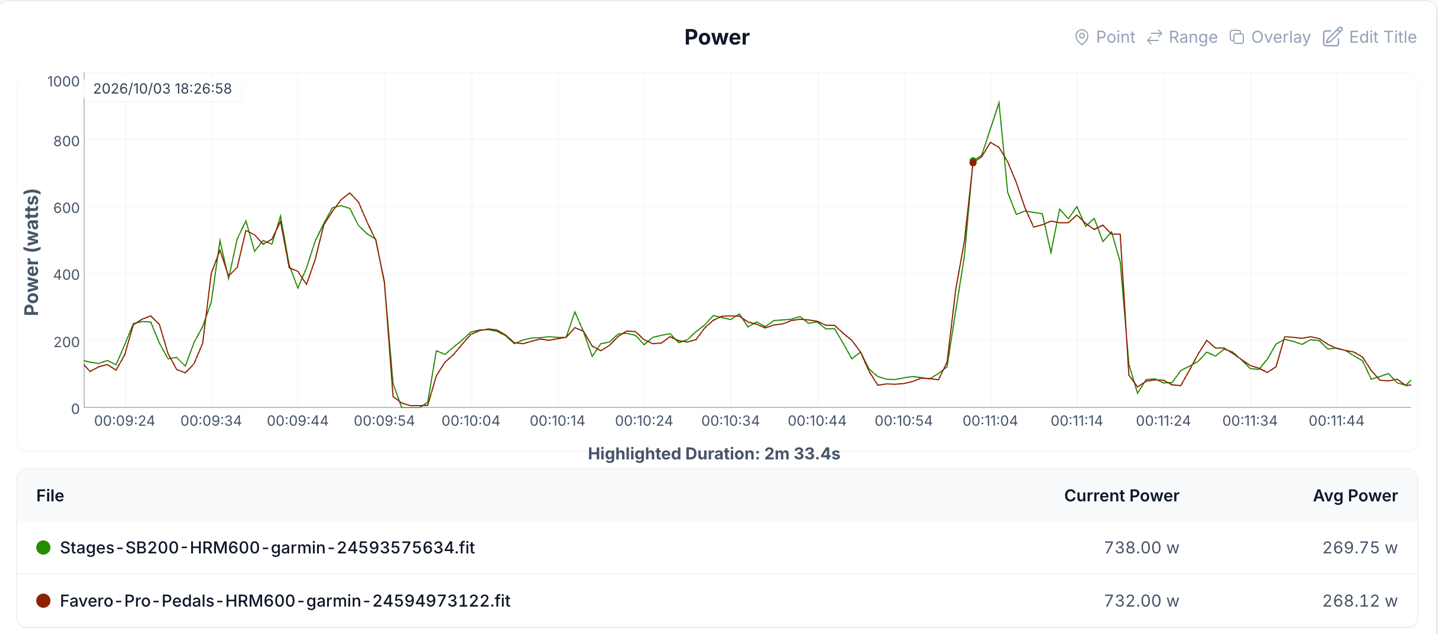
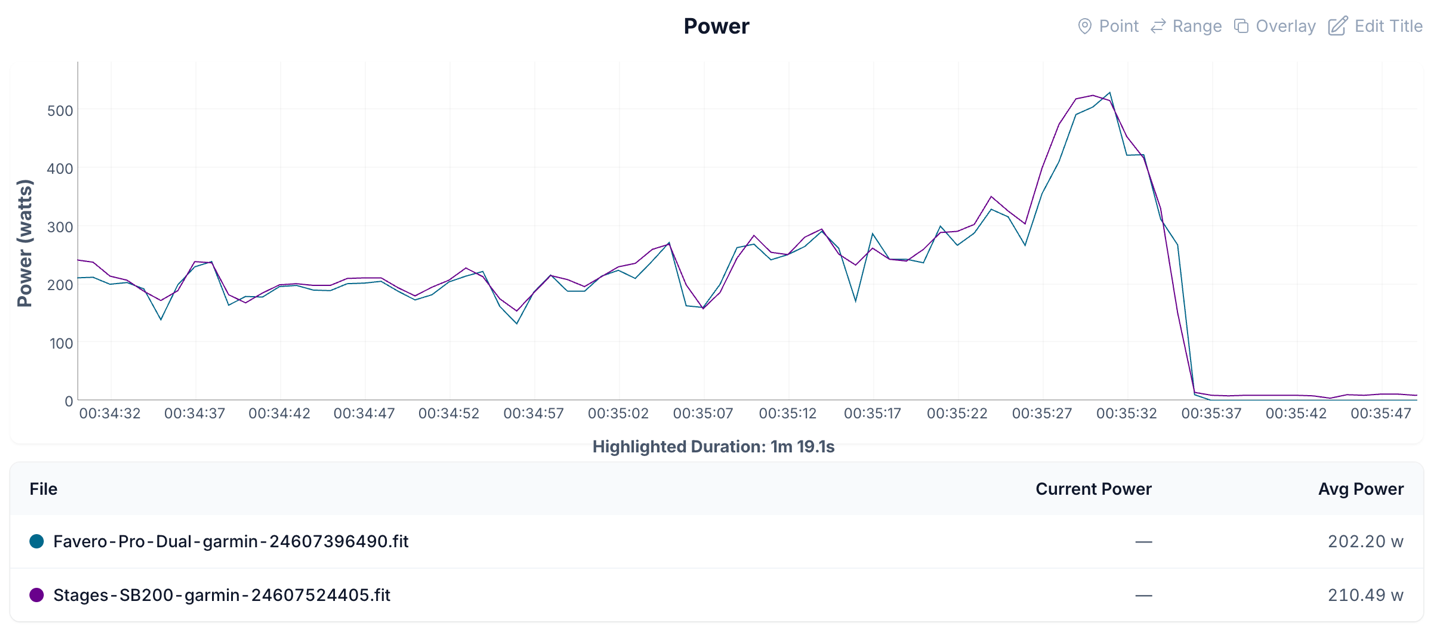
Again, at a high level, this looks pretty close, but let’s zoom in on some sections. Below we have two different things. First is a bit of a 550-600w surge for about 20-22 seconds. In this case, the two units stay basically spot-on to each other. As you can see, highlighted below, they are within 1% of each other during this.
However, in the second peak above, upwards of about 800w, we see the two units virtually identical for the initial 2-3 seconds (again, within 1%), but then we see the Stages SB200 go a bit higher, roughly 100w higher. Obviously, with just two power meters, it’s hard to know which one is correct for these sorts of sprints. That’s one of the downsides of testing indoor smart bikes.
Two units matching can mean it’s correct, or could frankly mean both are wrong. In this very specific case, I’d edge more towards Favero being correct, given the way the power surges after the initial sprint portion (since most of my sprints tend to reach their highest power initially, and then taper off).
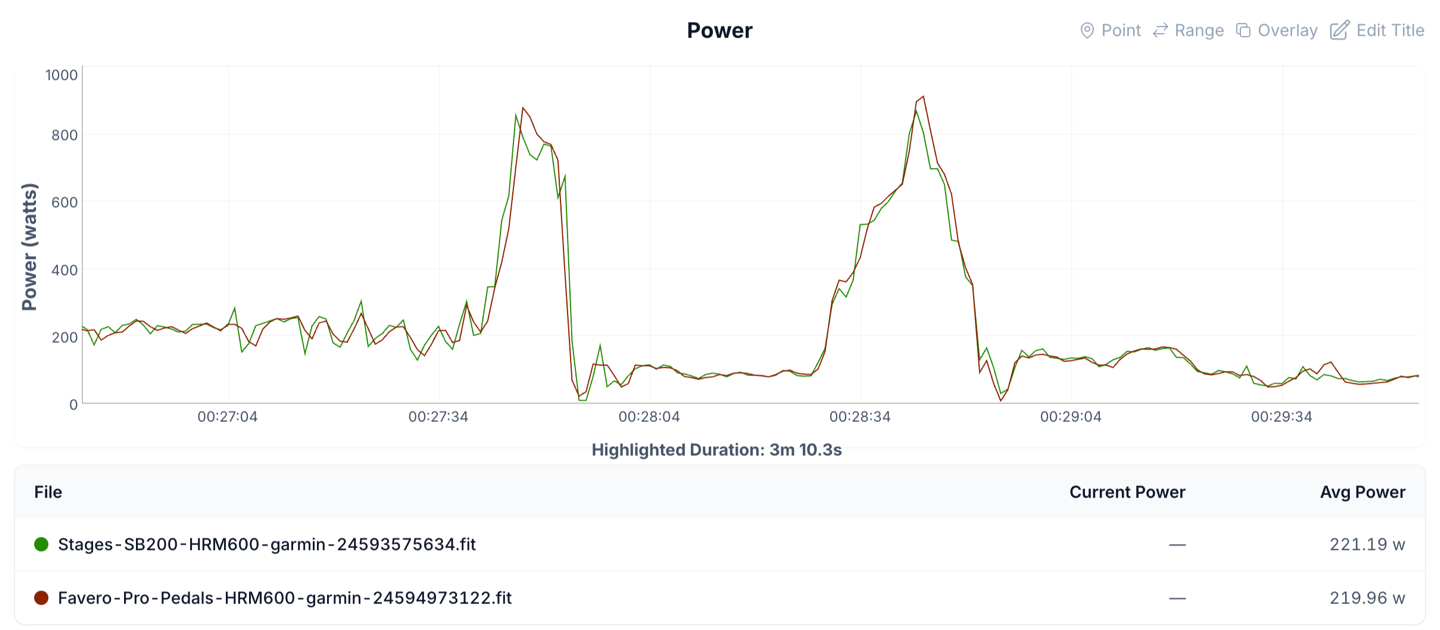
In any case, a bit later, two dual sprints in the 800w-900w range, and while the timing is about 1-second difference on these (welcome to the world of 1-second recording rates across multiple devices), they’re reporting very similar power. Again, getting two power meters to record identically on a sprint is usually more luck than accuracy.
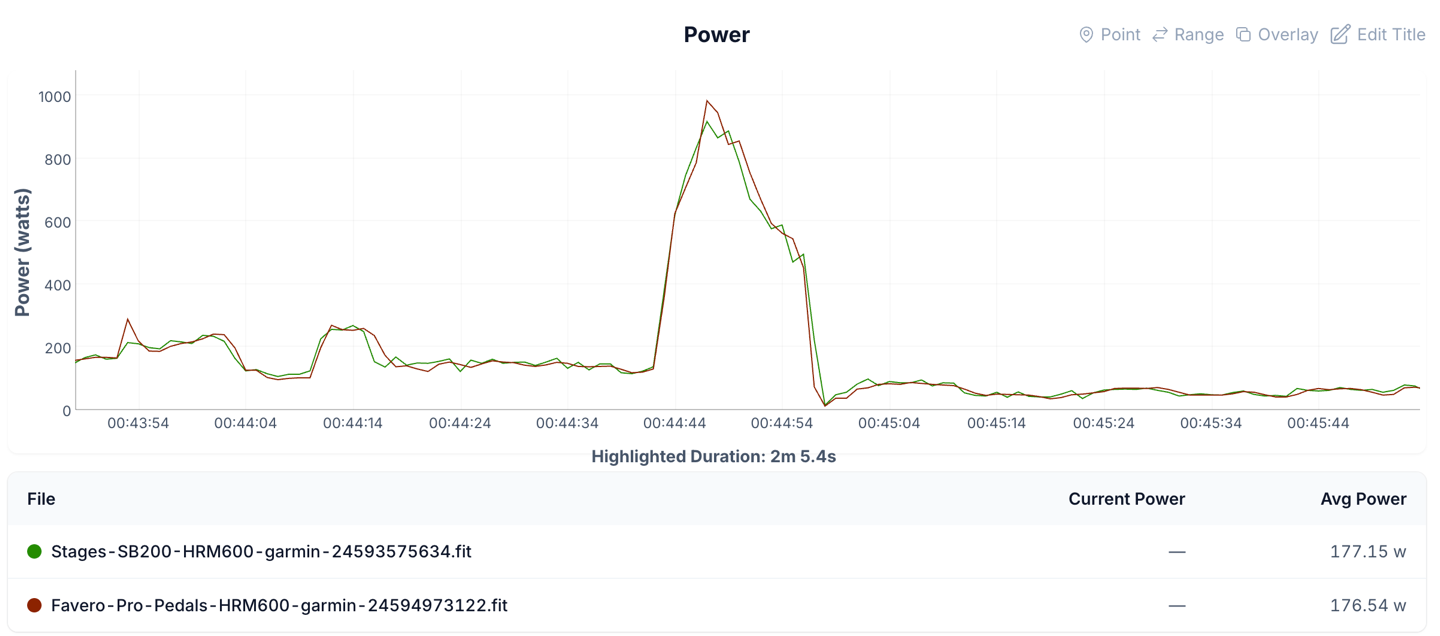
And finally, a 3rd sprint in this workout, roughly 1,000w, and this time Favero goes higher than Stages. So…yeah. Again, welcome to the world of trying to compare max powers on trainers. And this only gets messier the higher you go (e.g., 1,300w, 1,500w, etc.).
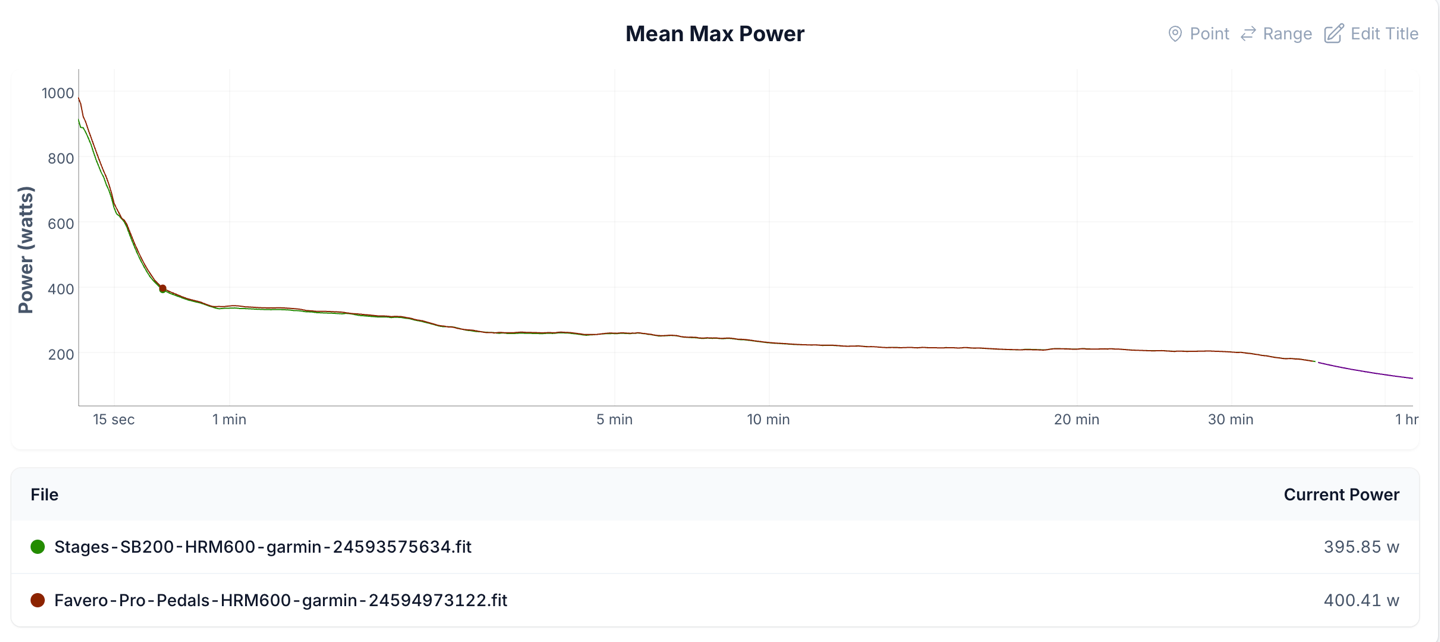
Finally, looking at the Mean-Max power curve for this workout, you can see it’s within 1.5% between the two units at 400w, and only slight separation as we go up to higher wattages.
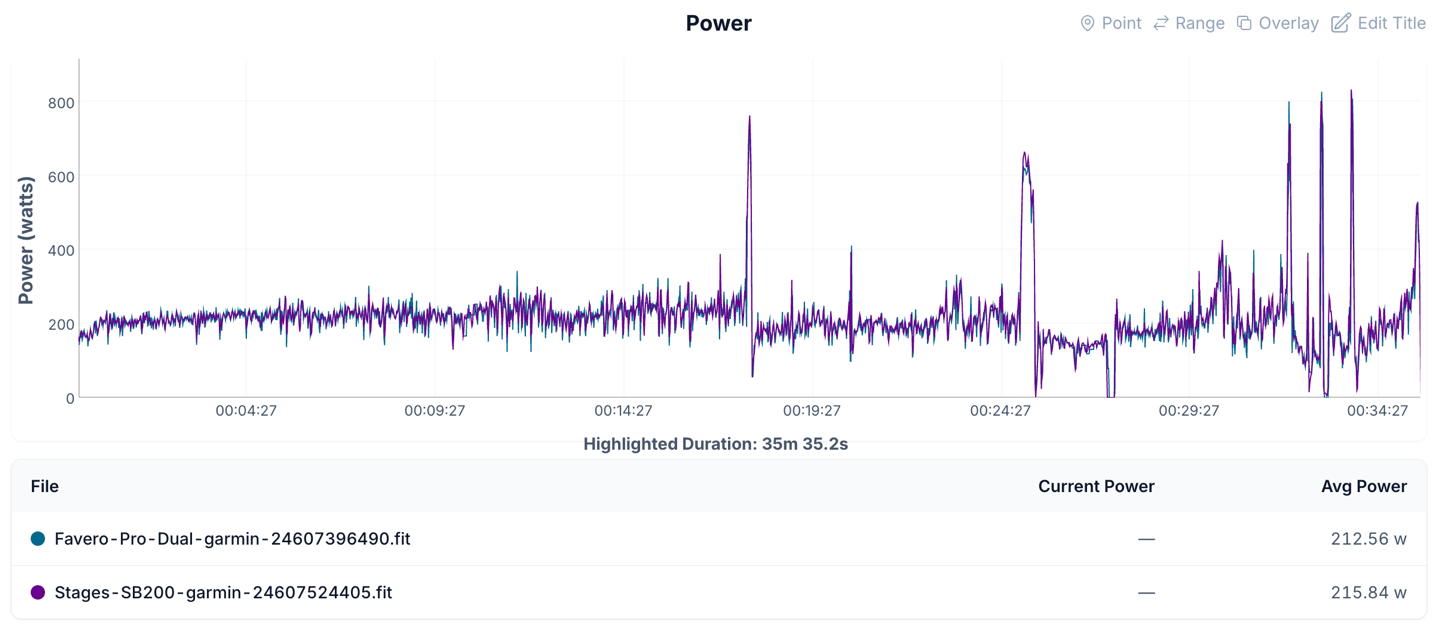
Last up, we’ve got a Rouvy SIM ride from last night. This one was interesting, because I had some belt slip issues at one point. Stages has sent me simple instructions on how to tighten it (not hard, but not something I had time to do yet this morning). But you can see each time it slipped on a bit of a sprint, how things temporarily went sideways. Anyways, here’s the data. For the screenshot below, I excluded the last 10 minutes where the slippage occurs; I’ll show it later on below.
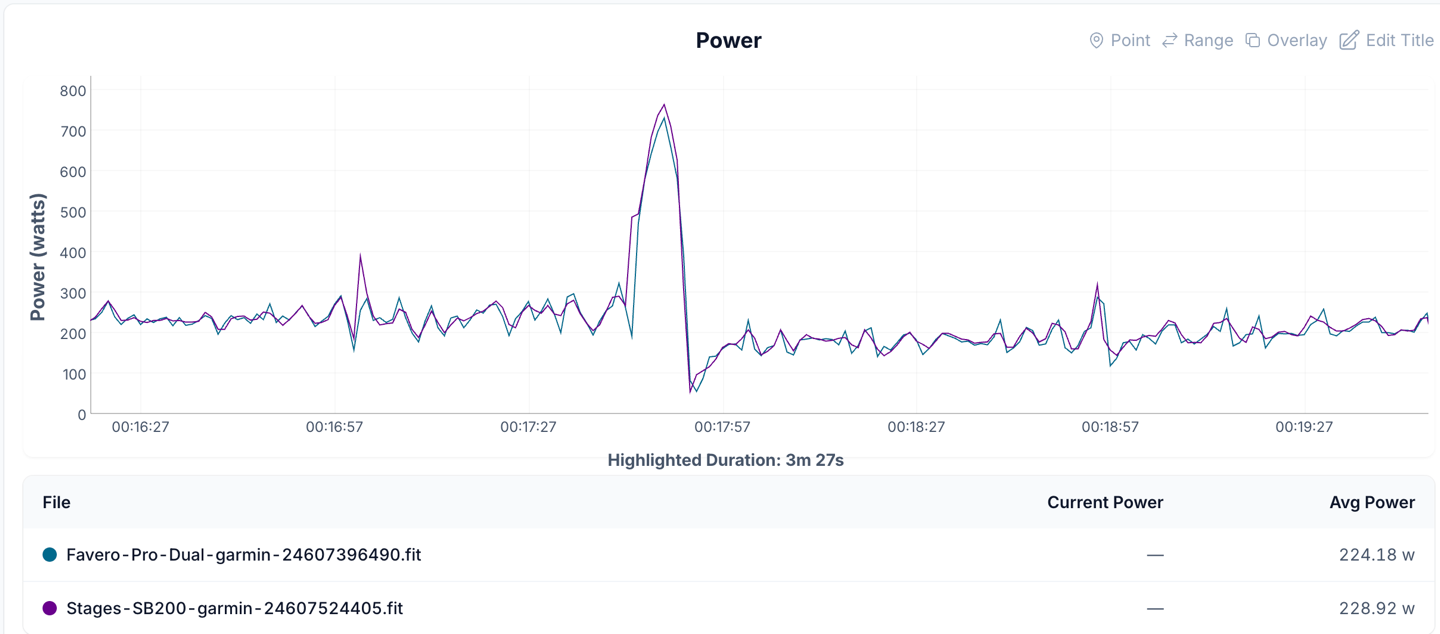
Here’s a bit of a surge I did to 700w, and no issues here:
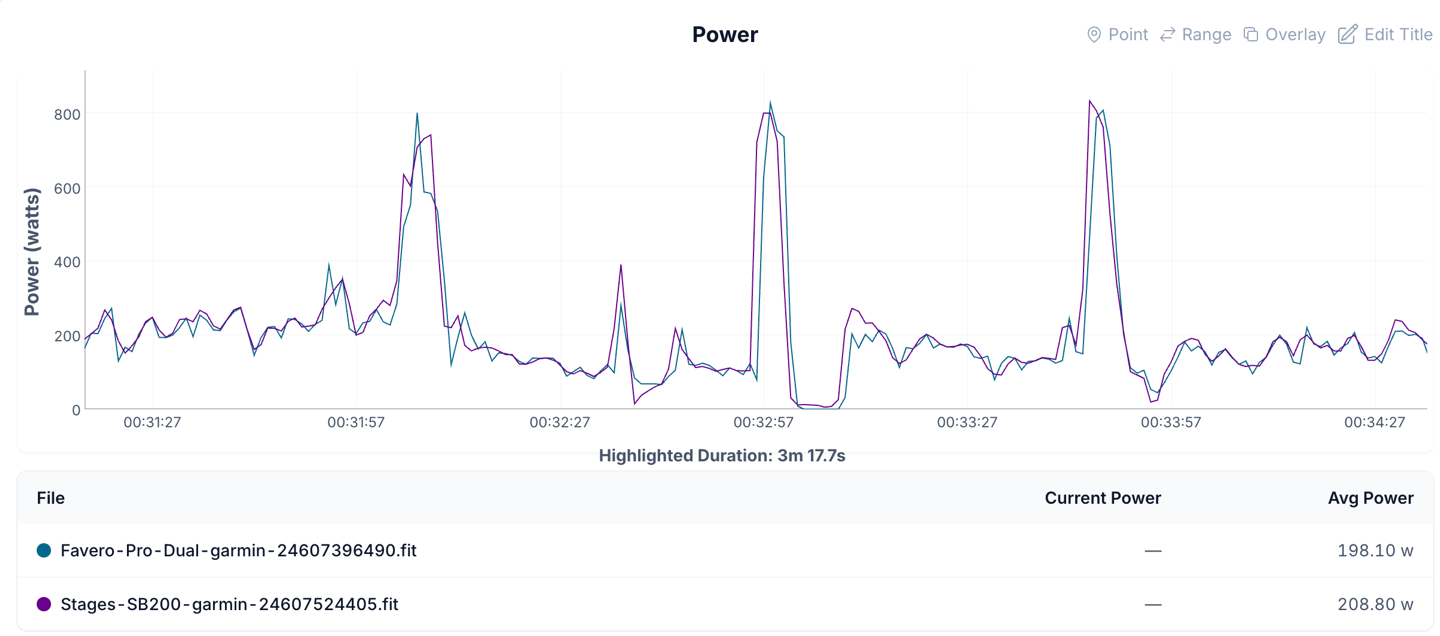
Here are three lazy 800w sprints I did back-to-back. In this case, you can see slight differences with each one, but equally, all are essentially in the same ballpark. From either a racing or training standpoint, there’s no difference here. We’re again talking 1-second recording rates being the difference in these values.
Next, I tested high cadence on the unit, pedaling up to 190rpm before my legs decided it was enough. Had I tried it again, I’d probably gotten to 200rpm, which is the limit of the Stages SB200 from a cadence measurement standpoint. You can see the Favero’s flutter up to 198rpm here. I’m honestly not sure if that’s correct though, because you can also see down below it goes and oscillates a ton right as I easy-pedal, which doesn’t quite seem right either.
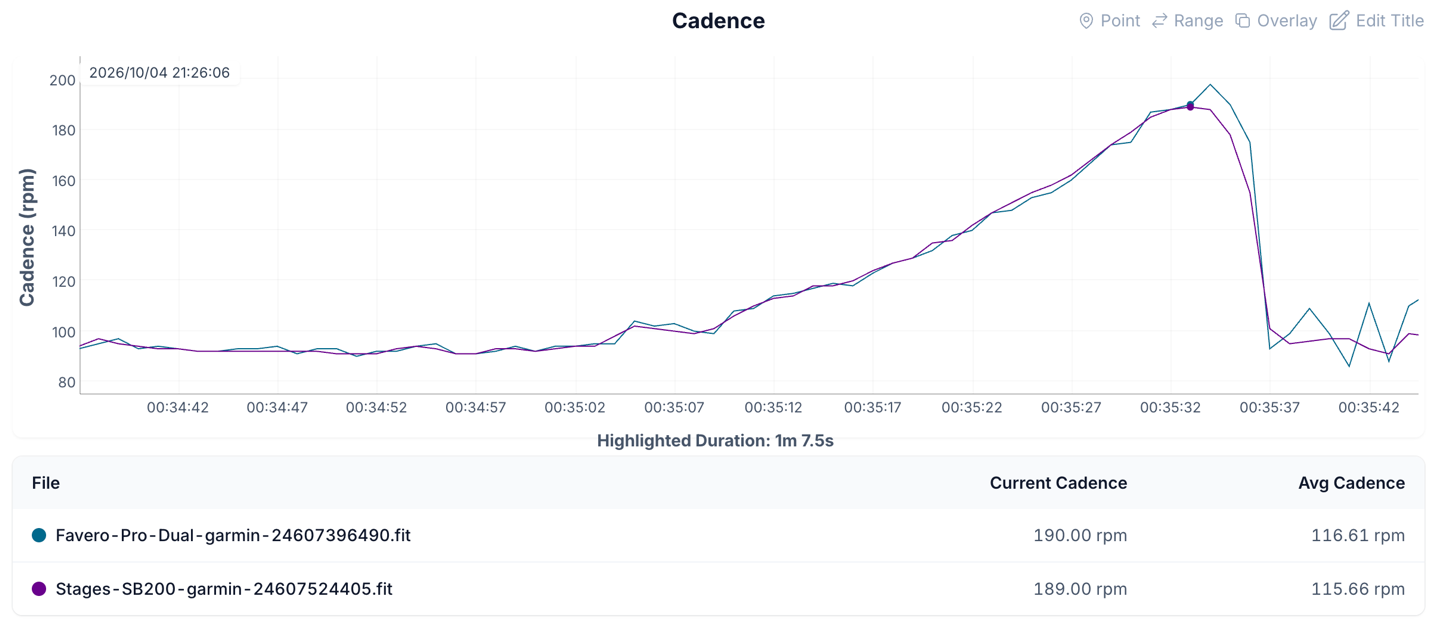
That said, the power between the two units for this high-cadence work was spot-on. Well done here.
Finally, as promised, here’s the moment the belt slipped on me, and then the immediate power offset. In confirming with Stages, the offset would exist until the belt stopped moving (which matches what I saw), because the bike immediately sees the belt slip and stops ‘trusting’ the values till it resets.
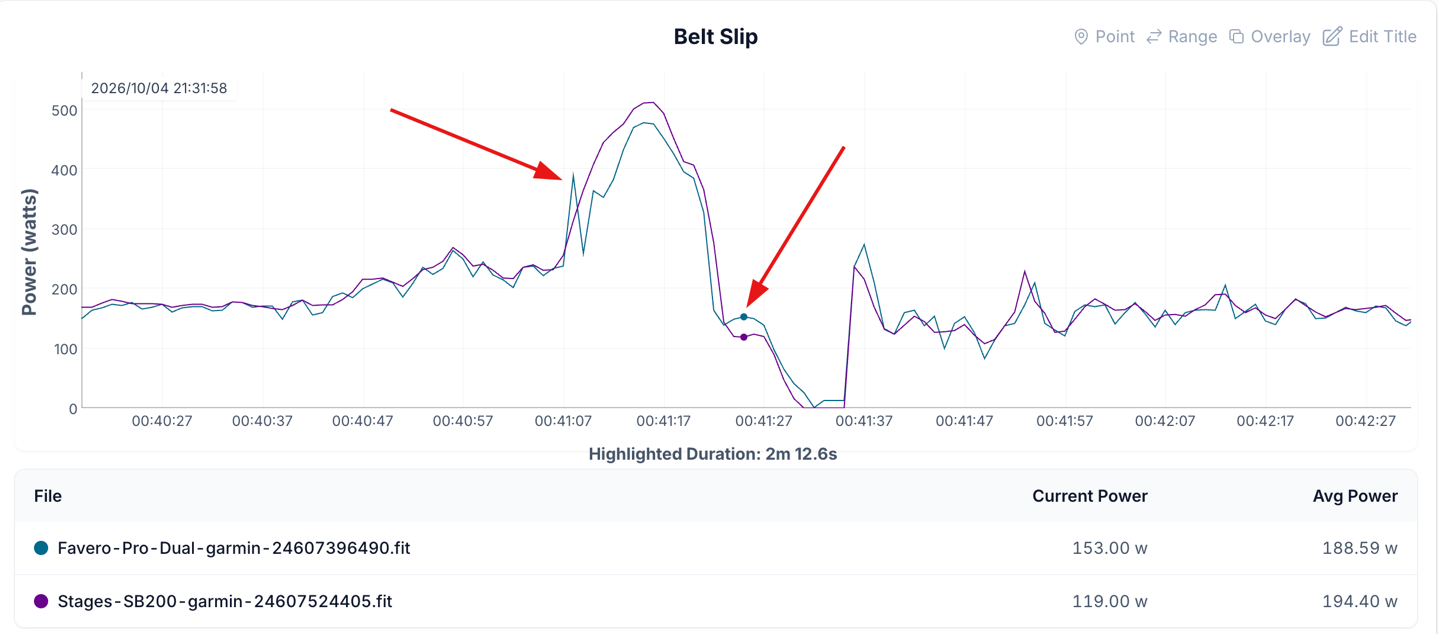
As noted above, Stages says I should only need to remove the casing and tighten a bolt one turn, and then I should be good to go. They don’t expect this to be a recurring issue once this is done. I’ll update this post once I’ve done that (it just happened last night) and then, longer-term, whether it pops back up again.
In any case, as for power meter accuracy, I’m not seeing anything that concerns me at any of the wattages I can ride. I simply can’t output 1,500w or other higher wattages, so I can’t replicate/test those (if you don’t know if you can hit those wattages, I promise you, you can’t). But at all the wattages I can test, the power is looking good accuracy-wise.
I’m looking forward to a bit more middle-ground on the ERG smoothing piece, which is something I’d thought I’d never say given how anti-smoothing it is. But the faster power update rate seen these days via WiFi especially, combined with the faster update rate of the SB200 itself (at 40x/second), means we are simply seeing far more human variability than we used to in the past.
(Note: All of the charts in these accuracy portions were created using the DCR Analyzer tool. It allows you to compare power meters/trainers, heart rate, cadence, speed/pace, running power, GPS tracks, and plenty more. You can use it as well for your own gadget comparisons; more details here.)
Upcoming Accessories:
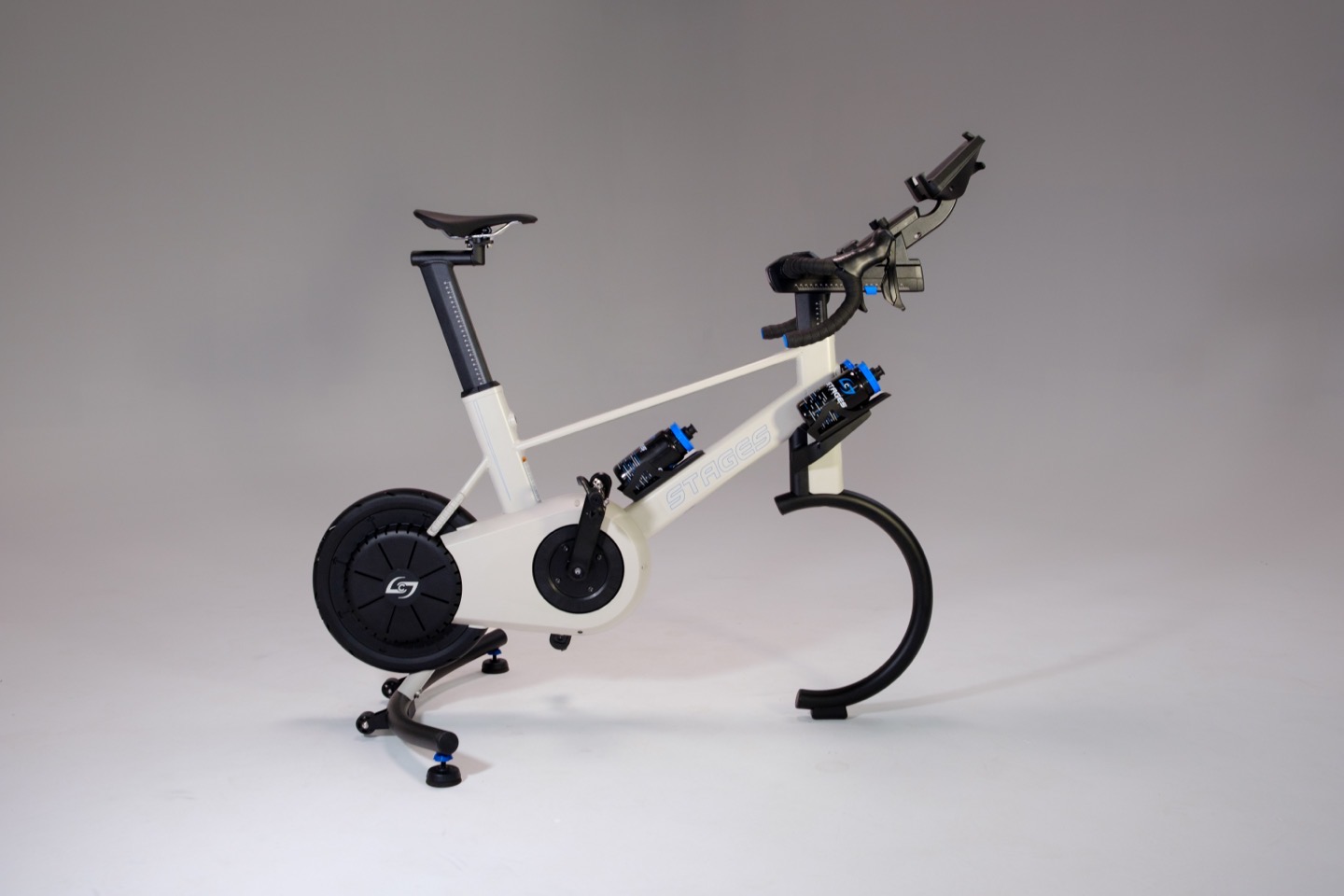
Just a super quick note that there are three upcoming near-term accessories for the Stage SB200 that I want to briefly mention. I don’t have any of these three accessories yet, but all three sound like they’re quite near-term (days/weeks to end of year at latest).
They are as follows:
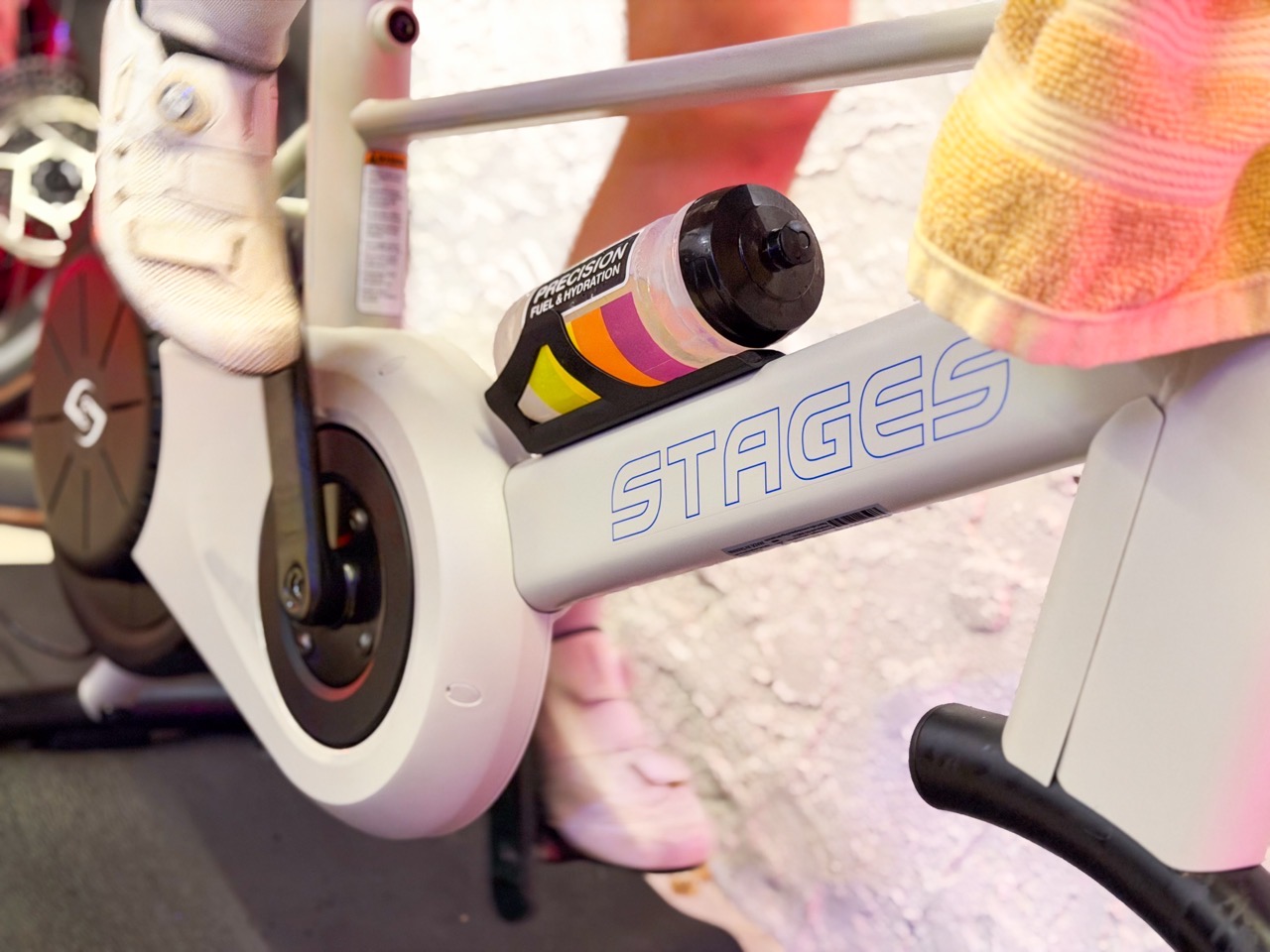
Hydration Station (seen above): This is simply two extra water bottles off the front fork, kinda reminding me of the Peloton Bike setup. While they noted that many people might just have a table/etc. nearby, as with most accessories, there’s a market for potentially edge cases like this.
RigidRide: Don’t like all the movement (or the front-wheel-looking fork)? No problem, you can swap out the front faux-wheel and put a dual-pronged fork that you see below. This will reduce side-to-side movement and improve stability.
More Adjustable Seat Post: This seat post allows fore/after adjustability of the seat post assembly, rather than just the saddle adjustability of the stock unit. This is honestly one I feel probably should have been part of the base unit, given how common seat post adjustability is. There is not yet a photo available of this accessory.
Also of note is that there’s no pricing on any of these accessories at this point in time.
Wrap-Up:
I think the Stages SB200 is a very solid re-introduction into the marketplace for Stages. To begin with pricing, they managed to slice $400 off the previous 2020-era pricing, which is a very good start to things, especially given that the KICKR Bike Pro sits at $3,999 (though the KICKR BIKE SHIFT, which is probably a bit more comparable, sits at $1,999). Obviously, the dedicated smart bikes are more expensive than the recent trend of frames+trainers. But they also serve a slightly different, albeit partially overlapping market.
Looking at the previous SB20 unit, I think the SB200 is a massive upgrade over it, though. Starting off with the ‘form’ side of things, it’s just a much more consumer-friendly design, whether it be the weight/portability, or the styling/look, or aspects like the display and phone holders. I’m super happy with the vast majority of the hardware choices here. I also appreciate the inclusion of an app with a bunch of workouts built-in, and easy sync of other workouts into it (such as TrainingPeaks workouts). All for free, without a subscription.
The areas where I’m not as thrilled about would be the lack of seat movement fore/aft being included, the freehub sound when coasting, and some of the ERG mode smoothing pieces. Stages has promised a very near-term firmware update that will give users three options to sort the smoothing pieces out. So that should address that concern. The other two aren’t deal breakers for me though, so I don’t think most people need to overthink those too much.
Overall though, I’m keen to see where Stages takes this reincarnation, both on the tweaks/updates front, as well as potential future Stages SB200 accessories. And the same goes for firmware updates to the unit, giving the display more customization/control. All things fully within their capabilities via updates. And beyond that, I really appreciate Stages adopting the OpenBikeControl standard – hopefully that’s the start of a trend from more hardware players.
With that, thanks for reading!
FOUND THIS POST USEFUL? SUPPORT THE SITE!
Hopefully, you found this post useful. The website is really a labor of love, so please consider becoming a DC RAINMAKER Supporter. This gets you an ad-free experience, and access to our (mostly) bi-monthly behind-the-scenes video series of “Shed Talkin’”.
Support DCRainMaker - Shop on Amazon
Otherwise, perhaps consider using the below link if shopping on Amazon. As an Amazon Associate, I earn from qualifying purchases. It doesn’t cost you anything extra, but your purchases help support this website a lot. It could simply be buying toilet paper, or this pizza oven we use and love.
FacebookXLinkedInShare Tags: Stages, Stages Bike, Stages Bike SB200 « Apple Watch Series 12 In-Depth Review: Worth Upgrading? Huge Amazon Prime Big Deals Sports Tech Tracker! »Related Posts
 » Stages Announces New Smart Bike: Hands-on Details
- » Stages Dash L50 & M50 GPS Bike Computer In-Depth Review
- » Stages Bike (SB20) In-Depth Review
 » Stages Announces New Smart Bike: Hands-on Details
 » Stages Dash L50 & M50 GPS Bike Computer In-Depth Review
 » Stages Bike (SB20) In-Depth Review
I just replaced the bottom bracket on my Kickr Bike V1 after ~ 30,000 “ miles”. I’m waiting for Wahoo or someone else to come out with a replacement that’s worth the cost to upgrade and no one has yet. I should be happy the V1 is so great but I’m kind of sad. It’s been almost 7 years!
Impressive for a V1!
Mine sadly didn’t last quite so long. It wasn’t dead-dead, but had some issues that needed repair*. A friend took on the task when I left Amsterdam.
Issues:*
1) GPLAMA “redesigned” the seatpost clamp one day during a ride using random bits from my shed toolbench. To be fair, not sure it was any worse than the original Wahoo design that broke mid-ride on him.
2) The entire bottom hinge thingy wobbles everywhere. Some might consider this a bonus rocker-plate however, so…there’s that!
On the bright side, electronically it was just fine, and as long as you didn’t need to adjust the seatpost, all was well with a bit of rock!
If you ever do get the to be release seatpost with the fore-aft adjustment, will you check if the seat ends up level left to right once you tighten things down? This is the one annoyance on my SB20 – on both the seatposts I have – that when you tighten the fore-aft adjustment down the seat ends up tilted slightly to the right (the left edge of the saddle is about 2 – 3mm higher than the right).
So now they’re defo back up and running, and given they’ve made parts for the SB20, could a second hand SB20 be worth looking into?
(I assume this should read no legal requirement “despite a legal requirement to do so”)
(Good catch on the typo, thanks!)
For picking up an SB20, I think it’d really depend on the price, and to a lesser extent the condition/usage. If the unit was lightly used, and looks like it was in good shape (especially around the crankset, nobody threaded any bearclaw holes, etc..), then it could be interesting. Especially if you primarily did ERG workouts and didn’t care as much about shifting/buttons/etc that are more applicable to Zwift or 3rd party apps.
If you dont mind some very mild ‘tinkering’ a used SB20 is a great buy. Be warned – the most difficult part of the puchase will be logistics… they are extremely heavy and awkward.
In the here’s how its different section, you state it supports Ant+, this was good news to me as I had previously read it didn’t support Ant+.
But later you say it doesn’t, so I assume Ant+ is not supported.
Definitely no ANT+ support. Was supposed to read ‘No ANT+’ in the quick summary up top.
At $2399 for this, an SB20 would need to be insanely cheap.
Any chance that we will get a Kickr Climb type replacement fork in the future?
Those cranks are terrible. I run 160s despite being 183cm tall with shortish legs.
My vertically challenged partner runs 155, mainly because thats the smallest widely available. She probably should use even smaller. Having your shortest option only go down to 165 is basically having 0 adjustment.
Love the top display. The T7 I just bought has a good display but in a bad position. I also desperately wish it had an option to configure 1x shifting instead of 2x. It also has a really nice setting in the app where you can input fit data and it will tell you exactly what settings to put the bike on for the same geo. Every adjustable trainer should have something like that available.
Looks like a great product other than the lack of shorter crank lengths. Both me and my wife I ride 160mm cranks. We are in the market for a smart bike, but the Zwift Ride looks like a much better option with the new model.
“I remember so clearly getting the Stages SB200 bike all unboxed and setup 6 hours ago.” I assume you mean the SB20 and 6 years ago.
6 hours….6 years… same-same in COVID-era timeframes.
Ray,
In the bike fits bit, it looks like you duplicated the picture showing how to adjust the handlebars up and down, instead of including one showing the fore-aft adjustability.
Great review. Glad to hear that the SB200 looks like a viable upgrade path once my SB20 finally dies – it’s still going strong after 6+ years of use. I don’t get not including a seatpost with true fore-aft adjustability at this price point. That seems like the only real miss
Nice, removed the duplicate photo (the fore/aft actually was down below, so think it’s all more logical now). Thanks!
Thanks for being a DCR Supporter!
“one of the ‘complaints’ about the previous SB20 was that it felt too much like a gym bike, and less like a bike that would fit in your living room (or garage). And indeed, the thing was a tank. Sure, it could last forever, but equally, it was overkill to the extreme for home usage.”
You’re really selling me on an SB20 tbh, especially with the renewed factory support.
Regarding the new one:
-That’s a max torque at the motor of 95.5nm if my math is right, better than the electric motor units but worse than a Kickr.
-High inertia is pretty interesting.
-What’s that crankarm/bb interface look like? How feasible would it be to swap cranks?
Great review! Loved my SB20 except that I’m one of those “robust” exaggerated movement-type sprinters and I broke the weld on the handlebar assembly (multiple times)…pic attached. So I finally switched to a Zwift Ride. How does this handlebar assembly look? I’m interested in this thing if the handlebars are less likely to snap off! Thanks.
Sadly, no support for flat bar setup. 31.8 bar clamp would obviously support a MTB handlebar – but currently no option for shifting. Maybe a future accessory (I hope!). I have a sb20 with flat bars and the stages flat bar shifters – with many, many thousands of happy indoor miles – I’ll continue to soldier with that for now.
Its puzzling to me as I see more flat bar bikes in the wild vs curly bar bikes – but indoor training setups seem to ignore this.
Great review Ray. Like always, the information I really need.
I have been an SB20 owner since 2021. Still going strong but I remain interested in the Stages ‘comeback’.
Here are a few other trade-offs I saw after reading your review and the online owner’s manual:
1. Unique method for adjusting crank length. When someone cross-threads the crank, only a replacement nut will be needed. Not so for bear-claw cranks. +1
2. Finally, a display! Should help people recover from “I turned the bike on but nothing happened”. Seeing current gear is also nice. +1
3. Garmin computer holder is +1. Lack of ANT+ means it will consume a Bluetooth channel to monitor/control rides with a Garmin computer. -1
4. HR relay saves a Bluetooth channel. +1
5. Shifters on the brake levers are good. 10 programmable buttons on the inside of hoods is nice to see. +1 No SB20 remote / sprint buttons means no convenient buttons when riding with hands on top bars. -1. Dream Drive is still with us +1.
6. Single frame leg on the floor under the handlebar (like Zwift Ride) is a bit disappointing. It hurts sprint stability. -1 On the plus side, the quasi-built-in rocker plate is nice. +1 The optional front legs are a good compromise +1
7. On / Off switch. It’s about time +1
8. Belt drive +1. Freewheel clicking noise is -1 but not a big issue when you have enough fans running.
9. Looks a bit pricey. Let’s just say -/+0 for now.
10. Lack of real power meter is a loss for me. No concerns about drivetrain wear and software modelling. Power meters reliably measure your effort. -1
11. With a few more firmware updates, Erg mode looks like it will be good. The SB20 Erg mode is poor. +1
12. Light enough to ship in one box via UPS and FedEx. Stages probably won’t go bankrupt this time 🙂 +1
More +plus than -minus.
Honestly, I appreciate Ray’s review, but think I will wait until you buy one and take it apart and tell us its real Strengths and weaknesses. The stuff you have done for the SB20 community has been invaluable in keeping a lot of our bikes alive.
Couldnt agree more! Craig has been a rock star for us SB20 users.
I have owned a SB20 for over 3 years now and without many complaints.
The one complaint I have always had and still have today, is the fact that the SB20 has programmable buttons, which were promised to become programmable for zwift actions. But alas, 3 years down the line, these buttons still remain totally useless (at least concerning zwift, no experience with other platforms).
As the SB200 buttons are now programmable in zwift, any chanse they might open up this feature to the SB20???
Please say yes!
Thanks as always Ray.
The elephant in the room for me is how it stacks up against the Cycplus T7.
I’m guessing they are not sending you one or we would have heard about it before now.
Based on other reviews I’ve seen it looks pretty solid from a performance viewpoint and the styling and build looks much better than this “frame with bolted on bits” approach and the price is also substantially lower.
Interested in your thoughts if you have seen or tried the T7.
I second this. The T7 minus the crank, water bottle mount, and display issues is far more compelling since it gives you gradient simulation at a much lower price point.
Nice review – how would you compare it to the Kickr Bike Pro?
I was looking at the Kickr, but it seems it requires much more space and I like the inclusion of Smartpone and tablet holder with the Stages SB200.
A more detailled comparison would be really nice…
Thank you for the great review, I currently own a SB20 and have a couple of comparing questions. because it looks interesting, except the loud freewheeling. Would sound nice for my family when asleep.
With the SB20 I use the brakes to sprint, does this work with the sb200 as well, braking to quickly gain a higher recistance?
How does the material (paint-treatment) compares to the SB20, becuase mine is rusting severely (whipe it down after every ride, but you can’t wipe down below the covers ;))
The SB20 only has batteries in the cranks, not the shifters ;), and it has cool wheels for relocation at the front.
Hi Ray, did I miss any mention of things like “Race Mode” and whether that is supported? Also nice to see the sticky watts from the SB20 are gone.
In GPLama’s video he says Race Mode is supported in 2.4GHz WiFi, but not on 5GHz WiFi
Any WiFi band will do 10Hz race mode. BLE is 4Hz.
Whoa, surprised to see Stages come back from the dead, just in time for Halloween. Just out of curiosity, which is the Stages app used to configure this bike? And does it also support the SB20? IIRC the old Stages Link app the SB20 used isn’t even in the App Store anymore, which is why I had given up on trying to sell mine (I didn’t want to sell someone a brick). Maybe I can finally sell it now!
There is already a new working app for the sb20. Downloaded mine a few months back.
Thanks for the thorough review. I’m with the crowd that feels burned by Stages’ financial past financial difficulties. SB20 owners were basically abandoned for nearly two years – first support disappeared while the company’s finances spiraled, and we were left in limbo while the company sorted through the bankruptcy and sale process and went silent on the future of the product – despite eventually reengaging with tentative and limited product support. I understand Giant is one of the titans of the cycling industry, but it makes it a tough call to trust a new Stages product given the history. One of the reasons I bought an SB20 was because I was familiar with the quality of their commercial spin bikes.
As for your review, despite the better electronics the bike sounds like a lower end product. Bouncing around on sprints while the bike is plugged does not sound like fun? The clicking drivetrain – which I like on my outdoor bike – would be a total downer in a home gym. Though “overbuilt”, to its credit, the SB20 felt indestructible, at least until the electronics or cranks would fail. I think that was because the bike shared design lineage with Stages’ great spin bikes. This product seems to have moved on from that design ethos.
The lack of fore/aft adjustment on the seatpost is definitely a disappointment, as is the tool required adjustments to the bars and seatpost. After all those both have been mainstays of high-quality spin bikes for years (Peloton being the exception with no fore/aft adjustments in the handlebars and the difficulty in raising and lowering the bars given the screen weight). Also, the front-end stability sounds like it could be a hazard in the making.
That said, the newest update of the Wattbike is $2899 in the US. How would you compare the SB200 to that product, is it worth considering?
Thanks again for allyou do.
Most indoor bikes bounce around a bit (or, the opposite, and they’re like the Tacx NEO Bike or Wattbike ATOM, and have zero give). I’m simply pointing out that depending on your weight/sprint style, you might get a bit more trainer mat movement. But hardly a deal breaker, and certainly not a hazard.
In terms of the Wattbike ATOM at $2,899, vs SB200 at $2,399, not even remotely close. Heck, I’d argue the Wattbike ATOM would have to be solidly sub-$2,000 to even consider it these days. And even then, I’d get the KICKR SHIFT at $1,999 instead. After all, the Wattbike ATOM came out just a couple months after the original Stages SB20 way-back in 2020. Heck, I think the Wattbike ATOM is probably solidly in the danger zone right now. At almost every price, it’s kinda hosed. At $1,999 (so $900 less than current), I’d recommend Wahoo KICKR BIKE Shift. At $1,500, I’d recommend Zwift Ride V2. And even down to $1,000…I’d still recommend Zwift Ride V2 (with KICKR CORE). I don’t know if there’s a price point that makes sense for it in 2026.
Anyway….
What the KICKR BIKE Shift lacks compared to the Stages SB200 has is mostly around customizable controller buttons, including things like Zwift Protocol support, Zwift Race mode, etc… Plus things like the lack of display, lack of phone holder spot, and other handlebar-related bits. Inversely, though, the KICKR Bike SHIFT has fore/aft seatpost/saddle adjustment.
Great feedback as always. Really appreciate your insight.
Sorry for the confusion, I meant the belt itself slips at high torque, not that the whole unit bounces during sprints.
I’m a subscriber to Training Peaks Virtual and just received a notice for a 10% discount and free shipping on this trainer.
gr8 – and what is the discount code?
Did you notice any slipping while doing the sprints? I’ve noticed on my Wattbike, which is also belt-driven, that during max sprints from a rolling start or a dead start, the belt slips. I’m curious if the two-belt system fixes this.
FWIW, the belt on my SB20 never slipped after hundreds, if not thousands, of sprints.
I had belt slippage issues (I talk about it in the accuracy section). Stages is essentially saying that was tied to getting me an early production unit, and has since been addressed. They don’t expect it’s something a regular user should see or do.
In my case, they sent over relatively simple-looking instructions for tightening it. It’s on my to-do list later this morning (it’s not hard, just a matter of a handful of screws to take off both sides of the lower plastic case, and then one turn of the tensioning bolt).
Thanks for the review! Could you post the max saddle height please? Previously Stages also specified a very tall max user height, but the max saddle height was much lower. I am 2m (6″6) and have 89cm saddle height (above the BB) and am outside the SB20 range.
It looks stylish and minimalist—I like it. I was going to ask about stability, but the mention of RigidRide accessoiry probably makes that question unnecessary. Still, is it a bit “wobbly” without the RigidRide?
Price of the RidgeRide?
Never mind- you have already answered the question about stability in your report.
Passt das Sb20 Sattelrohr in das SB200?
Now that the new Stages SB200 supports gear display on Zwift, can we expect that it will aslo work on the Stages SB20?