요약
A shadow on a wall can’t tell you everything about the object casting it and neither can a blurry UAP video, a ghost photo, or an AI-generated image. This essay offers a five-step test for separating genuine observation from the hidden story we quietly add to…
본문
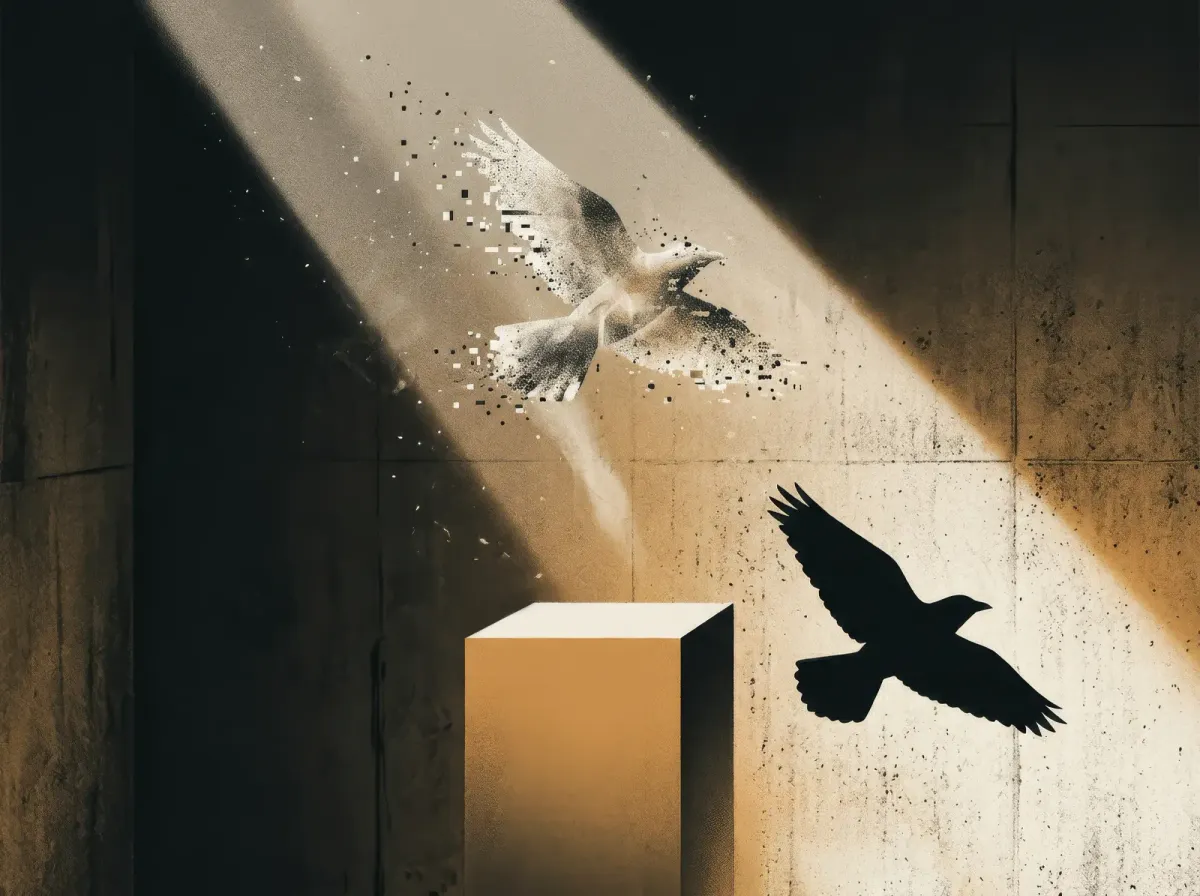
Suppose you are shown a shadow moving across a wall. You can measure its length. You can watch its direction change. You can record its speed. With enough observations, you may even predict what it will do next. But how much do you actually know about the object casting it?
The shadow may preserve some information about its source, but it also destroys information. Different objects can cast similar shadows. The same object can cast radically different shadows under different conditions. And a convincing shadow might even be generated without the object you imagined being there at all.
That simple problem offers a useful skeptical rule for an age of UAP videos, ghost photographs, sensor anomalies, eyewitness testimony, and AI-generated media: Never attribute more structure to a hidden source than the evidence can carry.
Anomalous evidence is almost always a projection of some sort. A blurry light in the sky, an infrared signature, a photograph of an apparent figure, or a short video clip is a representation produced by an instrument, a witness, an algorithm, or some combination of them. A witness may even report an experience with extraordinary clarity and sincerity. Those facts can be real facts about the evidence without settling what caused it.
Consider a UAP video. The observation may justify a modest claim: something appears in the recording that the observer cannot presently identify. That is already interesting. But “unidentified” does not necessarily mean “extraterrestrial,” just as “anomalous” does not entail “supernatural.” The evidence may establish that there is an unresolved observation, but it does not automatically establish the ontology of whatever produced it.
The skeptical task is not to ban possibilities; it is to prevent possibility from masquerading as probability or evidence.
Whenever we encounter exaggerated inference about anomalous evidence (pretty much any time the topic is brought up in the media, podcasts, or conversations on social media), a useful way to discipline our reasoning is to pass the claims through five thresholds:
1. What was actually observed? Describe the evidence without smuggling the explanation into the description. “A bright object crossed the frame” is an observation. “An alien craft crossed the frame” is already an interpretation.
2. What must be true for this evidence to exist? This is the realm of necessary inference. A digital image requires some causal history. A radar trace requires a signal-processing event. A reported experience requires an experiencer and a memory report. But necessity usually takes us much less far than we want.
3. What remains underdetermined? Could multiple causes produce the same observation? Almost always, yes. Atmospheric effects, aircraft, sensor artifacts, perspective, misperception, hoaxes, classified technology, software processing, or genuinely unknown phenomena may overlap at the level of the evidence.
This is where the shadow analogy is most useful. A two-dimensional projection may be compatible with many three-dimensional sources. If several hidden structures could produce the same visible pattern, the visible pattern cannot by itself tell us which hidden structure is real.
4. What is merely possible? Possibility matters, but it is cheap. Aliens are possible. Unknown atmospheric phenomena are possible. Unknown technologies are possible. A supernatural explanation can be stated as a possibility too. The skeptical task is not to ban possibilities; it is to prevent possibility from masquerading as probability or evidence.
A realistic image or video can now function like a shadow cast by no corresponding event at all.
5. Where does inference become metaphysics? This is the boundary we cross when we begin describing the hidden source in detail even though the observation does not uniquely support that description. At that point we are no longer reading information from the evidence but adding information to it.
AI-generated media makes this problem even sharper. For most of photographic history, an image at least carried a default assumption that some external scene stood in a causal relationship to the picture, even if the scene was staged, misleading, or manipulated. Generative AI weakens that assumption. A realistic image or video can now function like a shadow cast by no corresponding event at all. We may now first have to ask, “Was there an object or event of this kind behind the image in the first place?”
Obviously, this does not mean that every extraordinary image is fake and every witness mistaken, or that every UAP is mundane. It means that extraordinary claims increasingly arrive through layers of mediation: cameras, compression, sensors, software, and now generative AI models. Each layer can distort or even manufacture patterns that invite fallacious or misguided interpretation.
The deeper lesson here is about how human beings reason whenever we are trapped on one side of an informational boundary. We see effects and infer causes. When we see outputs, we infer systems. To refer back to our analogy, when we see shadows, we tend to imagine the objects that cast them.
The error lies in forgetting when inference has outrun the information available.
Often, that is exactly how knowledge advances. Science routinely infers unobservable structures from observable effects. But, good inference earns each step by showing why the proposed hidden structure explains the evidence better than its alternatives and by generating tests that could prove it wrong.
So the next time a strange video, anomalous sensor trace, ghost image, or AI clip appears on your screen, try a simple question before asking what it “really is”: What can this shadow actually tell me about the thing—if any—that casts it? Then ask the harder question: At exactly which step did I stop observing the evidence and start supplying the hidden world myself? That boundary may be the most important thing in the picture.