요약
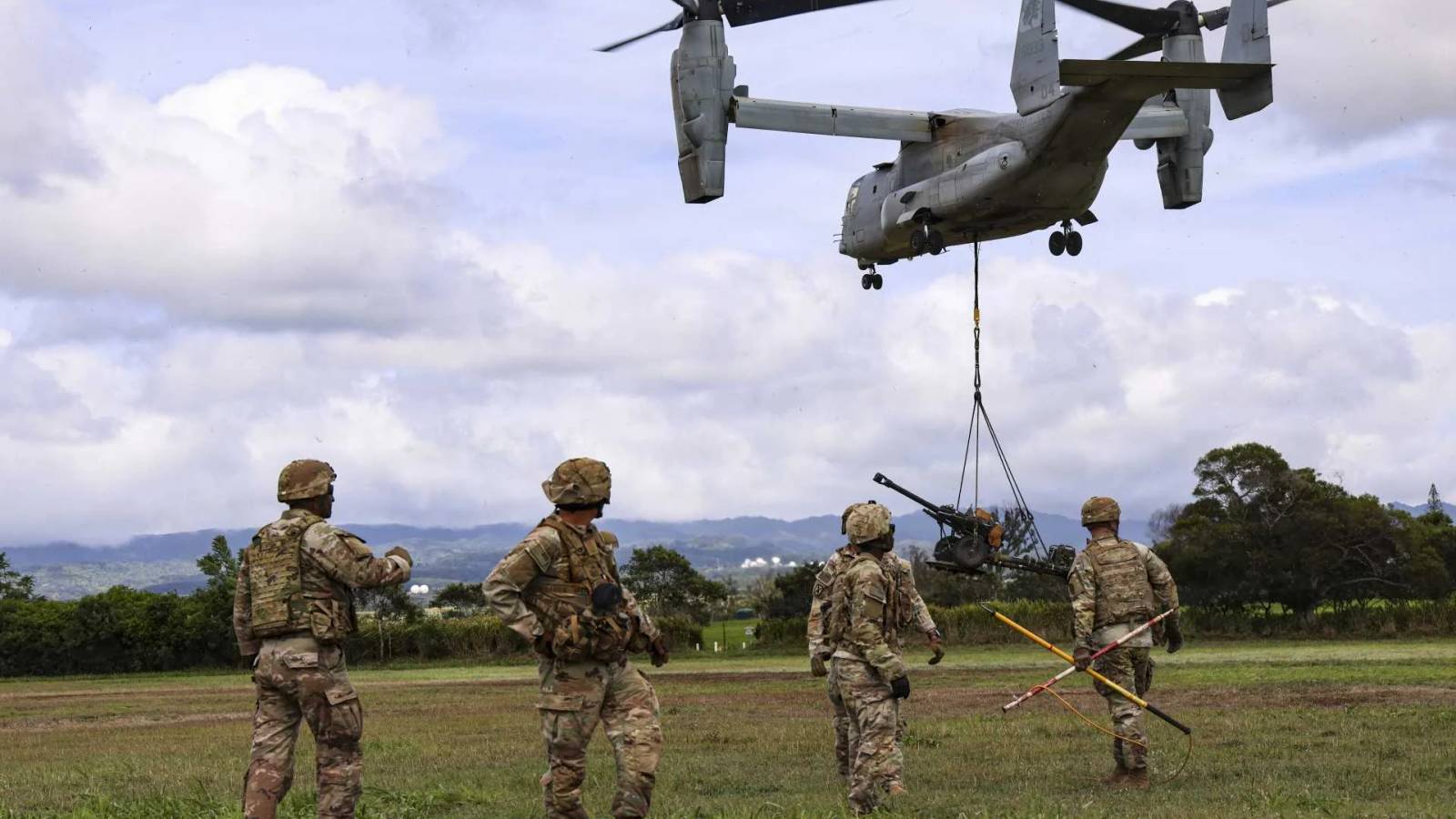
Army soldiers tested a Marine MV-22B Osprey carrying an M119 howitzer in Hawaii as part of long-range maritime air assault training.
본문
Follow Followed Add us on
 By
Matthew Reisdorf
Published Sep 2, 2026, 3:00 AM EDT
Sign in to your Military.com account

The Army is testing a new way to move artillery across the Pacific, training the conventional helicopter lifts for Marine Corps tilt-rotor aircraft that are capable of carrying crews over longer distances and across swaths of open water.
The Bravo Battery, 3rd Battalion, 7th Field Artillery Regiment, 25th Infantry Division conducted a gun raid with a Marine Corps MV-22B Osprey in Hawaii during August. In the exercise, soldiers sling-loaded the weapon beneath the aircraft.
The Army said the training validated the joint capabilities needed to prepare soldiers for Long-Range Maritime Air Assault Operations. This mission enabled them to test out what it would be like to give commanders a way to rapidly place artillery on islands or isolated coastal positions that cannot easily be reached by standard roads.
As reported by Army Recognition, the test is a potential shift from short-range helicopter-support gun raids towards a longer duration of mission, with the lethal combination of Army artillery and Marine aviation.
A Gun Raid Built for the Pacific
Gun Raids are designed to be quick. Aircraft can carry an artillery piece to the proper firing position, where soldiers activate the weapon and fire on the necessary combatants in a timely manner. After completion, extraction is then started.
The process of gun raids reduced the amount of time that a crew needs to stay at the firing locations. As drones and other long-distance technology make artillery positions more dangerous, speed is of the highest priority.
In the Pacific, there is an additional challenge. Units need to island hop and maneuver in between positions that don’t exactly have fortified roads all the time. Ports, airfields, and other transportation that is safe usually become a target in the early stages of a conflict.
The Osprey can help to bypass these problems. The aircraft takes off and operates like a helicopter but is able to fly and transition into somewhat of a fixed-wing aircraft, giving it greater speed and range than regular utility helicopters.
The Marine Corps has listed that the MV-22B has a radius of 350 nautical miles in the correct operational settings. The Army did not mention how far it traveled during the recent exercise, and that radius may be changed with the giant weight of a howitzer on the inside. Depending on cargo and support staff, that radius could also be affected.

Why the Army Went This Route
The M119 is a light 105 mm howitzer designed for operations where larger artillery pieces may be difficult to transport. It weighs approximately 4,700 pounds and can be moved beneath helicopters and other vertical-lift aircraft.
It has a range of just under nine miles with standard artillery and can also shoot rocket-assisted projectiles an additional 3 miles further than the standard range. The max firing rate is six rounds per minute.
There is a variant, called the M119A3, that uses a digital fire-control system that can help crews establish a firing position more quickly. As stated earlier, speed is of the utmost essence. During a raid, every minute that is wasted is a minute closer to death, as enemy surveillance systems are very efficient.
The close range (limited at the moment) is something to notice. A 105 mm howitzer has to operate closer to firing targets than a 155mm artillery system does. Air mobility can partially offset that disadvantage by moving the gun closer to a supported force rather than relying on the short range of the weapon.
Out With the Old
In 2020, soldiers in Hawaii used the UH-60 Black Hawk helicopter to carry three howitzers between training areas before establishing firing positions. These exercises were a demonstration to show how helicopters could rapidly reposition light artillery over a relatively shorter distance, and the August training added the longer reach of the Osprey and linked the mission further to maritime operations.
These extensions would allow units to cross water, avoid damaged roads, or reach hard-to-navigate mountainous terrain. The operational capacities make this a win-win. It also shows the cooperation needed between branches to demonstrate the effectiveness of combat efficiency.
While the exercise left some questions unanswered, such as the minute details of such a raid, much to celebrate if artillery raids can level up like this for the services.
A complete mission would require more movement than just transferring a howitzer. Crew, ammunition, communications equipment, and a whole host of their support staff assistance would potentially be a factor in these kinds of operations.
This recent exercise shows the service is always evolving battle tactics for the advancement of lethality and safety. While traditional artillery transportation is still a thing of the future, in a Pacific fight, the survival of a crew and the success of a mission all rely on speed, of which this mission objective will surely be embedded in future operations if done successfully.