요약
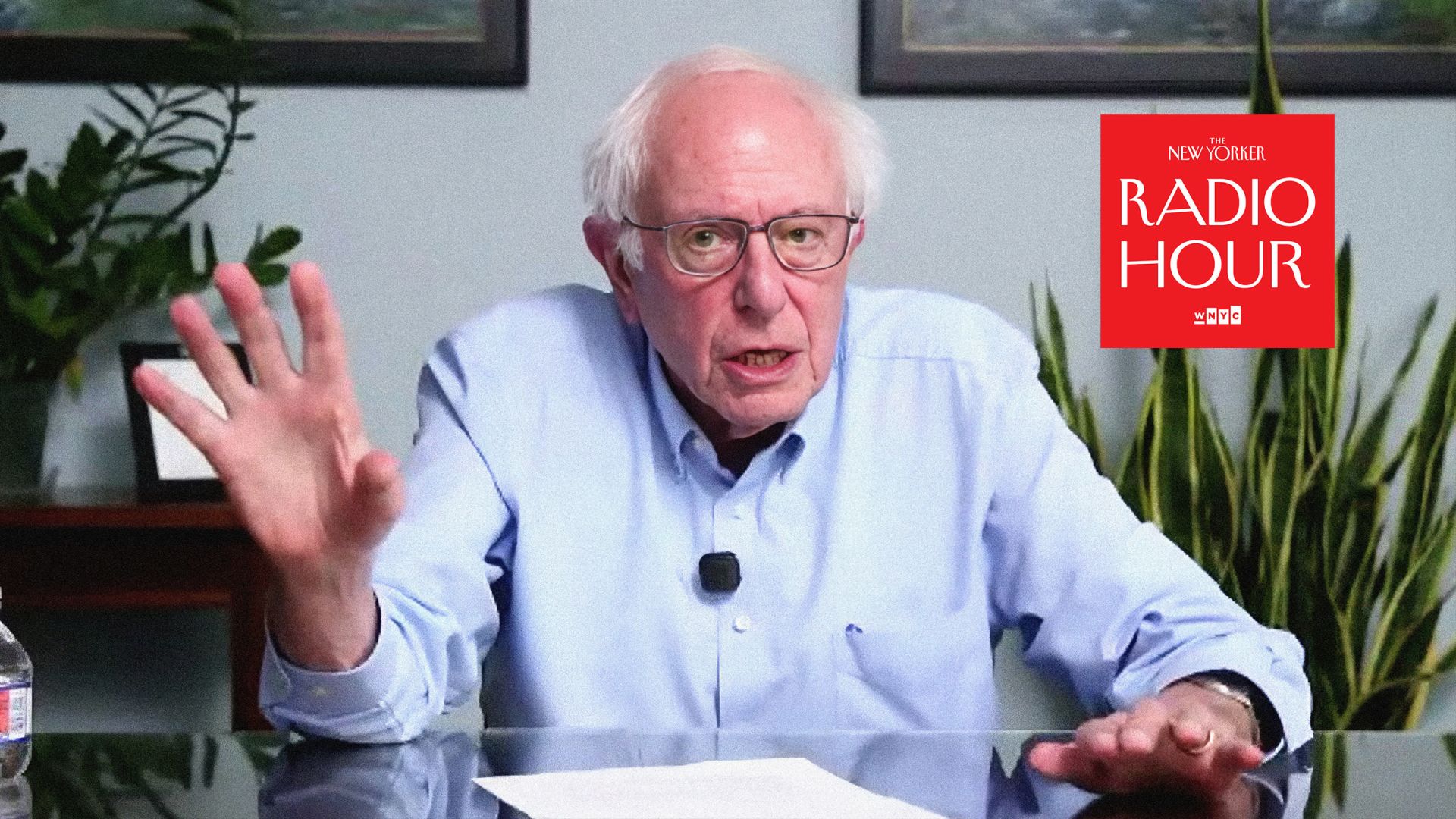
The Vermont senator co-sponsored a bill that calls for a moratorium on building data centers. He discusses the environmental and economic concerns, and what the government can do. This interview is drawn from The New Yorker Radio Hour, a weekly radio show and…
본문
Released on 08/14/2026
TranscriptHow are you?
I'm great.
Senator Sanders, welcome to The Radio Hour.
[Bernie] Thank you.
It's good to see you.
You know, back in March, almost a half a year ago,
you and Alexandria Ocasio-Cortez put forward
the AI Data Center Moratorium Act.
What led to your action?
Well, there were a couple of fundamental reasons.
Number one, it was clear to us that these
very large big tech corporations owned
by some of the wealthiest people in the world
were just shoving their way through small communities
and doing significant environmental damage,
raising electric rates,
threatening scarce water supplies in some cases.
And I thought it was important
to make it clear that that was unacceptable.
But in addition to that, I was worried,
and I think Alexandria is as well,
that this AI and robotics revolution
is moving so, so quickly.
It is so transformative that we have got to slow it down.
It is going to impact every man, woman, and child.
And I got involved in this, to be honest with you,
not because I'm a tech nerd,
but because I looked around me and I said,
Wait a minute, this stuff is moving lightning fast.
And who is standing up and saying,
What is this impact going to mean?
What is it going to mean to workers,
to our environment,
to our kids, to our privacy, to our democracy?
What is it going to mean in terms of the possibility
of an existential threat if AI becomes smarter
than human beings?
So I'm asking these questions.
I'm reading stuff, I'm talking to people,
and I go down to the floor of the Senate,
virtually no serious discussion.
So I think the most important point is, slow it down.
We got to make AI and robotics work for ordinary people,
not just to make Elon Musk
and Zuckerberg even richer than they are.
So, the point is not just to slow down
the construction of data centers
and the potential damage they do in terms
of the environment, water,
as you mentioned, electrical bills,
it's also to slow the process entirely.
Who are you talking to?
What kind of information are you getting about AI
and its dangers and what you may see
as its benefits as well?
And who should decide these questions?
I have talked to a whole lot of people.
A number of months ago I went to California
where I talked to, you know,
a lot of these guys, very smart guys.
I talked to Jeffrey Hinton,
one of the godfathers of AI.
We did a town meeting at Georgetown.
And he told me, he said, Look, Senator,
AI will sooner or later become smarter than human beings.
And it is then likely that human beings
will lose control over AI,
which could be an existential threat to the planet.
And you know, David, what you're seeing,
what have we seen in the last week?
We have seen from OpenAI, we've seen from Anthropic,
we've seen from Meta
that they have lost control of some of their models
that have hacked into other entities.
So you got all of these threats there.
And we cannot allow Mr. Musk
and a handful of multi-billionaires
to determine the future of humanity.
You mentioned you talked to Jeffrey Hinton,
who was profiled a great length in The New Yorker,
and you're absolutely right.
He was a godfather of AI in some senses,
and also one of the people who stand up now
to talk in warning about it.
Do you ever talk to the Zuckerbergs and the Musks
and those kind of people
to get their input. I talked to Altman.
I talked to Altman.
He was here... That's a conversation
I would love to have been a fly in the wall for.
Tell me about your conversation
with Sam Altman. Wasn't all that exciting.
Altman is, I think, a very good salesman.
He is, you know, he's selling his product.
He wants to get- What did he say to you?
Look, I, you know, he says is that, I mean, literally,
I think the same day or day before or later,
he was to see Donald Trump.
So the idea he goes to see Trump, he goes to see Sanders.
Wow, that's great, you know?
He's talking to everybody.
But I think, you know, what he wants to do,
I think he's talking about, as Trump is,
Well, we're going to have Americans share in the wealth
and we're going to give them 5% of our profits,
and so forth and so on.
And that's kind of what he was talking about.
Meanwhile, OpenAI and the other AI entities
are spending huge amounts of money
in campaign contributions through their super PAC
to make sure that Congress does not do
what should be done.
But, David, here's the bottom line to me.
Take a deep breath.
Take a look at what AI and robotics can do economically
in terms of displacing millions and millions of workers.
Okay?
That's a fact.
Now, no one knows exactly what the rollout is,
when, how, what.
It will displace millions of workers.
Are we prepared for that?
No, we are not.
It will have an emotional impact
on the mental health of our kids.
All right?
You got kids now who are spending five,
10 hours a day on their screens.
You have 40% of kids age two
and younger who have tablets now, all right?
This is re-altering the brains of our kids.
Reading skills are declining.
Writing skills are declining.
Cognitive capabilities aren't declining.
AI will only exacerbate that.
I think, make it worse.
Privacy rights.
Hey, go to the doctor's office, go to the...
Make, you know, have a bank account.
Send out an email.
Somebody will know what you are doing.
What are we going to do about that?
Protect privacy rights.
Democracy.
I don't know if you've had that experience.
I've had the experience.
Deep fakes.
You know what a deep fake is?
[David] Of course.
All right. They do it really well.
Somebody could take me on your show right now
and transform every word that I said, right?
And people say, Why did Bernie Sanders say that?
Why does he say how much he, you know,
loves Donald Trump?
You know?
I'm surprised to hear that.
How the hell are we going to know the difference
what is true and what is false?
I think you're probably hearing, Senator Sanders,
in conversations with people like Sam Altman,
that if the United States acts too slowly,
then the Chinese will win the AI revolution.
Can I guess that that was one of the things he said to you?
Yeah, it was.
And you know, that's the usual line.
Although I am very happy to tell you,
a number of months ago,
I did a public meeting here on Capitol Hill
in the Visiting Center.
We had hundreds of people coming out.
And you know what we did?
We had two leading AI scientists
from the United States and two scientists
from China beaming in.
And boy, did I get criticized for that.
Imagine having American scientists
talking to Chinese scientists.
And of course that is going on all the time anyhow,
but we made it public.
We had this public meeting.
And I'm happy to say that,
or maybe we should be scared,
that even the Trump administration,
which criticized me for that meeting,
is now planning to meet with the Chinese
because of what I suspect
are legitimate concerns about existential threats.
Which takes me back to an issue again.
Literally in the last couple of weeks,
we have had AI models breaking away from human control.
Not just for the last few weeks.
David, that is now.
[David] Understood.
If we don't deal with this stuff,
what's going to be the case next year, five years from now?
You've also proposed an American AI
sovereign wealth fund act.
I did.
Talk to me about that.
How would that play a role in the effort
you're describing? All right.
Two important factors there.
One more important than the other.
The first is [coughs] the foundation
of AI is human knowledge, right?
The discussion that you and I
are having this very moment will end up
on the internet, will end up within the AI world.
It'll be part of the zillions of other aspects
of human knowledge, et cetera, et cetera.
It strikes me that if we as human beings
create the foundation of what AI stands on,
the people who do it should get benefits,
financial benefits from that.
And that's what a sovereign wealth fund would do.
If AI profits, as I suspect it will,
I want the American people to benefit
from that, not just Mr. Musk and Mr. Zuckerberg.
Second of all, more importantly, when we have 50%
ownership of the major AI companies,
which is what the sovereign wealth fund does,
what it does is put public representation
on the boards of every major company.
So if a company comes forward and says,
You know, we got this great idea.
Companies want it.
We can eliminate five million jobs
in the next year.
Somebody in the public will say, Sorry,
that is not what you can do.
Public will have a voice there.
Will be able to stop bad things,
stop you on the undermining
of our democracy, et cetera, et cetera.
So the two goals of that one, more importantly,
have the public represented on these AI companies
to stop bad things from happening.
Second of all, to the degree that money is being made,
I want AI profits to benefit ordinary Americans,
not just Mr. Musk and Mr. Bezos.
One of the alarming aspects,
and there are many, about data centers,
is that local and state officials
have been signing non-disclosure agreements in deals
with data and AI companies.
For example, the governor of Louisiana is reported
to have signed an NDA with Meta, Mark Zuckerberg's outfit,
on a $50 billion data center campus.
Is it legal for government officials to sign an NDA?
What are these...
What is the existence
of these NDA signal to you. Well, David,
we're living in a moment... Who knows?
where the law is not all that relevant anymore.
We have a president who kind of doesn't believe
in the Constitution or the rule of law,
and I'm afraid his views have spread down
to other Republicans.
But what I would say,
whether it's legal or not, I don't know.
What I would say is, if you're a small town, all right,
and you got some volunteer members of the board
of select people, selectmen, right?
These are guys that work for a living.
They come to a meeting once a week,
they volunteer their time,
and suddenly you got some multizillion dollar company
with 18 lawyers and accountants coming in
and saying, We have a deal for you.
And all you got to do is sign right here
and you're going to get, you know, money for, you know,
property tax relief or schools or whatever you want.
Just sign right here.
Yeah, these are ordinary people
taking on some of the largest corporations in the world,
not quite a fair fight.
But what we have seen [laughs]
in the last many months, it's quite unbelievable,
is you've seen a grassroots resistance
that I think the big tech oligarchs never expected.
And that is-
And that's what I want to ask you about.
How much is this picking up steam as an issue?
God knows there's such a range of issues
in this Trump era to focus on,
on the left or anywhere else.
How much has data centers picked up steam...
That's interesting.
[David] as a galvanizing issue?
Yeah, you're absolutely right.
There are a million issues that are out there.
I mean, every day my office is dealing
with 10 different issues.
But I think what AI and these data centers
have done has given people who often feel powerless...
You know, what are they going
to do about oligarchy in America?
What are they going to do about
a corrupt campaign finance system
or the healthcare collapse in America?
But you know what?
Some company wants to come in
and destroy your local environment.
You know what? We can fight back.
And boy, have you seen, I'm sure you've seen some
of these videos of local people
taking on their poor, little,
you know, city councils, my God,
mayors getting thrown out of office, all that stuff.
I think people feel some sense of empowerment
that they can actually stop something.
But I think also, and maybe I'm wrong in this,
but I don't think I am,
what folks are saying is, Look,
I don't want this colossus to be in my backyard.
It's ugly. It's disgusting.
It's taking farmland.
It's destroying our environment, water, electric rates,
noise, heat, all that stuff.
That's real.
But I think in the back of the minds
of many of these folks, and by the way,
they are conservatives,
they are progressives, they are moderates.
There's something else going on.
They're saying, What the hell are we doing?
What is this going to contribute to?
Is this going to result in my kid
not being able to have a job?
Is this going to result in, you know,
my not having any privacy?
Why am I aiding these large corporations
owned by the wealthiest people in the world
who could care less about me?
How is this different from other historical instances
in which there's rapid technological change?
I don't mean, you know, horse and buggy movement,
but the rise of the automobile,
the rise of electricity, the rise of the internet.
But I have to tell you, Senator Sanders,
when I would watch congressional hearings
about the internet,
I did not have any great faith [laughs]
in our elected representatives
and their knowledge of what the internet was about.
This was exemplified by watching a member, I think it,
I don't remember if it was a senator or congressman,
I believe it was a senator,
asking the head of Facebook how they made money,
not understanding a thing about these technologies.
And they sounded like, you'll forgive me,
the way my kids treat me with technology,
or I would've treated my parents with a certain kind of,
you know, eyebrow-lifted condescension.
And then they just went to town
and did whatever the hell they wanted.
And it resulted in one
of the great transformations of human consciousness
and behavior in the history of civilization.
And it wasn't at all tempered by the efforts
of our elected legislators.
Well, I mean, what's...
You're discussing a very significant reality.
The way I see it is that
you have this extraordinarily transformational technology.
You talked about electricity.
We can talk about the industrial revolution,
profound impacts, but it took...
It took place over a period of years.
Right.
I think the difference about this one, David,
it is moving much more rapidly
than any other technological change.
And it's going to impact us in every aspect of our life,
from who we are as human beings
and how we relate to each other,
not to mention the economy and privacy and democracy
and all the rest of that stuff.
Number two, I mean, and then you pose a real concern.
This is pretty complicated stuff, you know?
And I can absolutely guarantee you
that most members of the United States Senate
are not, you know,
steeped in the kind of knowledge that,
in fact, we should have.
And I include myself in that.
You do. This very...
It's complicated stuff.
But I think at the least that we can do
is call upon those people who do know what the impact of AI
and robotics will be to help us design guardrails
which makes certain that these technologies work
for ordinary people, not just enrich the very rich.
That seems to me the goal that we've got to achieve.
I gather you recently met
with Erin Brockovich to talk about...
[Bernie] I did.
data centers.
What was that conversation like?
Probably different than Sam... I like her a lot.
I mean, she's a-
Different than with Sam Altman.
Yeah, very different.
She's an heroic figure,
and I think she expressed to me a real surprise.
I think she got into this kind of fairly recently,
that people started calling her from all over the country.
They were conservatives, they were progressives.
And they said, We need help in organizing
in stopping these data centers,
which are going to have such
a destructive impact on our communities.
I like Erin a whole lot.
Considering the complexity
and the technological nature
of the question we were just talking about,
does that also signal to you that it's time for a change
of generations in the Senate, in the Congress,
in the presidency as well?
Is this a generational question about understanding?
Well, you know, my politics is the youngest person
of the United States Senate is a little different than most.
I know that that's...
There's always folks who are saying,
You know what we need?
to change the country?
We need more young people.
We need more Blacks, we need more gays, we need more women.
We need more this.
And I believe in all that stuff.
And I've probably done as much
as anybody in the United States Senate
to get young people involved
in the political process, with some success.
But this is not a quote unquote...
And it is also clear
that younger people understand the impact
of this technology better than older people.
That's true too.
But at the end of the day, it's not generational.
It's ideological.
It's which side you are on.
So you have plenty of young people here who are saying,
Yes, let's give the big tech companies
everything they want.
We got to take on China.
Let's go to war with Iran.
Let's give tax breaks to the billion...
I'm young.
I'm the new generation.
And you got a lot of us old fogies saying,
Maybe that's not a great idea.
So I think we don't want to get caught...
We do want young people in the process. Absolutely.
And I run around the country trying to do that.
But we need people who are prepared to stand up
for the working class of this country,
to protect our environment,
to protect our constitution,
to end bigotry, et cetera, et cetera.
So, to me, I don't look at it as generational.
I look at it as ideological.
Which side are you on?
Are you on the side of the working class of this country?
And as you may know, we just had some elections in Michigan
the other day,
which I think indicate
that maybe the American people are in agreement.
We certainly did.
And we had on Abdul El-Sayed a couple of weeks ago.
And he was heading toward what seemed like a 10
or 15 point victory, and he won by one point,
and he underperformed with working class voters
and voters of color despite a very populous message.
How do you interpret that?
Well, let me tell you something. [laughs]
I would look at it again, David,
in a slightly different way.
I happen to think that his victory on Tuesday
was the most extraordinary and impressive political victory
in the modern history of the United States of America.
Now, you tell me, you've studied these things, right?
All right.
And I want your opinion.
Think back.
You tell me of a candidate, a major candidate in a big race,
primary, Senate primary,
who took on the entire leadership of his own state,
the state of Michigan, Democratic leadership,
took on the Democratic leadership
nationally here in Washington,
took on $70 million of super PAC
and special interest funding.
Okay?
Took on various levels of bigotry
because he happens to be a Muslim.
And he won the election.
I have never seen a candidate take on
all of that opposition and win an election.
So, to me, it was an extraordinarily impressive victory.
Now, I got to tell you something about polling in Michigan.
When I ran for president in 2016,
literally the day before the election,
we were told all about,
Bernie, you're 20, 30 points down.
You can't win.
You know what?
We got out of Michigan.
We went someplace else because we thought we could lose.
And then we won. [laughs]
We had to hold a press conference someplace else
to announce our victory in Michigan.
I don't know what goes on with polling in Michigan,
but please do not underestimate...
I'm not underestimating
What not only... at all.
But I'm asking a very specific question about
where he performed best and where he underperformed.
Yeah, and that's fair.
But I think what you're going to see is, you know,
he was up against a popular governor.
The governor came out against him.
She has a lot of-
And it's similar to New York City.
I mean, Mamdani did great,
but Black voters actually did...
He underperformed with them.
Well, we will see what happens in the general election.
I suspect that you're going
to see a very strong coming together.
And Haley Stevens, by the way,
was very gracious in her concession speech.
She was.
And she understands, as I do, that now is a time
that we come together to defeat
the most dangerous president
in the history of the United States.
And I think without any doubt,
the Black community will be there,
the Latino community be there,
the working class community will be there.
And to the degree that I can be of help to Abdul,
I certainly intend to do that.
Senator Sanders, I appreciate your time.
Thank you so much. Thank you. Thank you.
[David] Take care, all.
[bright music]
[vocalist humming]
Up NextPutin, Russia, and Trump
Malcolm Gladwell on School Shooters and Police Bias
Malcolm Gladwell Challenges LeBron and Predicts an N.B.A. Champion
James Comey on His Infamous Dinner with Trump
James Comey on the Clinton E-mails and Guilt
Ronan Farrow’s Unlikely Path to Public Service
Lies and Truth in the Era of Trump
Lisa Brennan-Jobs on the Shadow of Steve Jobs
Robert Redford on His Last Role as an Actor
Ezra Klein in Conversation with David Remnick
Zohran Mamdani in Conversation with David Remnick
Adam Schiff in Conversation with David Remnick
The Epstein Files Reveal What Trump Knew | The New Yorker Interview
Ben Shapiro Is Waging Battle Inside the MAGA Movement | The New Yorker Interview
Jennifer Welch, Host of the Podcast “I’ve Had It,” Goes “Dark Woke” | The New Yorker Interview
Graham Platner in Conversation with David Remnick
Andrew Ross Sorkin in Conversation with David Remnick
Jon Stewart Talks with David Remnick
Anna Wintour in Conversation with David Remnick
Bernie Sanders Takes on Data Centers | The New Yorker Radio Hour