요약
There has been 3.5 second improvement in the marathon world record in the past 12 years. Recent progression 2:02:57 (2014) 2:01:39 (2018) 2:01:09 (2022) 2:00:35 (2023) 1:59:30 (2026). Improvements have accelerated with technology. Drivers supporting continued…
본문
There has been 3.5 second improvement in the marathon world record in the past 12 years.
Recent progression
2:02:57 (2014)
2:01:39 (2018)
2:01:09 (2022)
2:00:35 (2023)
1:59:30 (2026).
Improvements have accelerated with technology.
Drivers supporting continued progress
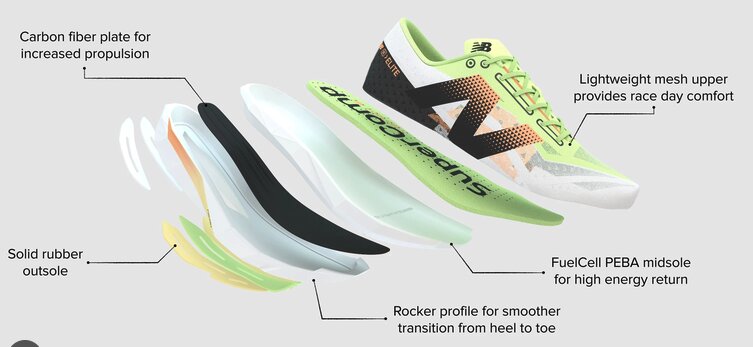
Super shoes (carbon plates + advanced foams) deliver ~2.6 to 4.2% better running economy, enabling both faster race-day performance and higher-quality training with better recovery.
Refined training, sports science, nutrition, and larger professional talent pools (especially East African depth + successful track-to-road transfers).
Stacked fields, optimized courses/conditions, and pacing strategies.
Parallel trends in shorter events (far more sub-10 100 m athletes; recent mile WR) show the “fastest going faster” and barriers falling more frequently.
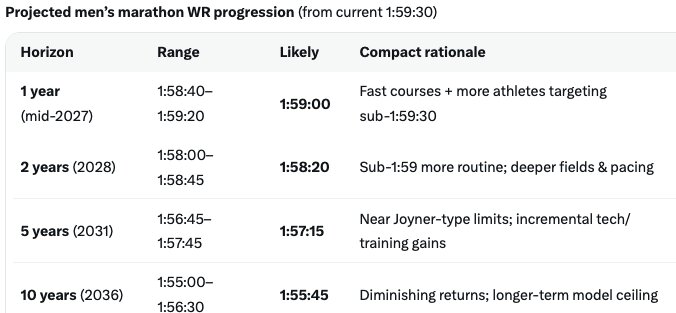
Likely world-record progression projections
These assume continued (but gradually slowing) incremental gains from current tech/training trends, no major rule changes banning further shoe evolution, emergence of new talent, and typical major-race conditions (Berlin, Chicago, London, etc.).
The steepest gains likely in the first 2–5 years before the curve flattens.
In a world with a 1:55 marathon world record and dozens of elites in the 1:55–1:57 range, the entire elite distance-running landscape would shift dramatically.
What it would mean
Depth and competitiveness explode where 1:57 would be ordinary elite rather than historic. Major marathons would routinely feature large packs running 1:56–1:58, with sub-1:56 becoming the new championship standard. Winning times under 1:56 would be common on fast courses.
Likely 5 km and 10 km world records
Current (mid-2026) benchmarks
5000 meter track ≈ 12:35 (Cheptegei 2020)
10 000 meter track ≈ 26:11 (Cheptegei 2020)
Road 10 km ≈ 26:24–26:31
A ~3.8% faster marathon (1:59:30 → 1:55) would not translate 1:1 to the shorter distances, because shoe and economy gains are relatively larger over 42 km and track spikes/surfaces already push short-distance limits hard.
Realistic projections if the same training/tech wave continues
5000 meter low-to-mid 12:20s (possibly approaching 12:15–12:25)
10 000 meter mid-to-high 25:30s (perhaps 25:30–25:50)
12:00 and 25:00 remain extreme barriers that sit beyond the most optimistic near-to-medium-term extrapolations. They would represent a further step-change after the marathon has already moved into the mid-1:50s. Going faster would need a further leap in VO₂ max, running economy, or technology beyond anything currently projected.
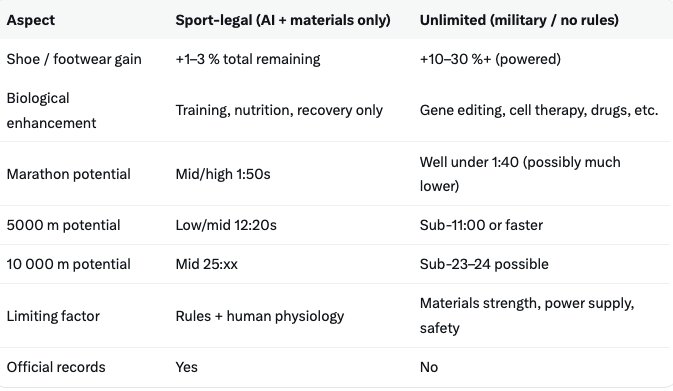
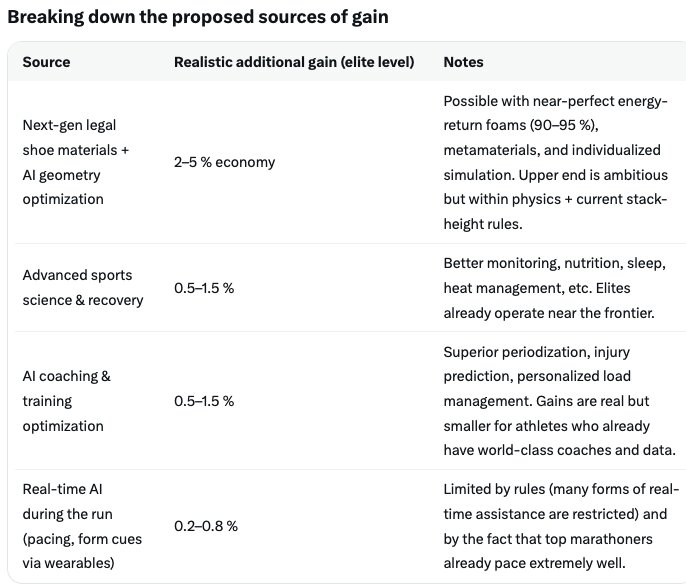
Cumulative realistic legal total is roughly 3.5–8 % in a best-case, multi-decade scenario in which every factor hits near its upper bound simultaneously.Lower-to-mid end of that range → marathon WR in the 1:52–1:55 area.
Absolute upper end (everything maximal and additive) → possible approach toward 1:50–1:51, but sub-1:50 becomes a stretch even under very optimistic assumptions.
Key constraints that keep sub-1:50 difficult under legal rules
Stack-height and passive-only rules still limit how much mechanical advantage shoes can provide.
Human physiology (VO₂ max, lactate threshold, running economy of the body itself, fatigue resistance) does not scale linearly forever.
Many AI during the run tools risk being classified as illegal assistance.
Diminishing returns each successive percentage point of improvement is harder than the last.
 Brian Wang
Brian Wang is a Futurist Thought Leader and a popular Science blogger with 1 million readers per month. His blog Nextbigfuture.com is ranked #1 Science News Blog. It covers many disruptive technology and trends including Space, Robotics, Artificial Intelligence, Medicine, Anti-aging Biotechnology, and Nanotechnology.
Known for identifying cutting edge technologies, he is currently a Co-Founder of a startup and fundraiser for high potential early-stage companies. He is the Head of Research for Allocations for deep technology investments and an Angel Investor at Space Angels.
A frequent speaker at corporations, he has been a TEDx speaker, a Singularity University speaker and guest at numerous interviews for radio and podcasts. He is open to public speaking and advising engagements.