
요약
Image Courtesy of Fireshine Games There’s no rule that says a train car can’t do a kickflip. Tony Hawk and the various blank slate skaters who have permeated throughout video game history may have implied only human or humanoid creatures can attempt such a …
본문
There’s no rule that says a train car can’t do a kickflip. Tony Hawk and the various blank slate skaters who have permeated throughout video game history may have implied only human or humanoid creatures can attempt such a trick, but that’s not the case. Denshattack — a clever multilingual portmanteau of a title that sums up what the game is all about — has plenty of different on-rail locomotives performing all sorts of ludicrous feats where physics is just a suggestion. But this premise is far more than a silly gimmick, as Denshattack is one well-tuned and chaotic skating-adjacent game that is both visually and mechanically arresting.
Videos by ComicBook.com
The Tony Hawk’s Pro Skater games make for a decent surface-level comparison for said mechanics, but it is significantly closer to the tragically underplayed classic OlliOlli World. Linear levels with branching paths, multiple types of extracurricular challenges to complete, and tricks being relegated to fighting game-like motion inputs are foundational elements that tie the two together. Their brilliance overlaps, but this doesn’t make either one of them feel derivative; the comparison point only makes a bizarre game like Denshattack a tad easier to understand.
Rating: 5/5
| Pros | Cons |
|---|---|
| Its chaotic, trick-based gameplay requires focus, rewards skill, and marvelously layers in new mechanics | |
| Absolutely ridiculous set pieces contrast nicely with the more serious themes of coming together to fight an oppressive state | |
| The boisterous, peppy soundtrack matches the tone and vibrant visual style perfectly | |
| Various optional challenges and score-based medals add a ton of replay value and give the game more depth |
Denshattack Is Overwhelming in All the Best Ways
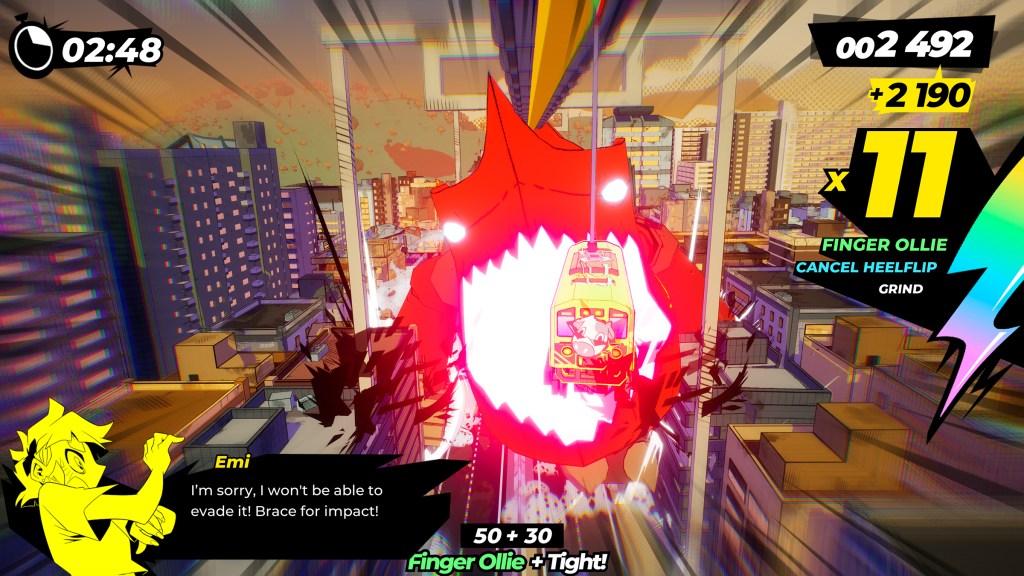
Speeding down rails is an exercise in skill and reflexes. Various hazards are peppered around stages and require track switching, last-second jumps, swerves, magnetizing to the ceiling, wall rides, rail grinds, and, if airborne, ground pounds to avoid derailing. Smooth controls mean these defensive maneuvers aren’t tricky to pull off; they’re all usually just a flick of the stick or a tap of the correct button. The trick is to do all this while barreling through the track at speeds that would get a normal driver’s train license revoked on sight.
Clarity is key here and what saves Denshattack from becoming a train crash simulator with gorgeous cel shading. Most of these hazards come with blaring icons that flash at the top of the screen with an accompanying sound effect, clearly signaling what’s on deck. These friendly (and, frankly, essential) notifications — along with the snappy restarts — allow Denshattack to move as fast as it does. While it starts out somewhat slowly, the game doesn’t take long to pick up speed and start throwing these obstacles at players in quick succession.
Making it through these gauntlets unscathed is an electrifying feeling because of the game’s hasty velocity and the generous signposting that keeps it all fair. The energetic soundtrack only augments this feeling since it’s composed of only the funkiest earworms that dial up the tempo to match the frenetic action on the screen. Watching the medals roll in on the results screen after busting through the finish line with a massive score multiplier is already immensely rewarding and made that much better by the catchy, record scratch-heavy tune that blares over it. Each bit of its presentation is always working in concert like this to make the entire game more engaging.
Denshattack‘s Complexity Is Masterfully Designed
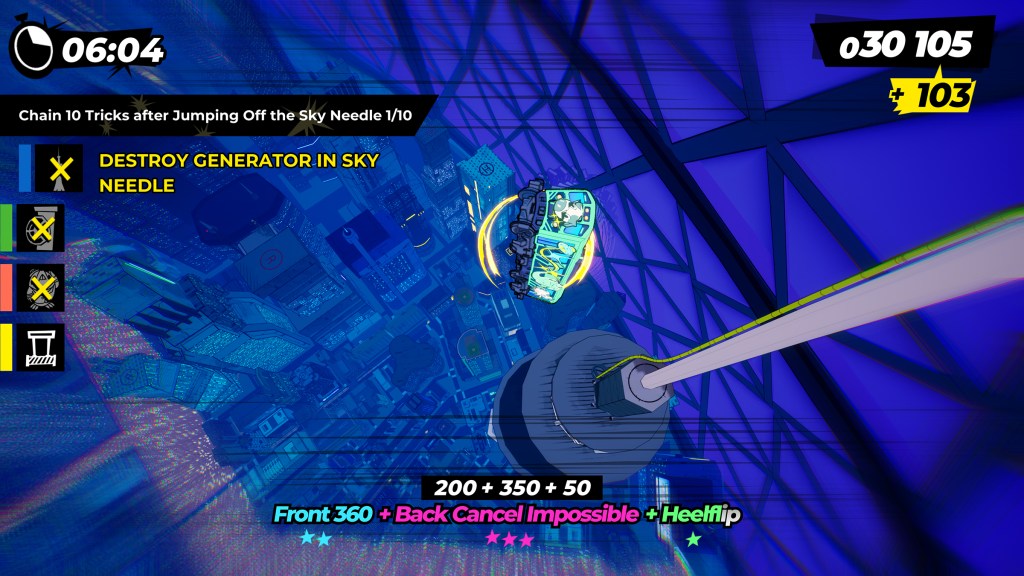
A lot of this gratification is tied directly to how well its layers of challenge are laid out. Remembering which button or stick does what in the moment is initially tough because it is a mentally taxing game with a lot going on, but it all begins to click with enough practice. Simply getting through stages takes some dexterity, and that straightforward journey to the credits, for the aforementioned reasons, is gratifying.
But going one more step up the ladder by ticking off the side objectives and going for higher scores is where its depth becomes more clear. Since it’s upheld by responsive controls that invite players to improve, climbing the optional rungs of difficulty becomes a satisfying process that’s both intrinsically and extrinsically rewarding at each step. New trains, paint jobs, and cutesy lore-filled zines are tangible prizes worth seeking, and persisting through repeated failures and gradually getting better at executing long trick combos is a delightful process that greatly benefits an arcadey game like this.
The arcadey nature bleeds into its levels, and they match the sort of lunacy that comes with the premise of a locomotive that can effortlessly spin through the air and manual when hitting the ground. Players are pinballed around iconic Japanese landmarks and witness apocalyptic levels of destruction caused by an average-sized train car. One moment will have players grinding up to the tippy top of the Tokyo Skytree, while another will have them avoiding stomps and slashes from a newly awakened kaiju. Watching this lunacy unfold is always a riot because it doesn’t let up with its numerous goofy scenarios that completely understand what kind of deeply stupid game they’re in.
Denshattack‘s World Is About More Than Trains

An affinity for stupidity, however, doesn’t mean Denshattack is only a silly game about little more than high scores and preposterous set pieces. Denshattacking, the act of using a train to pull off sick stunts, is used as a form of resistance against the tyrannical government that carved up Japan after climate change ravaged it. Such a calamity gave the rich and powerful an excuse to create literal bubbles to sequester themselves away from the undesirables, a self-serving turn that painted a huge target on their vast collection of artificial intelligence data centers, prisons, and security equipment.
Trains are used as the blunt weapons to fight back against the state and its high-tech tools, but, just as importantly, Denshattacking acts as a means to bring people together. Being slick on the tracks is a point of pride for these forsaken souls and helps smooth over the hostilities between the various rival factions that have popped up over the wastelands. It’s a communal exercise as much as an antifascist one, demonstrating the value of sharing hobbies with others and the nobility of working together toward liberation. The dialogue is also impressively able to fill in backstory, provide motivation for the next objective, and dissect the many cruelties of the oppressive systems behind it all without grinding the pacing to a halt. Denshattack could have just consisted of flipping trains off skyscrapers and been a great game, but injecting deeper meaning into its ridiculousness gives it all more weight.
It’s this well-rounded approach that makes Denshattack such a thoroughly fantastic experience. Chaining tricks together and using a train as a projectile against various metal monstrosities while the bop-filled soundtrack thumps is enrapturing, especially as it expertly layers in more systems and rewards those who put in the time to master its intricacies. Placing these systems in a story about fighting back and building unlikely communities works surprisingly well and only adds welcome context to the destruction. It’s a masterful balancing act to put all this into one cohesive package that doesn’t veer off the rails, but Denshattack stays on the tracks, despite its penchant for sharp turns and breakneck speeds.
A PS5 copy of Denshattack was provided by the publisher for the purpose of this review.
What do you think? Leave a comment below and join the conversation now in the ComicBook Forum!
Crimson Desert’s Generative AI Disclosure Debacle Is Just the Beginning
Denshattack, Video Game Reviews Follow Us On Discover Make Us Preferred In Top Stories