🔗 원문 전체 보기 → New York Magazine
요약
‘Even by the standards of FIFA’ what has happened with Trump pushing FIFA to rescind a suspension for the U.S. star player is an unprecedented level of foul play.
본문
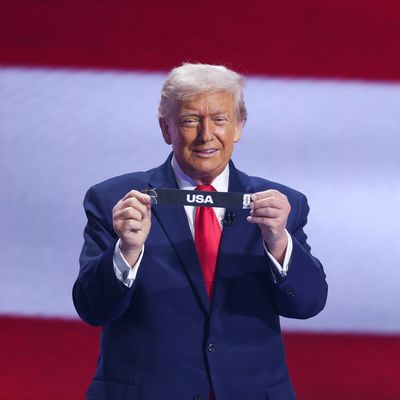 Photo: Michael Regan/FIFA/Getty Images
The first time Gianni Infantino met Donald Trump in the Oval Office, back in 2018, FIFA’s president brought a gift: a referee’s little black book containing a pair of cards. “Yellow card is a warning,” Infantino said, “and when you want to kick out someone, this one here.” He pulled out a red card. A grinning Trump held it up to the press pool, issuing reporters a mock ejection.
When assembling the long list of ways that Trump might interfere with this World Cup, no one appears to have considered the possibility that he might actually try to get involved in red-card decisions himself. But that is what appears to have happened last week, when Trump called up Infantino and lobbied him to rescind the one-game suspension that U.S. forward Folarin Bolagun’s automatically received as a result of being sent off for a hard foul in the team’s first knockout match, making him eligible to play tonight against Belgium. “I didn’t know what the hell a red card was,” Trump told reporters on Monday. “When I found out, I said, ‘You gotta be kidding!’”
Shortly after the news of Trump’s intervention broke, I ran into the Belgian journalist Samindra Kunti in the press box at MetLife Stadium, where he was about to watch the World Cup match between Norway and Brazil. Sam wrote a book about the Brazilian team that won the 1970 World Cup, but like everyone else, he was talking about the shocking commutation, which he said was an unsavory move, “even by the standards of FIFA.” Sam is one of a handful of journalists who cover the organization that governs world football as a muckraking beat, investigating its internal intrigues and perennial scandals, much to Infantino’s annoyance. (Sam says that FIFA’s president was looking in his direction when, at a 2023 press conference in Rwanda, he demanded to know, “Why are some of you so mean?”) We first met in April when I covered an annual FIFA congress in Vancouver, while I was working on a story about Infantino’s efforts to endear himself to Trump. At one point, he pursued Infantino down a hallway, firing questions about his decision to award Trump a newly invented FIFA Peace Prize. For the last month, he has been traveling the U.S., covering the action and writing travelogues that offer acerbic critiques of America’s transportation systems, fan culture, commercialization, drink pricing (there was an unfortunate incident with a check in Miami Beach), and stadium atmosphere. (He calls MetLife “a concrete box of sadness.”)
On Monday, Sam and I originally had plans to get together to watch our respective nations play each other. Instead, as Balogungate turned into an international incident, we had a chat about Trump’s perfect phone call with FIFA.
As someone who’s followed FIFA and Infantino for a long time, does this surprise you?
I think I can call myself a FIFA watcher. And what is apparent with Gianni Infantino at FIFA is that there is a lack of good governance. Usually that involves behind-the-scenes decisions of an administrative nature but [this] is a moment where you see it spilling onto the pitch. It’s affecting the sporting integrity of the FIFA World Cup — which is the biggest sporting event in the world, which is FIFA’s flagship tournament, which is watched by millions and billions around the world. And it is remarkable that FIFA here is undermining the sport and integrity of its own competition to simply satisfy the whims of a U.S. president who knows very little about football and who went on record earlier today to say that he had no clue what a red card actually is.
I thought it was ironic that he said that considering that the first time Infantino met Trump in the Oval Office, he presented him with a whole stack of red cards.
I do remember that.
This World Cup was seen as a safe haven for FIFA and football. You go to a western democracy and you’ll have a fairly flawless, decent World Cup. But then you get Donald Trump’s second term, you get this “bromance” between Infantino and Trump. I guess Trump has been portrayed in some American media quarters to have some sort of knowledge and affection for the game. But what I find fascinating is that this World Cup was presented in some quarters as the MAGA World Cup. Trump’s using this World Cup for political ends, and he understands that it’s the biggest TV show on earth, and he’s going to use that moment.
In the corridors of power in football, the message was always, “Well, Infantino needs to be close to Trump because he is so unpredictable.” But, of course, you can always question, Did it have to be that close?
To me, it seemed like it was all going so well, right up until about yesterday mid-morning.
Stadiums have been full; there have been dramatic matches. There was Cape Verde, a David-versus-Goliath story. Overall, that feeling of Trump casting a shadow over the World Cup had not materialized until yesterday, when perhaps — I don’t know if this is legally the correct term — he conspired with FIFA to get this suspension reversed. Even though Trump suggested he had merely asked for a review, it seems fairly funny that that review was then enacted swiftly according to his wishes. This moment undermines the entire sporting integrity of the competition.
To use football terminology, it seems like a bit of an own goal.
It’s a massive own goal. But it also symbolizes that Infantino is obviously not in control of the relationship with Trump. And that power dynamic was the same in Qatar with the Emir of Qatar [for the 2022 World Cup]. It was the same with Vladimir Putin in Russia and his “sportswashing” project [as host of the 2018 World Cup]. It’s an own goal even more so, not just for defying your own rules, for undermining the integrity of your own competition, but also because from a good-governance point of view, FIFA will always say “there can’t be political interference in the game of soccer. Sports and politics have to be strictly separated.” But they use that principle when it suits them. And this is perhaps the biggest example. This is clear political interference based on what Mr. Trump said earlier today on the record. Let there be no doubt about this.
This is political interference, and it’s leading to what is potentially, from a sporting point of view, the biggest scandal in World Cup history. It’s hard to find precedents that match the scale of what is happening right now.
[Editor’s Note: On Monday afternoon, FIFA released a statement on Infantino’s behalf. “Yes, I regularly discuss matters related to the FIFA World Cup with the President of the United States, and on this matter, I did receive a call from Donald Trump,” Infantino acknowledged. However, he contended that the decision to replace Balogun’s one-match suspension with probation was made by an independent disciplinary committee. “I read the decisions of the FIFA Disciplinary Committee when they are issued. Sometimes I am surprised by them. Sometimes I agree with them, and sometimes I disagree. What I always do, however, is respect those decisions and the autonomy of the bodies that make them.” Late in the afternoon, FIFA issued a second statement, attributed to the chairperson of the disciplinary committee, saying that “suspension of the implementation was decided considering all of the specific circumstances surrounding the incident and evidence available” that “reviewing the legal consequences of red cards in football is nothing new in the modern game.”]
What was your feeling about the original call?
Look, football is a zero-sum game, it’s about results, it’s a hard game, it can be heartbreaking. Whether the red card was justified or not, I think it’s irrelevant here. The decision was taken, the player was sent off, and, according to the rules, he has to serve a one-match suspension. There’s no appeal. Now that might come across as heartless, but that’s just the reality of football. He’s not the first player to get a red card in a World Cup. Being a custodian of the game, you have to apply the rules. And as heartbreaking as the red card for Balogun was, the consequence should have been that he cannot play tonight.
This is also quite fascinating in that we’ve got Balogun who has become a talisman of the team, scoring in the opening match, being their top scorer, having immigrant roots from Nigeria; he’s become very, very high profile and a face of the team. He has now been cast into this role completely against his will, and he might become a villain in some people’s eyes. Just imagine that he scores or he gets the winner tonight. It’s a very, very unfortunate position for him to be in.
I don’t know if people elsewhere were inclined to support the U.S. even before this, but how does this affect how the U.S. team is viewed by the rest of the world?
I thought it was quite instructive that [U.S. manager] Mauricio Pochettino yesterday during his press conference seemed to defend this decision, which goes against all rules. And he even mentioned the word integrity. But from my initial limited understanding so far, because this is still obviously a developing story, I don’t think the U.S. here are being cast as the bad guys. I think it’s plain and simple. It’s FIFA being cast as the villain here yet again. And it’s unfortunate, to put it mildly, that an organization that is already struggling — has been struggling forever with its reputation — has inflicted this on itself. It’s all of their own making, basically.
Should Americans be wholeheartedly cheering for their side, or should they have mixed feelings about this?
I think genuine U.S. soccer fans should and will have mixed feelings about it. The World Cup on home soil always evokes strong emotion from the domestic fans and even from casual watchers because that’s what the World Cup does. It sort of galvanizes that. Let’s call it national sentiment; everyone can sort of cheer and support the team. But there has to be an understanding here that what has happened and what is happening as a result of Trump’s interference, and as result of FIFA blindly executing his demand for a review that is unprecedented and unpalatable, should make U.S. soccer fans at least think twice tonight.
As a Belgian, how do you feel watching this match tonight?
My understanding is that some members in the Belgium camp were absolutely fuming. This has been called a farce by fans and media in Belgium.
The main question here is does Balogun score? Do the United States win? FIFA have just rejected Belgium’s appeal. Now that the appeal has been rejected, it paves the way for Belgium to go to the Court of Arbitration for Sport. They can’t do that in time before the match, but they could do it if the United States wins. So you’ve got this whole legal Pandora’s box.
What power does the Court of Arbitration actually have if Belgium were to lose?
The court could overturn the result. But the Court of Arbitration for Sport is not without its own controversies, as you can imagine. It is partially or mainly funded by both FIFA and the International Olympic Committee. And some of the arbitrators on the court have clear conflicts of interest.
What does this mean for Infantino? Does this have any impact whatsoever on the way that he is viewed internally within his organization?
I suppose that’s the million-dollar question. Again, a decision that affects the sporting integrity of the competition to this extent is dangerous. Now UEFA, the European football confederation, has come out with a statement. [Editor’s Note: It calls the decision “unprecedented, incomprehensible and unjustifiable” and says FIFA “crossed a red line.”] So you wonder, will this whole Balogun situation galvanize UEFA to perhaps dare to stage a revolution against Gianni Infantino?
My gut feeling is that the reality of FIFA politics will prevent UEFA from doing this, even if the will is there to actually proceed with such an idea. Because ultimately Africa, Asia, and South America, and to an extent the Caribbean, those member associations, hold the power and easily outvote Europe. And do they care enough about this Balogun incident? They want development money from FIFA. As long as the development money from FIFA rolls in and it’s guaranteed with the revenues, the colossal revenues, the billion-dollar revenues of this World Cup, I’d be surprised if they care to support UEFA or to in general demand governance reform at FIFA at all.
So in the end, the reality is that money trumps — no pun intended — fair play.
Absolutely.
This interview was condensed and edited for clarity.
More on the World Cup
- Trump May Have Just Broken the World Cup: Live Updates
- The U.S. Lost to Belgium in 2014. Things Have Changed.
- Karl Ove Knausgaard ‘Can’t Enjoy When Norway Is Playing’