요약
Nvidia isn't just making faster GPUs anymore, and that's exactly the point.
본문
 By
Hamlin Rozario
Published Jun 18, 2026, 7:00 PM EDT
Hamlin has been in the tech field for over seven years. Since 2017, his work has appeared on MakeUseOf, OSXDaily, Beebom, MashTips, and more. He served as the Senior Editor for MUO for two years before joining XDA. He uses a Windows PC for desktop use and a MacBook for traveling, but dislikes some of the quirks of macOS. You're more likely to catch him at the gym or on a flight than anywhere else.
Sign in to your XDA account
By
Hamlin Rozario
Published Jun 18, 2026, 7:00 PM EDT
Hamlin has been in the tech field for over seven years. Since 2017, his work has appeared on MakeUseOf, OSXDaily, Beebom, MashTips, and more. He served as the Senior Editor for MUO for two years before joining XDA. He uses a Windows PC for desktop use and a MacBook for traveling, but dislikes some of the quirks of macOS. You're more likely to catch him at the gym or on a flight than anywhere else.
Sign in to your XDA account
If you've been paying attention to how Nvidia has been moving as a company lately, you'd be forgiven for wondering whether it still cares about gaming the way it did a few years ago. With data center revenue accounting for about 90% of the company's business, it's easy to see why many gamers feel that consumer GPUs have taken a back seat. In fact, in its most recent earnings report, Nvidia removed the gaming revenue category and merged it into "Edge Computing."
I started feeling this way when Nvidia's RTX 50-series reveal at CES 2025 was merely a 10-minute segment of an hour-and-a-half-long keynote focused on agentic AI, physical AI, autonomous vehicles, and robotics. But fast forward to mid-2026, and I don't think Nvidia has necessarily abandoned its roots. If anything, the company has become more involved in gaming, just not by releasing faster GPUs as we expected. So if you look beyond the hardware itself, you'll start to see why Nvidia's influence on PC gaming may be bigger than ever.
 Related
Nvidia just turned my 1440p gaming PC into a 4K capable machine overnight
My RTX GPU is now punching up.
Posts 11 By Samarveer SinghNvidia has moved beyond raw performance
AI is helping Nvidia overcome limits that hardware alone can't solve
Not too long ago, you had to either buy a faster GPU or lower your graphics settings to get better frame rates. That's still true to some extent, but Nvidia has spent the last several years trying to prove that raw hardware isn't the only answer anymore. Let's start with DLSS, for example. Sure, it has been around since 2019, but Nvidia has improved it significantly in the last couple of years. DLSS 4.5, which Nvidia released earlier this year, looks so good that I'd be hard-pressed to tell it apart from native 4K. A few years ago, using DLSS meant settling for a softer image, but now you're getting an FPS boost without compromising image quality.
Another neural rendering technique that Nvidia has pushed hard in the last couple of years is frame generation. We first got this feature alongside the RTX 40-series GPUs in 2022, but now we have Dynamic Multi-Frame Generation with up to a 6x multiplier to significantly improve frame rates. Of course, no amount of AI-generated frames can replace raw performance, but it just shows that Nvidia is trying to break through performance barriers with its software stack. And unlike a new GPU architecture, software improvements can benefit millions of existing RTX owners too.
Nvidia is shaping the future of PC gaming
It's still giving developers more tools to push games further
 Credit: Nvidia
Nvidia's software stack doesn't just end with DLSS upscaling and frame generation, even though those are what most of us gamers are familiar with. Behind the scenes, the company gives developers access to RTX Kit, which is basically a collection of tools that help them integrate path tracing and neural rendering technologies into their games. For example, RTX Mega Geometry, which Nvidia introduced last year, makes ray tracing more efficient, reducing CPU overhead and VRAM usage. At GTC 2026, Nvidia even showed off Neural Texture Compression, which can significantly reduce VRAM usage and benefit those with 8GB cards.
Let's also not forget that Nvidia announced DLSS 5 earlier this year, which is unlike anything we have today. This version uses a real-time neural rendering model to add photorealistic lighting that gives games a truly cinematic look. Whether it lives up to the hype is yet to be seen, but it shows where Nvidia thinks gaming is headed. The difference is that most of Nvidia's innovations are now happening on the software side, which easily goes under the radar because the benefits aren't always immediately obvious to us.
The reason we feel left behind is GPUs, and rightfully so
But I can't complain much when Nvidia's software lets us skip an upgrade
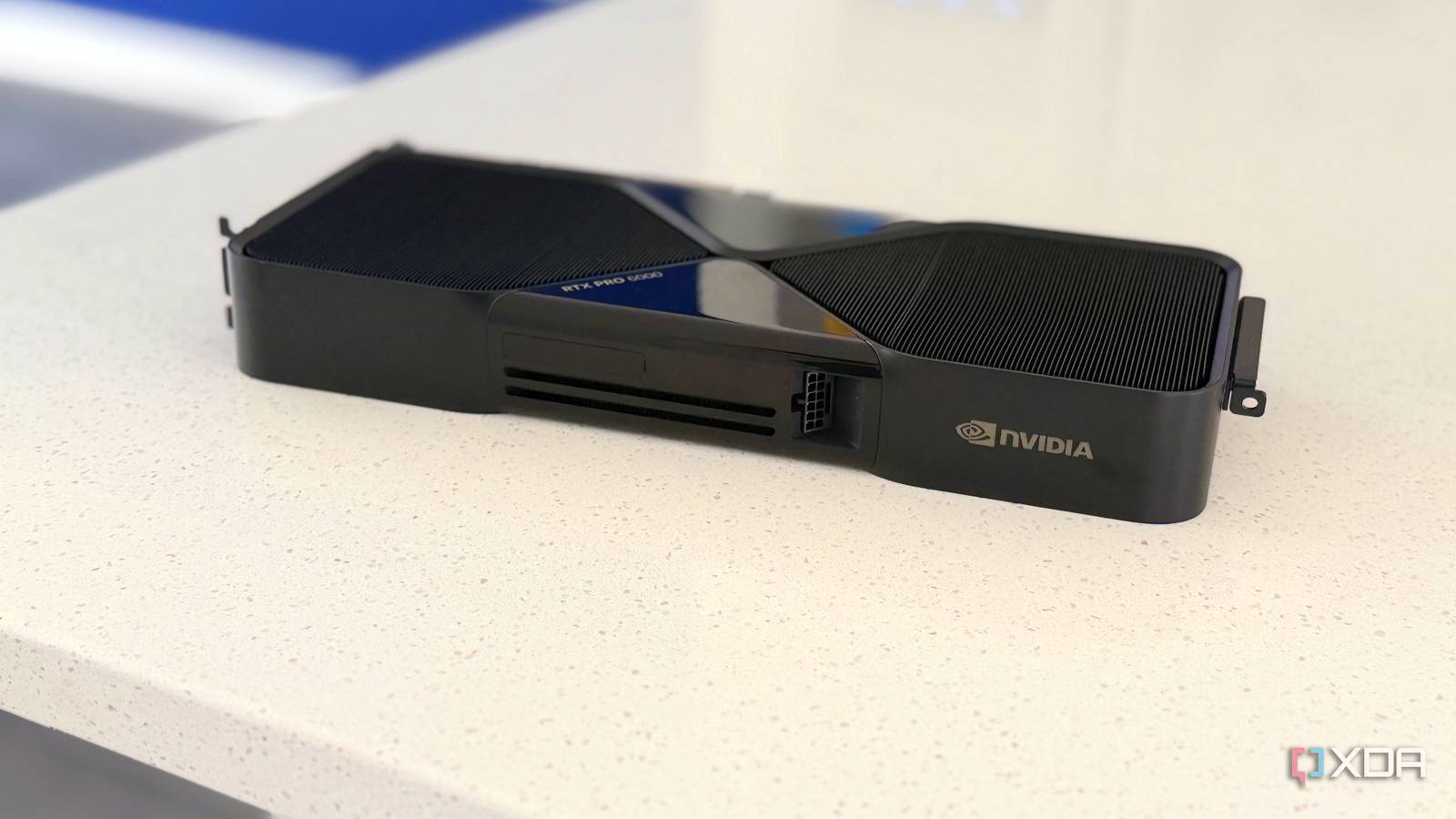
If GPUs are all you care about, then yes, Nvidia isn't showing gamers much love. The RTX 5090 is only about 27% faster than the RTX 4090 at 4K, despite costing roughly 25% more, and that alone gives many of us the impression that Nvidia doesn't care about providing value anymore. We're also well past the halfway point of this generation, yet there are still no signs of a SUPER refresh. More importantly, the company has done nothing to keep GPU prices in check. Add in the fact that roughly 90% of Nvidia's revenue is from data centers, and it's easy to see why consumer GPUs have taken a backseat.
That said, Nvidia has more than made up for it on the software side. Improvements to DLSS over the last couple of years are why I don't mind sticking with my RTX 4090 for a little longer, especially when the 5090 is currently going for over $4,000. And to be fair, AMD is partly to blame for these absurd prices. At the high end, Nvidia has no competition, and when it owns over 90% of the market, there's almost no reason as a business to price its flagship products aggressively. As frustrating as that may be as a gamer, I can't be too upset when Nvidia's software is helping many of us skip this generation in the first place.
Nvidia's priorities have changed, but it hasn't forgotten its roots
At this point, I think the narrative around Nvidia abandoning gaming is a little overblown. If you look at the moves Nvidia has been making lately, it doesn't look like a company planning to exit the gaming market anytime soon. If anything, Nvidia's RTX Spark reveal at Computex 2026 is a clear sign that it hasn't forgotten its roots. The company is simply going all in on its software stack and AI technologies rather than focusing solely on consumer GPUs. While that may not sit right with people who wanted better GPUs at more affordable prices, it's hard to argue that gamers haven't benefited from those investments. If Nvidia's software keeps getting better, there's no reason to think we've been left behind.
 Related
Nvidia's RTX Spark is a chip unlike any other, and it could change Windows laptops forever
Nvidia's high-end Arm CPUs are finally here, set to transform local AI hardware
Posts By Tanveer Singh