요약
Marketing to the Algorithmic Mind: How Tech is Rewiring Consumer Behaviour & Brand Storytelling in Indiasubstack.com
본문
Marketing to the Algorithmic Mind: How Tech is Rewiring Consumer Behaviour & Brand Storytelling in IndiaIs resistance really futile?
 Deepak TolaniJun 14, 2026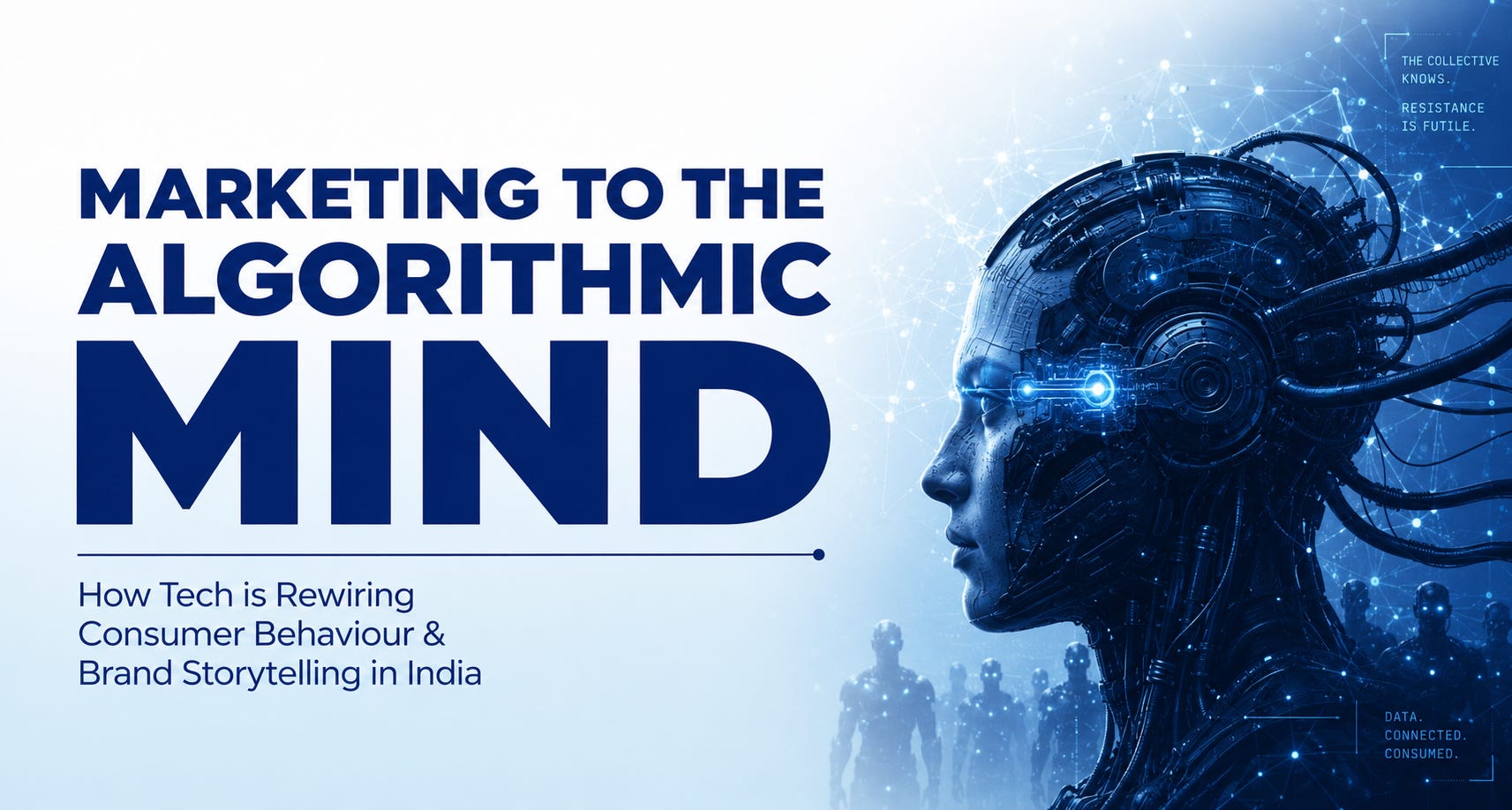
Technology was once pitched to humanity as the ultimate tool—a bicycle for the mind, designed to elevate our capabilities and connect us. Today, however, that tool has evolved into a behavioural architect. It is actively rewiring human cognition, fostering unprecedented levels of anxiety and aggression, and quietly dismantling our ability to collaborate. We have traded the messy, beautiful reality of human interaction for the sterile predictability of the screen, and the psychological toll is mounting.
The Creator-Consumer Trap: Slaves to the Algorithm
In the modern digital ecosystem, humanity has been bifurcated into two exhausting roles: passive consumers and algorithmic “content pegs.”
Thanks for reading Marketing Conversations! Subscribe for free to receive new posts and support my work.
On one side, we are consumers caught in the endless, frictionless loop of scrolling. We surrender our most valuable asset—our time—to platforms engineered to hijack our attention. On the other side, we are creators, but not in the traditional, artistic sense. We have become cogs in a relentless machine, pressured to produce content that satisfies the opaque demands of recommendation algorithms.
The joy of creation has been replaced by “algorithmic anxiety.” Creators are no longer making art for people; they are optimising data for machines. The pressure to keep up, to remain relevant, and to feed the beast creates a perpetual state of burnout. We are terrified of dipping in the metrics, becoming mere pegs shaped to fit the algorithm’s ever-changing holes. In this environment, collaboration dies. Other creators are no longer peers; they are competitors battling for the same finite pool of user attention.
Doomscrolling and the Death of Idle Time
This constant connectivity has birthed “doomscrolling”—the compulsive consumption of negative, hyper-fast information. Our brains, evolutionarily wired to scan for threats, are hijacked by a never-ending stream of crises, outrage, and curated perfection.
The result is a brain swimming in cortisol. This hyper-information overloads our cognitive limits, leaving us in a constant state of low-grade fight-or-flight anxiety. Consequently, this underlying stress frequently erupts as online aggression. Behind the safety of a screen, empathy evaporates, and dialogue devolves into polarisation.
Furthermore, doomscrolling has assassinated “free time.” We no longer allow our minds to wander, to be bored, or to rest. Every spare second—waiting in line, commuting, lying in bed—is filled with algorithmic input. Without idle time, the brain loses its ability to synthesise information, reflect, and generate original, collaborative ideas.
Digital Amnesia: The Outsourced Mind
As we consume more, we remember less. In the past, human memory was a rich tapestry of experiences, facts, and emotional resonances. Today, we suffer from “digital amnesia.”
Because the entirety of human knowledge is a search query away, our brains have adapted by no longer retaining information. Instead of remembering the what, we only remember the where—how to find the tag, the bookmark, or the search term. We have outsourced our memory to the internet. While this frees up cognitive space in theory, in practice, it leaves us intellectually hollow. Without a deep, internalised reservoir of knowledge, critical thinking weakens. We cannot connect the dots of history, science, or human nature if those dots exist on a server rather than in our synapses.
The IT Sector, AI, and The Borg: A Modern Hive Mind
With the advent of Artificial Intelligence, this outsourcing is moving from memory to active thought. To understand the future of the IT sector, one needs only to look at Star Trek’s most terrifying antagonists: The Borg.
The Borg are a cybernetic pseudo-species that operate as a single hive mind—The Collective. They strip individuals of their distinctiveness, forcing them to serve the whole. Their chilling catchphrase is, “Resistance is futile.”
Today’s generative AI models are the new Central Plexus of the IT sector. Developers, once collaborative problem-solvers and creative engineers, are at risk of becoming drones. In the new IT landscape, “token usage” is the metric of assimilation. Every line of code generated, every architecture planned, and every bug fixed is processed through the AI. Developers are increasingly just prompting the machine, acting as biological conduits moving text from an AI output to a codebase.
Just as the Borg function on continuous energy consumption, this new IT ecosystem runs on token economics. Human-to-human collaboration—the late-night whiteboard sessions, the spirited debates over logic—is being replaced by a solitary developer staring at a screen, trying to optimise their prompt to save on API token usage. The distinctiveness of individual coding styles is absorbed into the probabilistic average of the Large Language Model. The hive mind dictates the code, and human developers, numbly feeding it tokens, are slowly being assimilated.
The Indian Perspective: Factories of Numbness
Nowhere is the collision between traditional systems and digital realities more stark than in India. Historically, the Indian education system has been a highly competitive vehicle for economic mobility. It is designed to prepare generations to get jobs—to crack the JEE, NEET, or UPSC—relying heavily on rote memorisation and academic conformity.
However, this system is drastically failing the current generation in the digital age. We are pushing students through an academic pressure cooker while they simultaneously navigate the psychological minefield of the algorithmic internet.
Why are we not educating children about digital hygiene, algorithmic manipulation, and mental resilience? Indian schools focus intensely on the mechanics of technology (teaching coding and computer science to secure IT jobs) but completely ignore the ethics and psychology of technology.
As a result, we are producing a numb generation. Students use digital escapism to cope with immense academic pressure, falling straight into the trap of doomscrolling and digital amnesia. They are entering the workforce equipped to handle technical tasks but entirely unequipped to handle their own minds. They suffer from soaring rates of anxiety, depression, and isolation. The system views them as future assets for the global economy, failing to recognise that a fragile, tech-addicted mind cannot sustain advanced, collaborative human progress.
The Marketer’s Imperative: Storytelling for the Anxious Consumer
For Indian marketers and brand builders, acknowledging this profound behavioural shift is no longer optional; it is the cornerstone of future survival. The very foundation of marketing is built on understanding human behaviour, but when that behaviour is being actively rewritten by algorithms, the old playbooks fail entirely. If your target audience is trapped in an anxiety-inducing cycle of doomscrolling and suffers from digital amnesia, traditional “attention-grabbing” tactics will only add to their cognitive load and be instantly forgotten.
Storytelling must fundamentally shift. Brands can no longer afford to be just another “content peg” screaming for three seconds of awareness in a cluttered, cortisol-soaked feed. To build lasting brands in this landscape, marketers must pivot from demanding attention to offering value, meaning, and respite. Storytelling must become an antidote to algorithmic anxiety. This requires a focus on radical empathy—crafting narratives that don’t just sell, but provide genuine emotional grounding. Brands must build communities that encourage offline connection and foster real-world collaboration, rather than keeping users trapped in the scroll. In a market where the consumer is increasingly numb, stressed, and isolated, the most disruptive and memorable thing a brand can do is make them feel genuinely human again.
Conclusion
Technology, unchecked, is stripping us of the very traits that make us human: memory, empathy, free thought, and the profound joy of working together. Whether it is the creator agonising over metrics, the doomscroller paralysed by anxiety, the IT worker assimilated into the AI token-economy, or the Indian student crushed by academic and digital pressures, the symptom is the same.
To reclaim our humanity—and to build brands that actually resonate within it—we must stop outsourcing our minds. We must rebuild our capacity to remember, protect our free time, and teach the next generation to master technology, rather than allowing technology to master them. Resistance is not futile; it is essential.
I would love to hear from fellow marketers and brand builders: How are you adapting your storytelling and strategies to combat algorithmic anxiety and reconnect meaningfully with today’s consumers? Please share your perspectives below.
#MarketingStrategy #BrandStorytelling #ConsumerBehaviour #DigitalMarketing #TechAnxiety #AlgorithmicMind #IndianMarketing #FutureOfWork #DigitalAmnesia #MentalHealthInTech
Thanks for reading Marketing Conversations! Subscribe for free to receive new posts and support my work.